
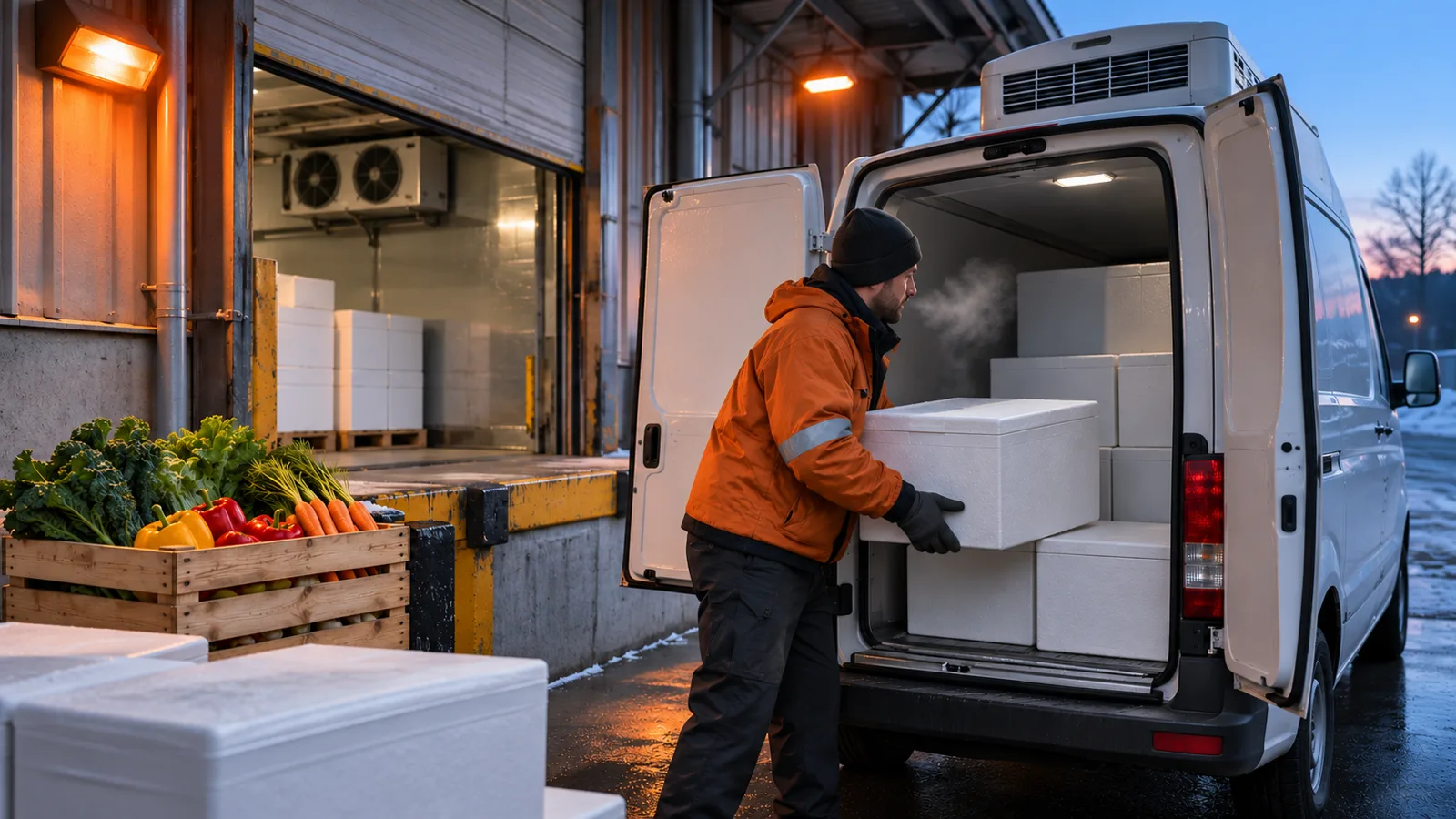
Online grocery and meal kit services are now a routine part of how many Canadians buy food. Demand jumped sharply in 2020, when delivery windows were booked out and some services paused new sign-ups to keep up, and many households that tried ordering food online for the first time back then never stopped. Today customers expect convenient delivery windows, accurate orders and food that arrives properly cold.
For the businesses on the other side of those orders, the challenge is not just volume. Food that needs to be kept chilled or frozen has to travel from a warehouse to a doorstep at the right temperature, sometimes over hundreds of kilometres, sometimes in an apartment lobby for an hour before the customer gets home. A late parcel of t-shirts is an inconvenience. A late box of chicken breasts and leafy greens may be a food safety problem and a total loss.
This article looks at how meal kit and grocery ecommerce businesses in Canada can deliver cold food at scale: the delivery models available, the packaging and temperature decisions involved, the food safety rules that apply, and the operational habits that separate a reliable service from one that is constantly fielding complaints.
Two Different Businesses That Share a Cold Chain
Meal kits and online grocery look similar from the outside, but their logistics are different in important ways.
- Meal kits usually ship on a weekly subscription cycle, with a fixed menu and a known order volume several days ahead. Every box contains a mix of chilled proteins, produce, dry ingredients and recipe cards. Order profiles are predictable, and boxes are often shipped by courier in insulated packaging.
- Online grocery involves much larger, more varied baskets drawn from thousands of SKUs across frozen, chilled and ambient temperature zones, with customers choosing specific delivery windows. Delivery is often handled by dedicated vans on local routes rather than parcel carriers.
Many businesses sit somewhere between the two: a specialty grocer shipping a curated range nationally, a farm box service delivering locally, or a prepared meal company shipping frozen dishes across provinces. Each needs to pick the right delivery model for its product and geography.
Choosing a Delivery Model
Parcel shipping with insulated packaging
Shipping chilled or frozen food through courier networks, in insulated boxes with refrigerants, is the most scalable way to reach a national market. A single facility can serve a large share of Canada's population within one or two days' transit. The trade-offs are packaging cost, the weight of refrigerants, and the risk that a delayed parcel will warm up. This model works best when packaging is designed and tested for the longest transit times on your network, with a margin of safety.
Dedicated local delivery
Refrigerated vans running scheduled routes give much better temperature control and allow larger orders. They also allow returnable totes rather than disposable packaging. The cost per stop depends heavily on density, so this model is strongest in dense urban areas such as the Greater Toronto Area, Montreal, Vancouver, Calgary and Ottawa. Serving smaller communities this way is far harder.
Regional hubs
As volume grows, many food ecommerce businesses move from one central facility to several regional ones. Instead of shipping from Ontario to British Columbia, a western facility in the Vancouver or Calgary area can shorten transit times, reduce refrigerant needs and improve reliability. Regional hubs add inventory complexity but are often the only way to deliver cold food reliably across a country spanning six time zones.
Most growing businesses end up using a combination: local delivery where density supports it and parcel shipping elsewhere, with regional stock positioned where demand justifies it.
Packaging and Temperature: Designing for the Worst Day
The key to cold parcel delivery is designing packaging for the worst plausible journey, not the typical one. Consider:
- Transit time plus dwell. Add the longest normal transit time to your farthest destinations, then add time for a missed delivery or a parcel left in a lobby.
- Seasonal extremes. A box crossing the Prairies in January faces very different conditions from one crossing southern Ontario in July. Fresh produce can freeze in winter, which is just as damaging as warming in summer.
- Insulation type. Expanded polystyrene, insulated liners made from recycled materials, and reflective bubble liners each perform differently and have different environmental footprints.
- Refrigerant choice. Gel packs and ice packs suit chilled items. Dry ice is used for frozen goods but brings handling and dangerous goods requirements. Our comparison of gel packs versus dry ice covers this decision in depth.
- Packing pattern. Where refrigerants sit relative to the food matters. Cold air sinks, so placement on top of products is common for chilled packs.
Seasonal packing "recipes", where the amount of refrigerant and insulation changes with the time of year and the destination zone, help control cost without risking quality. Test them with temperature data loggers inside real shipments before rolling them out.
Our existing articles on shipping frozen foods for ecommerce and handling perishable goods in fulfillment go further into packaging techniques.
Food Safety Rules in Canada
Food businesses in Canada operate under a mix of federal and provincial rules. The Safe Food for Canadians Regulations (SFCR), which came into force in January 2019, are central for many ecommerce food businesses. In broad terms, they require many businesses that import food, or prepare food for export or for sale across provincial borders, to hold a licence from the Canadian Food Inspection Agency (CFIA), to have preventive controls in place, and to keep traceability records.
Traceability is a practical concern for fulfillment. Under the SFCR, many businesses must be able to trace food one step back to their supplier and one step forward to whom they sold it. For a direct-to-consumer business, the "forward" step can mean linking product lots to customer orders. If a supplier recalls a batch of spinach, you need to know which boxes contained it.
Provincial and municipal public health rules also apply to food premises, and some products, like meat, dairy and eggs, have additional federal or provincial requirements. Labels on prepackaged food need to meet federal requirements, including bilingual information. When you choose a warehouse partner for food, ask how they support lot tracking, temperature monitoring and records, and whether their facility suits the specific products you sell.
Inside the Warehouse: Speed and Separation
Cold food fulfillment requires different discipline from ambient ecommerce:
- Multiple temperature zones. Frozen, chilled and ambient products need separate storage, and picking must bring them together without leaving chilled items sitting at room temperature.
- Short dwell times. Orders should be packed close to the carrier pickup time. Boxes packed hours early and left on the dock defeat the purpose of the packaging.
- Date control. Fresh product has short shelf lives. Picking must follow first-expired, first-out rules, and customers should receive enough remaining shelf life to use the product.
- Allergen and cross-contamination controls. Raw proteins should be sealed and separated from ready-to-eat items, and packaging should prevent leaks.
- Temperature monitoring. Storage areas and, ideally, packing areas should be continuously monitored with alarms and records.
This is why food brands often use specialist facilities rather than general ecommerce warehouses. Cold chain fulfillment brings temperature-controlled storage and food-safe processes together with parcel shipping.
Managing Delivery Expectations
Customers ordering food online care about two things: that it arrives when they expect, and that it arrives cold. Delivery communication supports both.
- Ship only on days that avoid weekend dwell. For courier delivery, many food businesses do not ship chilled parcels late in the week to destinations that might not receive them until Monday.
- Tell customers what day to expect their box and send tracking as soon as it ships.
- Encourage customers to refrigerate contents promptly, and include clear instructions in the box.
- Have a clear policy for delayed or warm deliveries, and act on it quickly. A fast replacement or credit preserves the relationship.
- For remote addresses, be honest about whether you can deliver safely. Some rural and northern postal codes may simply be out of range for chilled parcels.
Planning for Surges
Demand spikes, from the sudden jump in 2020 to holiday peaks, heat waves and big promotions, have shown how quickly a food ecommerce business can go from comfortable to overwhelmed. Some practical lessons apply whatever triggers the next one:
- Know your capacity limit for each day of the week, and cap orders before you exceed it.
- Keep extra stock of packaging and refrigerants, which can become scarce at the same time as demand peaks.
- Maintain relationships with more than one carrier, so you have alternatives when one network is under strain. A carrier management approach helps here.
- Consider outsourcing part of your volume to a fulfillment partner as an overflow option, so you can scale without building your own capacity overnight.
Bringing It Together
Delivering meal kits and groceries across Canada at scale depends on choosing the right delivery model for your geography, packaging for the worst day rather than the average one, keeping traceability records that satisfy food safety rules, and running a warehouse built for speed and temperature control. The businesses that master those basics will be the ones still serving loyal customers year after year.
ShipCarte offers food and beverage logistics and temperature-controlled fulfillment for brands across Canada. If you are scaling a meal kit or online grocery business and need cold chain capacity, schedule a consultation with our team.