
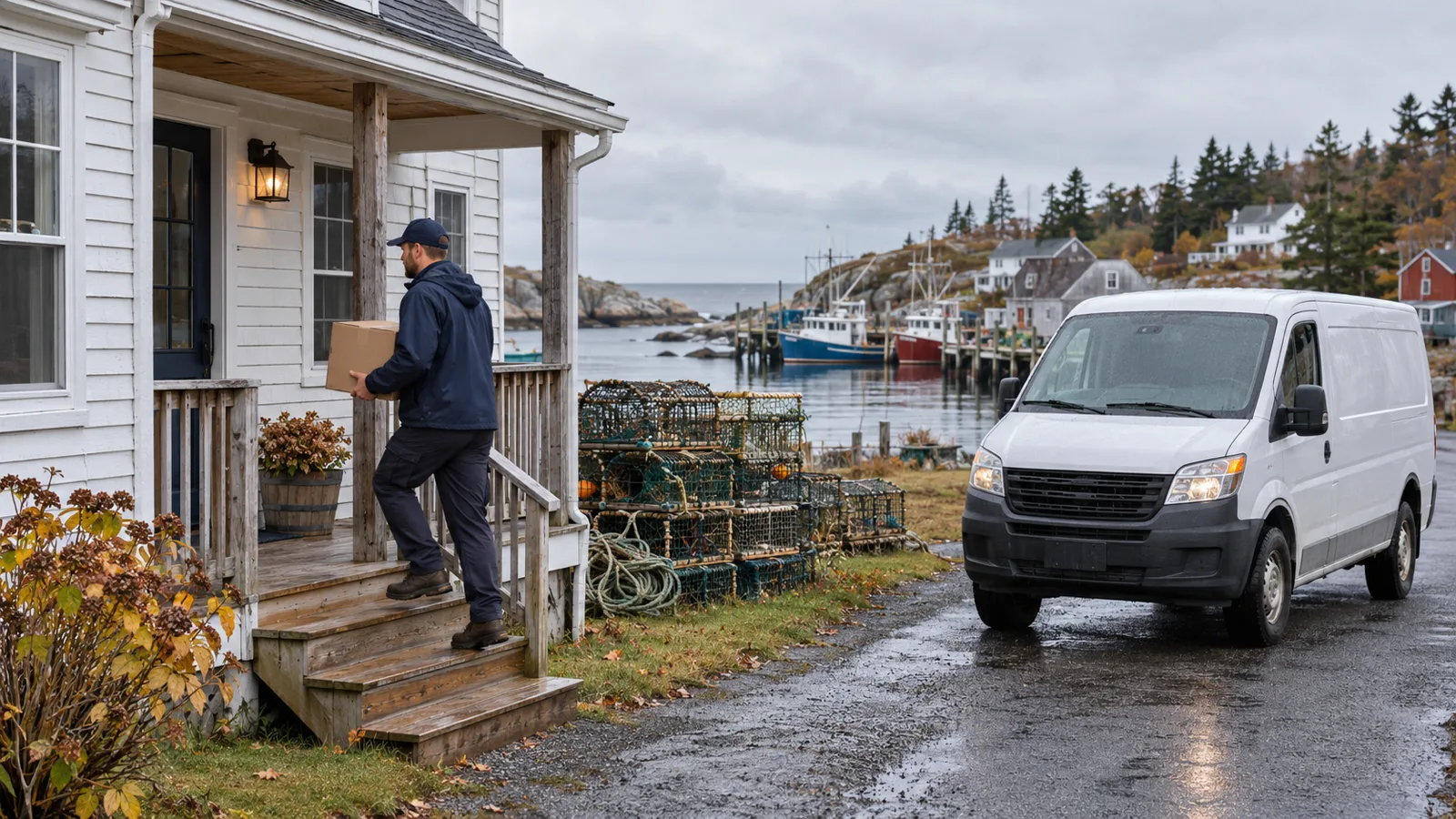
Look at the order map of almost any online store based in Ontario or Quebec and you will see the same pattern. Orders cluster around the big cities, spread thinly across the Prairies, and then pick up again on the East Coast. Customers in Halifax, Moncton, Fredericton, Saint John and Charlottetown buy online just as readily as anyone else in Canada, and many of them live in smaller towns where online shopping fills real gaps in local retail.
The trouble is that those same customers are often the ones who write in asking where their parcel is. A box that reaches a Toronto suburb in two days can take five or six to reach a village on the South Shore of Nova Scotia or a farm outside Summerside. Shipping rates climb, delivery estimates get vague, and a single winter storm can freeze an entire week of orders in place.
None of this means the Maritimes are a difficult market. It means they reward sellers who plan for the geography instead of treating Nova Scotia, New Brunswick and Prince Edward Island as one more zone on a rate card. This guide walks through what actually shapes delivery to the region and what you can do to make it faster, cheaper and more predictable.
Why the Maritimes behave differently on a shipping map
Distance is the obvious factor. The drive from the Greater Toronto Area to Halifax runs roughly 1,800 kilometres, most of it through Quebec along Autoroute 20 and then across New Brunswick on the Trans-Canada. Ground parcels moving that distance spend several days in linehaul trucks before they ever reach a local sorting facility. If your inventory sits in a single warehouse in Ontario, every Maritime order starts with that long trip.
The second factor is population density. Outside of Halifax, Moncton, Saint John, Fredericton and Charlottetown, a large share of Maritimers live in small communities and rural areas. Carriers serve those areas, but often through fewer delivery days per week, partner networks, or hand-offs between a national carrier and a regional one. Each hand-off is another point where time can slip and tracking can go quiet.
The third factor is water. Prince Edward Island is reached by road over the Confederation Bridge or, in the warmer months, by the ferry between Caribou, Nova Scotia and Wood Islands, PEI. Cape Breton connects to mainland Nova Scotia through the Canso Causeway. These links are reliable most of the year, but high winds can restrict traffic on the bridge and the ferry does not run in winter, so island deliveries have less slack when weather turns.
The three provinces are not one market
It is common to lump the region together, and for planning purposes that is a reasonable starting point. But each province has its own delivery quirks worth knowing.
New Brunswick: the gateway
New Brunswick is where most freight and parcels enter the Maritimes by road. Moncton in particular has grown into a distribution centre for the whole region because it sits close to the borders of Nova Scotia and PEI and has good highway connections in every direction. Shipments to Moncton, Dieppe, Riverview and Fredericton tend to move quickly. Northern New Brunswick, the Acadian Peninsula and communities along the Restigouche are a different story, with longer final-mile routes and more rural addresses. New Brunswick is also Canada's only officially bilingual province, so a French-speaking customer base is part of the picture, especially in the north and east.
Nova Scotia: a hub and a long tail
Halifax and Dartmouth receive the bulk of Nova Scotia's parcel volume and are well served, with Halifax Stanfield International Airport handling air cargo for time-sensitive shipments. Beyond the metro area, the province stretches out along long coastlines. Orders bound for Yarmouth, the Annapolis Valley, the Eastern Shore or Cape Breton can add a day or more compared with Halifax, and coastal communities are more exposed to winter storms that close roads.
Prince Edward Island: small, but island logistics
PEI is compact, and once a parcel is on the island it rarely has far to go. Most freight crosses via the Confederation Bridge, which is quick but can restrict high-sided vehicles in strong winds. Many PEI addresses are rural civic addresses, and customers frequently use community mailboxes or post offices for pickup. Getting the address format right matters more here than in many urban markets.
Choosing carriers and service levels for East Coast orders
Most online sellers in Canada use some mix of Canada Post and private couriers, and the Maritimes are a good example of why a single-carrier strategy often leaves money and speed on the table.
Canada Post reaches every address in the region, including rural routes, post office boxes and community mailboxes. For lighter parcels going to smaller communities, it is frequently the most practical option, and customers in rural areas are used to collecting parcels from their local post office. Private couriers can be very competitive into the cities and larger towns, especially for heavier or higher-value shipments where detailed tracking and signature options matter. Some of them hand off rural deliveries to partner carriers, which is worth asking about before you commit.
The practical answer for many stores is rate shopping at the order level: comparing services for each shipment based on weight, dimensions, destination postal code and promised delivery date. A multi-carrier shipping platform makes this realistic without someone manually checking rates for every Halifax or Charlottetown order. If you want a broader view of carrier selection, our carrier management service looks at which carriers perform best by lane, not just which one is cheapest on paper.
For time-sensitive products, expedited air services into Halifax and Moncton can close the gap with central Canada, but they come at a premium. Most sellers reserve them for high-value orders, replacement shipments for unhappy customers, or the last few days before a holiday cutoff.
Where your inventory sits changes everything
If you ship every Maritime order from a single warehouse in Ontario, you are accepting a few days of linehaul on every parcel. For a store with modest East Coast volume, that is usually fine, as long as you set accurate expectations at checkout. As volume grows, though, the question of inventory placement becomes worth a hard look.
Some brands keep their main stock in central Canada and use a faster service level only for Atlantic orders. Others move a slice of fast-moving inventory closer to the region, so that the long trip happens once, in bulk, on a pallet rather than hundreds of times as individual parcels. Moving inventory in bulk by LTL freight and then fulfilling locally can reduce per-order shipping costs and shorten delivery times, but it also adds inventory carrying costs and the complexity of managing stock in two places.
There is no universal tipping point. The decision depends on your average order value, how many SKUs drive most of your Maritime sales, how sensitive your customers are to delivery speed, and whether your products are bulky or light. The useful exercise is to pull six to twelve months of order data, isolate the E, B and C postal code prefixes (New Brunswick, Nova Scotia and PEI respectively), and look at order count, average parcel weight and the shipping cost you actually paid. That gives you a real basis for the conversation instead of a guess.
Weather, seasons and the delivery promise
Maritime winters bring nor'easters, heavy snow, freezing rain and coastal flooding. A storm that shuts the Cobequid Pass or closes roads in Cape Breton can delay deliveries for a day or two, and the backlog afterwards can stretch that further. Hurricanes and post-tropical storms in late summer and autumn can do the same.
You cannot control the weather, but you can control what you promise. A few practical habits help:
- Show delivery estimates by region at checkout rather than one national range. A customer in Moncton and a customer in Toronto should not see the same promise if the reality is different.
- Build an extra day into holiday cutoff dates for Atlantic Canada. Late November and December volumes already strain carrier networks, and a single storm in that window can push orders past Christmas.
- Send proactive notices when a major storm is forecast for the region. A short, honest email reduces "where is my order" tickets far more than a generic tracking link.
- Pack temperature-sensitive goods with winter in mind. Liquids, cosmetics and some foods can freeze in an unheated truck or a rural porch; insulated packaging or holding shipments during a deep cold snap may be worth it.
The past year has also shown how quickly carrier networks can be stretched. As more Canadians shifted their shopping online during the pandemic, many carriers introduced capacity limits and delivery surcharges, and rural and regional areas often felt delays first. Building flexibility into your promises protects your reputation when the network is under pressure.
Addresses, taxes and the details that trip sellers up
Rural and civic addresses
Rural addressing has improved across the Maritimes as civic numbering has been rolled out, but you will still see orders with rural route numbers, site and compartment numbers, or a general delivery address at a local post office. Checkout forms that force a strict street format can mangle these. Address validation tools help, but make sure they do not "correct" a valid rural address into something a driver cannot find. When an order looks unusual, a quick check before it ships is cheaper than a returned parcel.
HST across the region
Nova Scotia, New Brunswick and Prince Edward Island all use the Harmonized Sales Tax, currently at 15 per cent in each province. If you are registered for GST/HST, you charge the HST rate based on the province where the goods are delivered, so your store needs to apply the correct rate for Maritime addresses rather than your home province's rate. Shipping charges are generally taxed the same way as the goods they carry. If you are unsure how this applies to your business, confirm with an accountant or the Canada Revenue Agency.
Bilingual expectations
Federal labelling rules already require most prepackaged consumer products sold in Canada to carry bilingual information. In New Brunswick, offering French-language customer service, order confirmations or at least a French option on key pages is a meaningful courtesy that many Acadian customers notice and appreciate.
Returns from the East Coast
Return shipping from the Maritimes to a central Canadian warehouse is just as long a trip as the original delivery, and often more expensive because it moves as an individual parcel without volume discounts. Before setting your returns policy, check what a return label actually costs from Halifax or Charlottetown. Some sellers offer store credit instead of a refund for low-value items, or allow customers to keep a defective low-cost item rather than paying to bring it back. A structured returns management process lets you make those calls consistently instead of case by case. For more on designing a policy customers trust, see our guide on building a hassle-free returns process.
A quick checklist for better Maritime delivery
- Pull your order history and measure Maritime volume by province and by city versus rural postal codes.
- Compare Canada Post and at least one private courier on your most common parcel sizes into Halifax, Moncton, Saint John, Charlottetown and two or three rural postal codes.
- Set region-specific delivery estimates at checkout and adjust them seasonally.
- Check that your store applies 15 per cent HST to Nova Scotia, New Brunswick and PEI deliveries.
- Test your checkout with rural route and post office box addresses.
- Plan holiday cutoffs for Atlantic Canada at least a day earlier than for central Canada.
- Review whether bulk freight to a closer stocking point would cut your per-order cost once volume justifies it.
Bringing it together
The Maritimes are a loyal, under-served market for many online brands, and customers there notice when a store gets delivery right. Doing so is mostly about honesty and planning: realistic delivery promises, the right carrier for each order, tidy addresses and a clear view of what each parcel actually costs. As volume grows, the bigger levers of inventory placement and bulk freight come into play.
ShipCarte works with businesses across Canada on ecommerce fulfillment, multi-carrier parcel shipping and freight, including orders headed to Nova Scotia, New Brunswick and Prince Edward Island. If your East Coast deliveries are slower or more expensive than they should be, request a quote and we can look at your lanes and options together.