
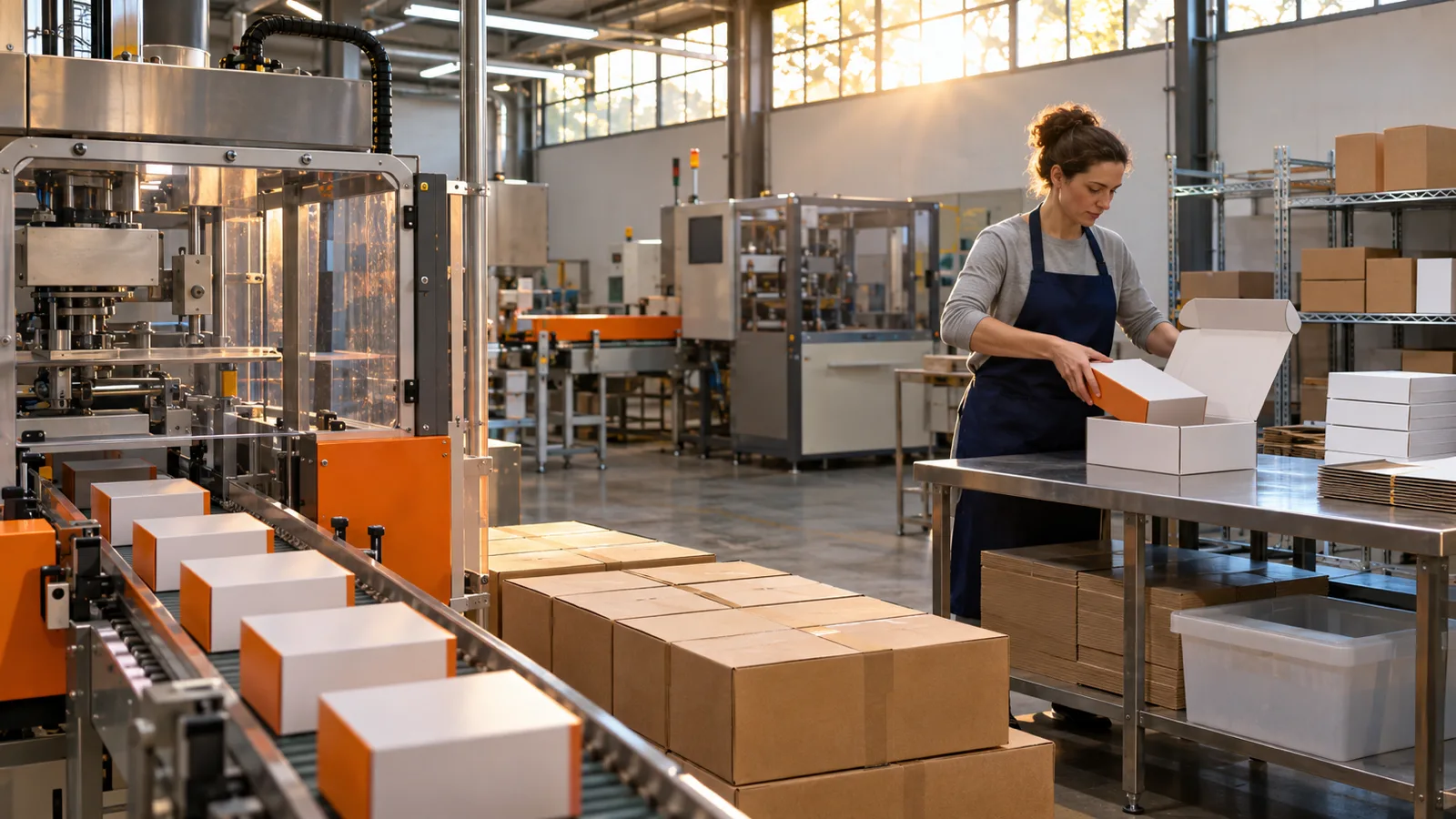
For thirty years, a family-run kitchenware maker in Meadowvale has shipped the same way: full pallets to distributors, a few truckloads a month to big-box retailers, invoices on net-60 terms. Then a younger generation joins the business, launches a Shopify store, and runs a small social campaign. Within a week the plant has two hundred orders for single frying pans going to addresses from Vancouver Island to Cape Breton, and the shipping department, which has never printed a parcel label in its life, is wrapping pans in stretch film and borrowing boxes from the recycling bin.
That story, in one form or another, plays out at manufacturers across Mississauga every year. Going direct-to-consumer (DTC) can lift margins, give you real customer data and reduce your dependence on a few large buyers. But the logistics behind a DTC order have almost nothing in common with the logistics behind a B2B pallet. The equipment, the packaging, the carriers, the software and even the definition of "on time" all change.
This article walks through that shift, side by side, so you can plan it deliberately rather than discover it one late order at a time.
B2B Versus DTC: What Actually Changes
It helps to lay the two models next to each other. Most manufacturers underestimate how many parts of the operation are touched.
Order size and frequency
In B2B, you might ship a few dozen orders a week, each one a pallet or more. In DTC, you could ship hundreds of orders a day, each one a single unit or a handful of items. The total volume of product might be identical, but the number of transactions multiplies dramatically, and each transaction carries its own labour, packaging and postage.
Packaging
Your B2B packaging was designed to stack on a pallet and survive a forklift. A DTC parcel has to survive conveyor belts, sorting drops and a porch in February. It also becomes part of the customer experience: the box is the first physical thing a consumer sees from your brand. Master cartons that hold twelve units are no help when you need to ship one.
Carriers
You probably have relationships with LTL and truckload carriers. DTC runs on small parcel networks such as Canada Post, Purolator, UPS, FedEx and regional couriers, each with its own rate structure, dimensional weight rules, surcharges and service areas. Choosing between them for each order is a skill in itself.
Customer expectations
A retail buyer accepts a delivery window and an appointment. A consumer expects a tracking number within hours, delivery in days, and a reply when they email asking where their order is. "Shipped by end of week" does not survive contact with online shoppers.
Returns
B2B returns are rare and negotiated. DTC returns are routine: wrong size, changed mind, arrived damaged. Somebody has to receive them, inspect them, decide whether they go back into stock, and trigger a refund.
Payment and cash flow
On the bright side, DTC customers pay up front. That can improve cash flow compared to net-60 terms, which helps fund the extra inventory and packaging you will need.
Step One: Decide Where DTC Orders Will Be Fulfilled
The first real decision is whether you fulfill DTC orders from your own plant or hand them to a fulfillment partner. Both are valid, and plenty of manufacturers start one way and switch later.
Fulfilling in-house keeps control close and uses space you may already have. It works when volumes are modest, the product is simple to pack, and you can dedicate people to it so that DTC orders are not constantly bumped by a big production run. The risk is that factory priorities usually win. When a retailer's purchase order needs to ship, the person packing parcels gets pulled onto the loading dock.
Outsourcing to a 3PL means moving a portion of finished inventory to a fulfillment centre that already has parcel workflows, packing stations, carrier accounts and software. Your plant keeps shipping pallets, which is what it is good at, and the 3PL turns those pallets into individual orders. For a Mississauga manufacturer, a nearby e-commerce fulfillment partner can be replenished with a short local truck run, sometimes the same day.
A practical test: count how many hours per week DTC orders take today, and project that number at three times your current volume. If the answer means hiring, buying equipment and carving out floor space, compare that cost to outsourcing before you commit.
Step Two: Rethink Packaging for Single Units
Packaging is where many manufacturers get caught out. A few things to work through:
- Ship-in-own-container (SIOC) potential. If your retail packaging is sturdy, it might be possible to ship some products in their own box with a label on it. That saves material but exposes your retail graphics to damage and tells everyone on the route what is inside.
- Right-sized boxes. Couriers charge on dimensional weight, so an oversized box costs money on every order. A small range of box sizes matched to your product dimensions usually pays for itself. Cartonization tools can choose the best box automatically based on what is in each order.
- Protection. Products that travelled safely inside a twelve-unit master carton may be fragile alone. Run drop tests before launch rather than learning from customer photos.
- Bilingual and regulatory labelling. If you sell consumer products across Canada, check whether your retail labelling already meets federal bilingual requirements. Products that previously reached consumers through a retailer's own relabelling process may need attention when you sell directly.
Our guide to packing fragile items properly is a good starting point if your products are breakable.
Step Three: Get Inventory Visible Across Both Channels
The moment you sell in two channels, inventory becomes a shared resource. If your website shows fifty units available but those fifty are already promised to a retailer's purchase order, you will oversell and disappoint consumers. If you hold too much back for B2B, the website shows "out of stock" while product sits on your racks.
The answer is a single view of inventory that both channels draw from, with rules about how much is reserved for each. Many manufacturers run an ERP for production and B2B orders. Connecting that to your e-commerce platform, either directly or through a fulfillment partner's inventory management system, keeps the counts honest. Decide in advance what happens when stock is tight: does the retailer order get priority, or the DTC customer? Write the rule down so the team is not deciding under pressure.
Step Four: Choose a Carrier Mix That Fits Canadian Geography
Shipping single parcels across Canada is not cheap, and the distances are long. From Mississauga, ground delivery into the GTA, Hamilton and Kitchener-Waterloo is typically quick. Ottawa, Montreal and much of southern Ontario are usually a day or two further out. Western Canada, the Maritimes and rural or northern addresses can take considerably longer and cost more.
Working with more than one carrier gives you options. One carrier may be strongest for residential deliveries in urban Ontario, another for rural routes, and another for heavier parcels. Rate shopping across carriers on each order, which a good shipping platform can do automatically, helps balance cost and delivery speed. It is also worth deciding which delivery promise you will actually show on your website. A realistic, consistently met promise builds more trust than an aggressive one you miss.
If you plan to sell into the United States, think about cross-border parcel options early. US consumers expect simple checkout and no surprise fees at the door, so how duties and taxes are handled matters. Shipping from Mississauga puts you within a few hours of the Niagara and Detroit-Windsor crossings, which helps on transit times for consolidated shipments.
Step Five: Plan for Returns Before the First Order Ships
Write your returns policy and process before launch, not after the first unhappy customer. Decide:
- Who pays return postage, and in which situations
- Where returns are shipped to: your plant, your 3PL, or a separate returns location
- Who inspects returns and what the grading criteria are (resell as new, resell as open box, refurbish, scrap)
- How fast refunds are issued once a return is received
For a manufacturer, returns can be valuable feedback. A pattern of the same defect coming back is information your quality team would rarely see through retail channels. A structured returns management process captures reason codes so that information gets back to production.
Step Six: Protect Your Retail Relationships
One part of the shift that is not purely logistical but has logistical consequences: your existing retail and distributor customers may feel uneasy about you selling directly to consumers. Some manufacturers handle this by offering DTC-exclusive products, bundles or colours, by keeping pricing aligned with retail, or by focusing DTC on parts, accessories and replacement components that retailers don't stock.
Whatever you decide, make sure your fulfillment setup does not let DTC orders delay retail shipments. Retailers often have strict delivery windows and compliance requirements, and a chargeback for a late or non-compliant shipment can wipe out the margin on many DTC orders.
A Realistic Launch Timeline
Every business moves at its own pace, but a sensible sequence for a Mississauga manufacturer looks something like this:
- Pick a small range of products to launch DTC, ideally ones that are compact, durable and already popular.
- Design and test parcel packaging for those products.
- Decide on in-house or outsourced fulfillment, and if outsourcing, move an initial stock position to the fulfillment centre.
- Connect your online store to inventory and shipping systems, and test orders end to end, including a return.
- Launch quietly to a limited audience, such as existing newsletter subscribers or a local market, and watch the numbers.
- Expand the catalogue and marketing once fulfillment is consistently on time.
How ShipCarte Supports Manufacturers Going Direct
ShipCarte works with manufacturers who want to keep their plants focused on production while building a direct-to-consumer channel. We can receive your pallets in Mississauga, store them, and pick, pack and ship individual orders through a range of carriers, with inventory and order data connected to your store. If you are weighing the move, schedule a consultation and we will talk through your products, expected volumes and what a sensible first phase would look like.