
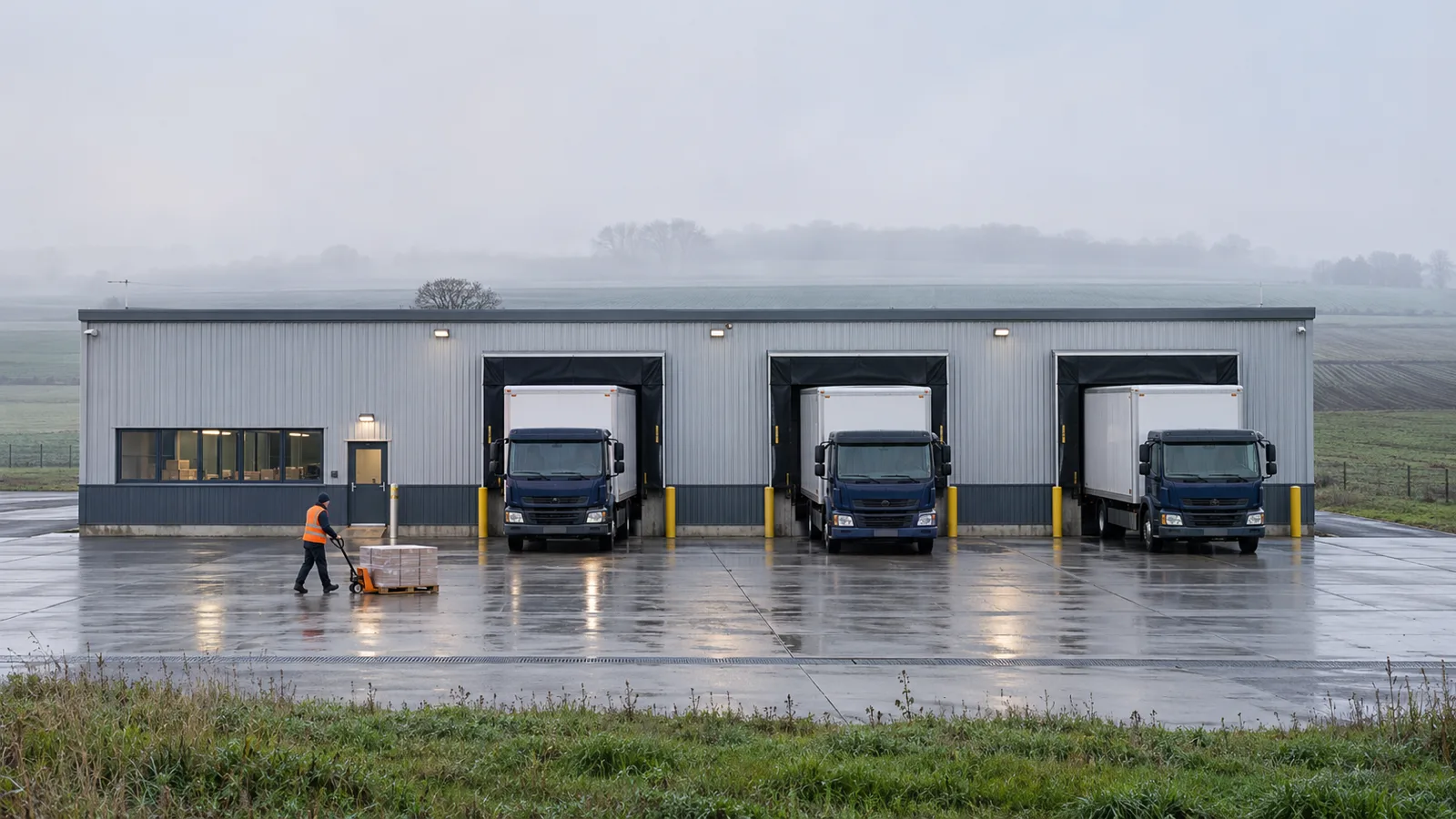
A building supply wholesaler with customers in Sarnia, Chatham, Stratford and Goderich has a familiar problem. Its stock sits in a warehouse in the GTA, and every morning its trucks leave Peel Region, battle the 401 through Milton and Cambridge, and reach the first Southwestern Ontario customer around mid-morning if traffic cooperates. By the time a driver reaches Goderich on the Lake Huron shore, half the day is gone, and the return trip eats most of the rest. Two-stop routes that should take a morning are taking a full shift.
Moving some of that inventory 190 kilometres west to London changes the shape of every route. Instead of a long run out and back, trucks fan out from the middle of the region. Windsor, Sarnia, Kitchener-Waterloo and the Lake Erie shore are all within roughly two hours. Customers who used to receive deliveries in the afternoon get them before lunch.
This article looks at when distribution from London, Ontario makes sense, how to design routes around it, and what to check before committing stock to the Forest City.
Why London Works as a Regional Hub
London sits at the junction of Highway 401 and Highway 402, which together form the spine of Southwestern Ontario's freight network. The 401 runs west to Windsor and the Ambassador Bridge and east to the GTA. The 402 runs west to Sarnia and the Blue Water Bridge into Michigan. Highway 4 heads north towards Exeter and Clinton, and Highway 3 and county roads reach the Lake Erie communities to the south.
The city itself has close to 400,000 people, and the broader region it serves, including Middlesex, Elgin, Oxford, Perth, Huron, Lambton and Chatham-Kent, adds several hundred thousand more. Along with the Windsor-Essex area, Southwestern Ontario is a sizeable market that is easy to underestimate from Toronto.
London also has the basics a distribution operation needs: CN and CP rail service, an international airport with cargo facilities, a substantial supply of industrial land along the 401 corridor, and a workforce that includes graduates from Western University and Fanshawe College. Industrial rents have generally been lower than in the Greater Toronto Area, although the tight market in 2019 has pushed rates up across much of Southern Ontario.
Drive Times From London to Key Southwestern Ontario Markets
Approximate driving times under normal conditions give a sense of how compact the region becomes when you start from the middle of it:
- St. Thomas: about 25 minutes
- Woodstock and Strathroy: about 35 to 40 minutes
- Stratford: about 50 minutes
- Tillsonburg: about 50 minutes
- Sarnia: about 1 hour
- Kitchener-Waterloo and Cambridge: about 1 hour 10 minutes
- Chatham: about 1 hour 15 minutes
- Goderich and Grand Bend: about 1 hour
- Windsor: about 2 hours
- Owen Sound: about 2 hours 30 minutes
From a GTA warehouse, most of these destinations are two to four and a half hours away, before accounting for congestion through Mississauga and Milton. That difference is what allows a London-based fleet to complete more stops per shift, or to offer earlier delivery windows to retailers and contractors.
Which Businesses Benefit Most
Wholesalers with route-based deliveries
Food service suppliers, building materials yards, auto parts distributors and agricultural input suppliers all run regular routes to many small customers. For them, the location of the warehouse directly determines how many stops a driver can make in a day. A London base can turn a single long route into two shorter, denser ones.
Manufacturers in the 401 corridor
Southwestern Ontario has a heavy concentration of manufacturing, particularly automotive parts suppliers serving assembly plants in Woodstock, Ingersoll, Cambridge, Alliston and Windsor, along with plants across the border in Michigan and Ohio. Holding finished goods or components in a London warehouse can shorten just-in-time deliveries and simplify cross-border shipments through Windsor or Sarnia.
Agri-food processors
The region is one of Canada's most productive farming areas. Processors in Huron, Perth and Middlesex counties often need cold or ambient storage close to their plants before goods move to grocery distribution centres in the GTA. A London hub can act as the consolidation point.
Retailers with stores across the region
A retailer with stores in London, Sarnia, Chatham, Woodstock and Stratford can replenish all of them from London on a single daily loop, rather than sending separate trucks from Toronto. Retail fulfillment and store replenishment services make this practical even for chains that do not want to run their own warehouse.
Designing Routes Out of London
A distribution centre only saves money if the delivery routes are designed around it. Here is how we approach route design for clients serving Southwestern Ontario.
- Cluster customers by corridor. Group deliveries into natural loops: a west loop along the 402 to Strathroy and Sarnia; a south-west loop along the 401 to Chatham and Windsor; a north loop up Highway 4 and Highway 8 to Exeter, Clinton, Goderich and Stratford; and an east loop to Woodstock, Ingersoll and Tillsonburg.
- Set delivery days by zone. Customers with smaller orders can often accept delivery on fixed days, for example the Lake Huron shore on Tuesdays and Fridays. That keeps trucks full.
- Use LTL for the edges. Owen Sound, the Bruce Peninsula and the far corners of Essex County may be cheaper to reach through LTL carriers that already run there daily, rather than with your own trucks.
- Plan for winter. Lake-effect snow off Lake Huron can close Highway 402 and county roads near Grand Bend and Goderich with little warning. Build alternative routing and buffer days into service promises for those areas from December to March.
- Review routes quarterly. As customers come and go, routes drift. Regular reviews keep them efficient.
London Versus Kitchener-Waterloo Versus the GTA
Kitchener-Waterloo and Cambridge also make strong distribution locations, and the choice often comes down to where the bulk of your customers are.
- If most customers are between Toronto and Kitchener, a Cambridge or Guelph-area site keeps you close to the GTA while easing congestion.
- If customers are spread across Southwestern Ontario with significant volume in Windsor, Sarnia and the Huron shore, London puts you closer to the centre of gravity.
- If you also serve Eastern Ontario and Quebec heavily from the same building, the GTA remains the better compromise.
Many businesses end up with a hybrid: a main warehouse in the GTA for provincial and national distribution and a smaller forward stocking location in London for the fastest-moving products. A distribution warehousing partner can make the London side of that network flexible, without a long-term lease.
The Cross-Border Angle
London sits roughly an hour from the Blue Water Bridge at Sarnia and two hours from the Ambassador Bridge in Windsor. For businesses shipping to Michigan, Ohio, Indiana and Illinois, that is a meaningful advantage. Many carriers use the Blue Water Bridge to avoid congestion at the Ambassador, particularly at peak times.
Cross-border shipments still need the usual preparation: commercial invoices, correct tariff classification, and proof of origin for goods claiming NAFTA treatment. Holding inventory in London and shipping into the US through Sarnia can shorten transit times to Midwestern customers compared with shipping from the GTA. Our cross-border shipping team can help with the paperwork and carrier choice.
Before You Move Stock to London: A Checklist
- Customer map: plot last year's deliveries by postal code. If fewer than a quarter fall in Southwestern Ontario, a London site may not pay for itself.
- Inventory split: decide which SKUs need to be forward-stocked. Often 20 percent of the products account for most regional orders.
- Replenishment plan: set how often stock moves from your main warehouse to London, and whether by your own truck, full truckload or LTL.
- Systems: make sure your order system can route orders to the right warehouse automatically and that inventory management shows stock at both locations in real time.
- Labour and safety: any warehouse in Ontario must meet the Occupational Health and Safety Act, including forklift training and racking inspection. A 3PL partner takes on that responsibility for its staff.
- Service promise: update customer-facing delivery windows once the new site is live, so customers see the improvement.
What a Typical Result Looks Like
When a distributor shifts its Southwestern Ontario volume from a GTA warehouse to a London forward location, three improvements usually follow. Routes shorten enough to add stops or drop a truck. Deliveries arrive earlier in the day, which matters a great deal to contractors and retailers who need product before they open. And the main GTA warehouse gains space, often delaying the need to expand there. The cost is a second inventory to manage and regular replenishment linehaul, which is why the decision should be based on real delivery data rather than instinct. For a wider look at moving freight across the province, our guide to next-day delivery across Ontario is a useful companion.
Serve Southwestern Ontario From Its Centre
London is not the right base for every business, but for companies whose customers stretch from Windsor to Owen Sound, it puts the warehouse where the deliveries are. With the 401 and 402 on its doorstep and two border crossings within easy reach, it is one of the most practical regional hubs in Ontario.
ShipCarte helps businesses design distribution networks across Ontario, combining warehousing, LTL and truckload services with real-time inventory visibility. To see whether a London-based distribution setup fits your customer base, schedule a consultation or request a quote.