
A cycling accessories shop near Port Credit noticed something odd in its order data. A large share of its online orders were going to postal codes within a short drive of the store, yet each one was being boxed, labelled and handed to a courier, then carried across town and dropped on a porch the next day. Customers were paying for shipping, or the shop was absorbing it, to move a pair of gloves less distance than a trip to the grocery store.
Local pickup fixes that. It lets nearby customers order online and collect their purchase themselves, often the same day. For the merchant, it can mean lower shipping costs, fewer lost or stolen parcels and a reason for customers to come face to face with the brand. For the customer, it means no delivery fee, no waiting at home and no porch pirates.
But "local pickup" is not one thing. In Mississauga, the three main models are curbside pickup, parcel lockers and in-store or counter pickup. Each fits different businesses, and each needs a little operational thought to work smoothly. This guide compares them and walks through how to set pickup up properly.
Why local pickup matters in a city like Mississauga
Mississauga is large and car-oriented, with dense residential neighbourhoods like City Centre, Cooksville and Erin Mills sitting a short drive from plazas, industrial units and big-box centres. Many people already pass a convenient pickup point on their commute along Hurontario, Dundas or the 403. That makes pickup a natural fit, as long as the pickup point is easy to reach, easy to park at and open when people actually travel.
Local pickup is not only for retailers with storefronts. Brands that operate from a warehouse or industrial unit, or that use a 3PL, can offer it too, either at a counter or through locker networks.
Model 1: Curbside pickup
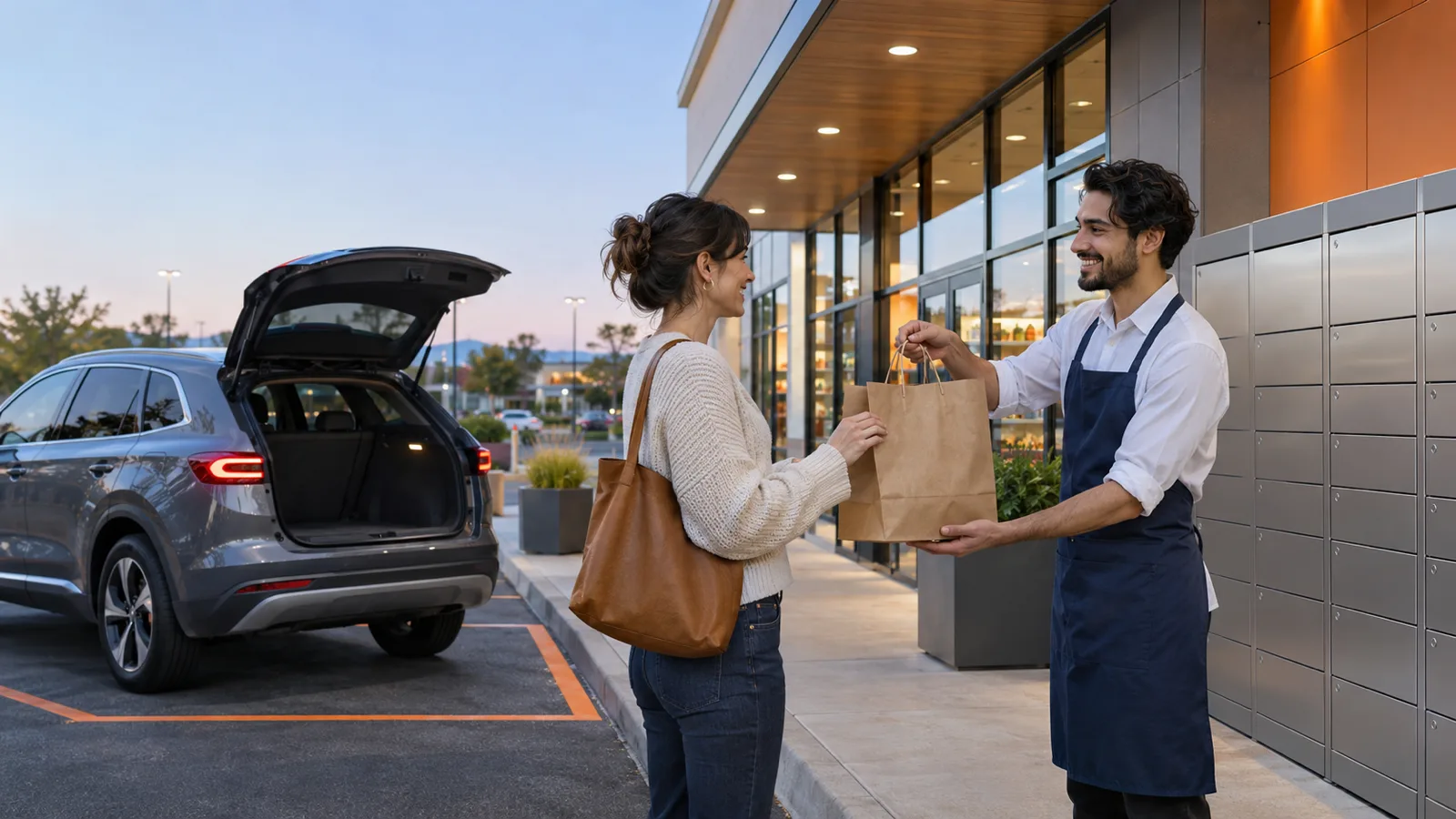
The customer orders online, chooses curbside pickup, and receives a notification when the order is ready. On arrival, they park in a marked spot and tell the store they are there, by text, app or phone. A staff member brings the order out to the car.
Best for
- Bulky or heavy items such as pet food, home goods, beverages or bike parts.
- Stores with dedicated parking in front.
- Customers with children in the car, accessibility needs, or limited time.
Watch out for
- Staffing. Someone has to be free to run orders outside, even in a Canadian February.
- Plaza parking rules. Check with your landlord before marking spots.
- ID checks, if you sell age-restricted goods.
Model 2: Parcel lockers
Orders are placed in a secure locker, and the customer receives a code or QR code to open it. Lockers can be on your own premises or part of a third-party network in transit stations, convenience stores, condo lobbies and shopping centres.
Best for
- Small and medium parcels.
- Customers who work long or irregular hours and want 24/7 access.
- Condo residents in dense areas like the City Centre around Square One, where package rooms fill up quickly.
Watch out for
- Size limits. Oversized items will not fit.
- Temperature. Standard lockers are not suitable for perishables or products sensitive to heat or cold unless they are specifically temperature-controlled.
- Network fees and dwell limits, which vary by provider.
Model 3: In-store or counter pickup
The customer comes inside to a service desk or pickup counter. This is the classic "buy online, pick up in store" model, and it is also how many warehouse-based brands offer pickup: a small counter at the front of an industrial unit with set hours.
Best for
- Retailers who want pickup customers to browse and add to their purchase.
- Products that benefit from a quick check or explanation at handoff, such as fitted items, electronics or tools.
- Exchanges and returns handled at the same counter.
Watch out for
- Queues. Pickup customers who wait behind full-price shoppers lose patience fast. A dedicated counter or express line helps.
- Industrial units. If your pickup is at a warehouse in an area like Meadowvale or Malton, make sure signage, parking and opening hours are crystal clear, and keep pickup customers safely away from forklifts and loading docks.
Side-by-side: which model fits you?
- Lowest staffing need: lockers.
- Best for big or heavy goods: curbside.
- Best for upselling and returns: in-store counter.
- Widest access hours: lockers, then curbside if you extend evening hours.
- Best for perishables: curbside or in-store, with cold holding on site.
- Easiest for a warehouse-based brand: a counter with fixed pickup windows, or a third-party locker network.
Many businesses combine models. A store might offer curbside for heavy items and a locker on the wall for after-hours pickup, for example.
Setting up local pickup: a practical checklist
In your ecommerce platform
- Enable local pickup as a delivery method and restrict it to locations that actually hold stock. Shopify and most other platforms support this natively; our post on Shopify shipping basics covers where the settings live.
- Show accurate "ready by" times. Promising "ready in two hours" and then taking a day undermines the whole offer.
- Collect a mobile number for notifications.
- Write clear pickup instructions into the confirmation email: address, hours, where to park, what to bring.
In your inventory and operations
- Keep pickup inventory accurate. Nothing frustrates a customer more than arriving for an order that was sold to someone else at the till. Real-time inventory management across channels prevents that.
- Create a staging shelf or area for ready orders, organized by order number or customer surname.
- Set a rule for unclaimed orders: how many reminders, how long you hold, and when you cancel and restock.
- Package pickup orders appropriately. They do not need shipping-grade protection, but they should look tidy and on brand.
At the handoff
- Verify identity with an order number, name or code.
- Mark the order as picked up in your system immediately, so the customer gets a confirmation.
- Have a returns process ready for the customer who opens the bag and decides it is the wrong size.
Pricing pickup
Most businesses offer pickup free, because it saves them shipping and handling costs. Some set a minimum order value, or charge a small fee for very large or same-hour orders. It is worth testing whether free pickup increases conversion for local buyers who would otherwise abandon at the shipping step. Our post on the real cost of slow shipping explains why delivery options influence checkout behaviour.
Pickup when a 3PL holds your stock
If your inventory sits with a fulfillment partner, you can still offer local options. Approaches include:
- Same-day local courier delivery from the warehouse as an alternative to pickup.
- Third-party locker or pickup point networks, where the 3PL ships to the customer's chosen location.
- Store replenishment, where the 3PL keeps your retail location stocked so in-store pickup works for a broader range of SKUs.
- Scheduled pickup windows at the warehouse for wholesale or B2B customers collecting larger orders, by arrangement.
ShipCarte's ecommerce fulfillment and retail fulfillment can support these hybrid models, with orders flowing in through order management and the right delivery method chosen for each.
Mistakes that make pickup frustrating
- Offering pickup at a location that does not have the stock.
- Sending a "ready" notification before the order has actually been picked and staged.
- Hiding the pickup point. A sign on the back door of an industrial unit is not enough.
- Opening hours that do not match commuters' schedules. If most people pass your store after 6:00 p.m., closing at 5:00 p.m. limits pickup.
- No plan for winter. Curbside in a snowstorm needs cleared, salted spots and staff with proper gear.
- Ignoring the data. Track how long orders wait for pickup, how many go unclaimed and how many pickup customers buy something else on the spot.
Preventing pickup fraud and mix-ups
Pickup removes the porch-theft problem, but it introduces a new one: handing an order to the wrong person. A few safeguards keep that risk low without slowing honest customers down:
- Require a unique pickup code or QR code rather than just a name, since names are easy to overhear or guess.
- For high-value orders, ask for photo ID that matches the order name, and note this requirement in the confirmation email so nobody is surprised.
- If a customer wants someone else to collect, let them add an alternate name at checkout or by reply.
- Log who handed over each order and when. If a dispute arises, you can check exactly what happened.
- Store ready orders out of public reach, not on an open shelf beside the till.
Measuring success
A few simple metrics tell you whether pickup is working:
- Share of local orders choosing pickup.
- Average time from order to "ready" notification.
- Average wait time at handoff.
- Unclaimed order rate.
- Additional purchases made at pickup (for in-store models).
- Shipping cost avoided compared with sending those orders by courier.
Review them monthly for the first few months and adjust hours, staffing and instructions accordingly.
Build a delivery mix that fits Mississauga
Local pickup will not replace shipping, but for nearby customers it can be faster, cheaper and more convenient than any courier. Pairing it with efficient parcel shipping for everyone else gives your store a delivery mix that suits a city as spread out as Mississauga. If you want help designing that mix, from pickup to small parcel shipping across Canada, schedule a consultation with ShipCarte.