
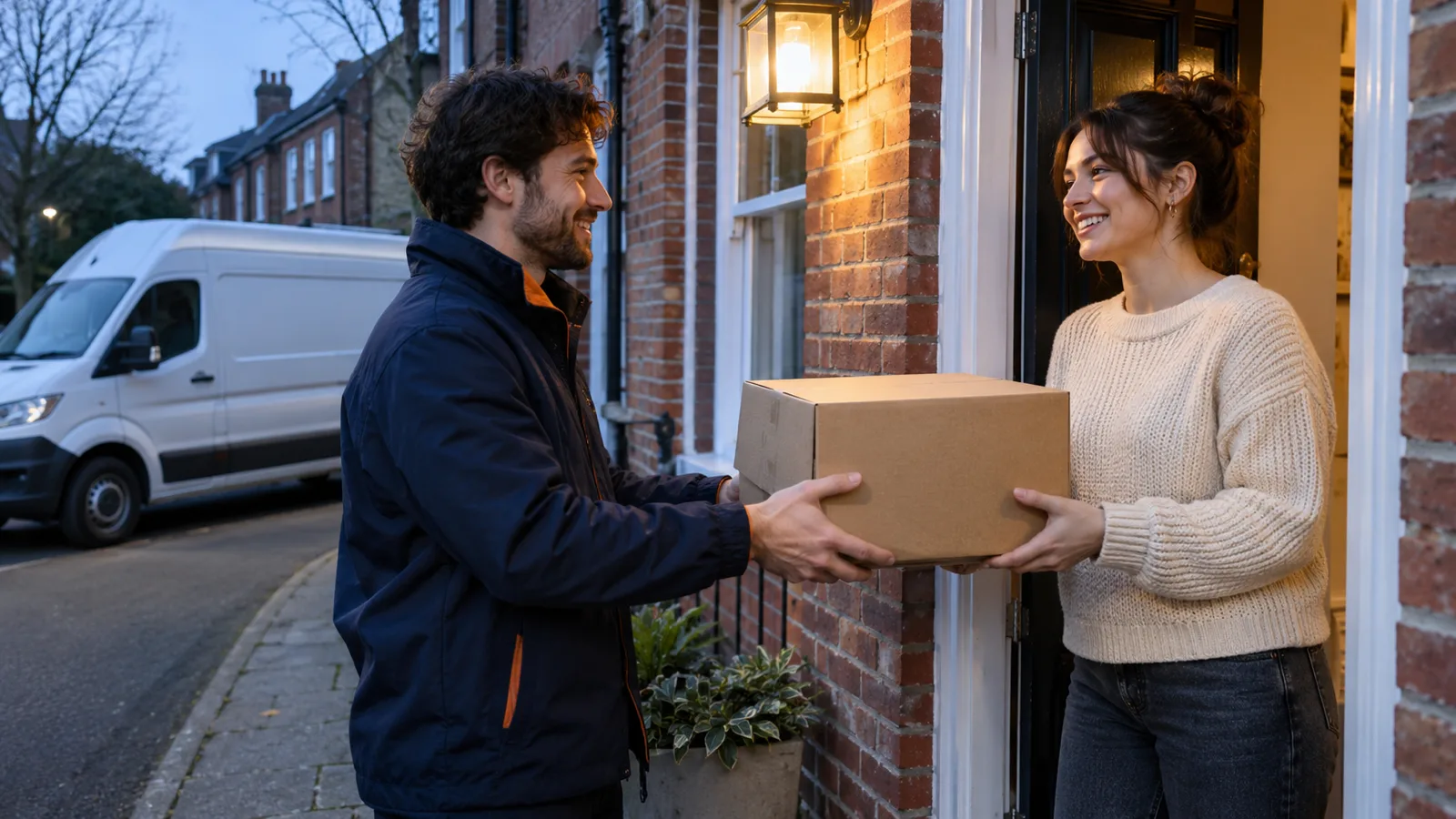
Think about the path a pair of running shoes takes before it reaches a front porch in Churchill Meadows. It may have crossed an ocean in a container with thousands of other boxes, ridden a train halfway across the country and travelled down the 401 in a trailer packed to the roof. All of that, per pair, can cost surprisingly little. Then a delivery van spends ten minutes finding parking, walking to a door and waiting for an answer, just to hand over one box. That final stretch is where the cost per package jumps.
Logistics people call it the last mile: the journey from the local delivery terminal to the customer's door. It is the part of the trip customers see, the part they judge your brand on, and very often the most expensive part on a per-parcel basis.
For online sellers and distributors in Mississauga, understanding why the last mile costs what it does is the first step toward controlling it. Here is what drives those costs and what you can actually do about them.
Why the Last Mile Is So Expensive
Long-haul transport is efficient because it moves many items together over a single route. The last mile reverses that logic. Each parcel goes to a different address, so the work is split into many small, separate stops.
Stops, not kilometres
A delivery driver's day is measured in stops. Every stop involves parking, finding the right door, carrying the parcel, possibly waiting for a signature and returning to the vehicle. When stops are close together, as on a dense residential street, the driver completes more per hour and the cost per parcel falls. When stops are scattered, cost rises.
Suburban sprawl
Mississauga is a mix of densities. City Centre around Square One is packed with condos. Neighbourhoods like Erin Mills, Meadowvale and Lisgar are classic suburbs with winding crescents and cul-de-sacs. Rural edges in neighbouring Caledon are spread out. Each pattern produces very different numbers of stops per hour.
Failed deliveries
When nobody is home to sign, a parcel may be taken back to the depot, rescheduled or redirected to a pickup point. Each failed attempt adds cost without adding value. Condo buildings with buzzer codes, locked mailrooms and limited parking contribute to this.
Traffic and parking
Time stuck on Hurontario or Dundas at rush hour, or circling for a place to stop near busy plazas, is time the driver is paid but not delivering. Downtown Toronto adds parking fines and loading restrictions to the mix.
Customer expectations
Shoppers have come to expect fast, free and trackable delivery. Faster services usually mean less time to build efficient routes and higher costs for the carrier, which flow back to the shipper.
Returns
The last mile works in reverse too. Every return is another pickup or drop-off, another scan and another trip. Our post on building a hassle-free returns process covers how to keep that manageable.
How Last-Mile Costs Show Up on Your Bill
You rarely see a line item that says "last mile." Instead, the costs appear in several forms:
- Base rates that are higher for residential addresses than commercial ones.
- Residential surcharges applied by many carriers.
- Extended area or remote surcharges for addresses outside dense delivery zones.
- Signature fees when proof of delivery is required.
- Dimensional weight charges, because bulky packages take up more space in a delivery van.
- Peak season surcharges when networks are stretched.
- Address correction fees when a driver must fix an incorrect address.
Our article on types of shipping surcharges breaks down each of these.
Eight Ways Mississauga Sellers Can Reduce Last-Mile Costs
You cannot change the geography of Peel Region, but you can change how your parcels enter the last mile.
1. Ship from closer to your customers
The shorter the distance from your warehouse to the local delivery terminal, the more likely your parcel enters the right route on time. Fulfilling from Mississauga puts a large share of Ontario's population within next-day ground reach. For a full picture of transit across the region, see our guide to reaching the GTA from Mississauga.
2. Right-size your packaging
Smaller boxes mean lower dimensional weight charges and more parcels per van. Tools like cartonization recommend the smallest suitable box for each order automatically.
3. Use more than one carrier
Different carriers are stronger in different areas and for different package types. Rate shopping by postal code and package profile often reveals savings, especially for residential deliveries. Small parcel shipping through a multi-carrier setup makes this practical.
4. Offer pickup points
Pickup lockers and retail counter locations let customers collect parcels at their convenience. Consolidating deliveries to a single location reduces stops and virtually eliminates failed attempts.
5. Collect better address data
Address validation at checkout, mandatory unit number fields for apartments and condos, and a delivery notes field for buzzer codes cut failed deliveries. Your order management system should flag incomplete addresses before labels print.
6. Be selective about signatures
Signature requirements protect high-value items, but they also increase failed attempts. Use them where risk justifies it, not by default.
7. Offer a slower, cheaper option
Not every customer needs their order tomorrow. An economy option with a longer window gives carriers more flexibility and can lower your cost. Many shoppers will choose it if it is free or cheaper. Our piece on the real cost of slow shipping explores where the balance lies.
8. Consider local delivery for dense zones
If you have a high concentration of orders in specific neighbourhoods, a local delivery route operated by a courier can sometimes be more economical than national carrier services for those postal codes.
A Simple Scenario: Two Ways to Ship the Same Order
Imagine an online home goods shop in Mississauga shipping a lamp to a customer in a Port Credit condo.
Version one: The lamp ships in an oversized box with plenty of void fill. The customer typed the street address but left out the unit number. Signature is required by default. The driver arrives at midday, cannot access the building and leaves a notice. The parcel goes back to the depot, the customer calls support, and the box is delivered three days later after an address correction fee.
Version two: The lamp ships in a snug box chosen by the warehouse system. Checkout required a unit number and buzzer code. The customer chose delivery to a nearby pickup point on their walk home. The parcel arrives next day, no signature is needed and the customer collects it that evening.
Same product, same city, same carrier network. The second version is cheaper, faster and better for the customer.
The Role of Your Fulfillment Partner
Many last-mile decisions are made long before the van arrives: where your stock is stored, how quickly orders are picked, which box is chosen, which carrier is selected and when the pickup happens. A strong e-commerce fulfillment partner makes those decisions consistently and gives you data to keep improving them, including on-time rates, failed delivery rates and cost per order by zone.
Look for late carrier pickup times, multi-carrier options and accurate tracking updates. A warehouse with an afternoon cut-off can get orders into the overnight sort and onto next morning's routes.
Looking Ahead
Last-mile delivery keeps evolving. Electric delivery vans, parcel lockers in condo lobbies, route optimization software and evening delivery windows are all changing how parcels reach doors in the GTA. Municipalities are paying more attention to delivery traffic and curb space. Sellers who track their own last-mile performance will be best placed to take advantage of new options as they become available.
Measuring Your Own Last-Mile Performance
You cannot manage what you never look at, and most sellers only notice the last mile when a customer complains. A short monthly review gives you a much clearer picture. Pull your shipment data and look at a handful of measures:
- Cost per order by postal code area. Comparing downtown condos, inner suburbs such as Cooksville and outlying areas shows where your delivery spend really goes.
- On-time delivery rate against the date you promised at checkout, not just the carrier's own estimate.
- First-attempt success rate, which reveals how often address problems or signature requirements are causing repeat trips.
- Surcharges as a share of spend, broken down by type, so you can see whether residential, dimensional or address correction fees are growing.
- Customer contacts about delivery, such as "where is my order" emails, which carry their own support cost.
Patterns jump out quickly. A spike in failed attempts in one neighbourhood may point to a building with access problems. A rise in dimensional charges may mean a new product is being shipped in the wrong box. Each finding is a specific fix rather than a vague sense that shipping is too expensive.
Make the Final Stretch Work Harder
The last mile will probably always cost more per parcel than the long haul, but it does not have to be a black box. With better packaging, cleaner address data, smart carrier choices and fulfillment close to your customers, Mississauga sellers can deliver faster for less.
ShipCarte helps e-commerce brands store inventory, pack orders efficiently and ship through multiple carriers across the GTA and Canada. Request a quote to see how your delivery costs could change.