
A hardware start-up in Waterloo's Uptown has just closed its first serious purchase order: 400 sensor units for a customer in Texas, plus a pilot batch for a distributor in Germany. Until now, every shipment has been a handful of prototypes in a padded envelope, dropped at a courier counter on King Street by whichever engineer was heading home. Suddenly the team needs to know how to pack lithium-powered devices, what goes on a commercial invoice, whether the encryption in their firmware needs an export permit, and why their US customer is asking about country of origin and Section 301.
Kitchener-Waterloo has spent decades turning research into products, and much of that output is physical: sensors, robotics, medical devices, telecom gear, industrial controllers and consumer electronics. Shipping these products is not like shipping T-shirts. They are valuable, fragile, often battery-powered, sometimes subject to export controls, and almost always headed outside Ontario.
This guide covers the issues that hardware companies in Waterloo Region run into most, from the first box of prototypes to steady production volumes.
Start With the Product: What Makes Hardware Different
Before choosing a carrier, it helps to classify your shipments along four lines, because each one triggers its own requirements:
- Does it contain or ship with batteries? Lithium-ion and lithium-metal batteries are regulated as dangerous goods.
- Is it sensitive to static, shock or moisture? Bare boards, modules and precision instruments need specialised packaging.
- What is its value? Standard carrier liability is low compared with the value of most electronics.
- Does it include encryption, radio transmitters or controlled technology? These can affect export permits and destination-country certification.
Lithium Batteries: The Rule That Catches Most Start-Ups
Lithium batteries are classified as dangerous goods under Canada's Transportation of Dangerous Goods Regulations for ground shipments and under the IATA Dangerous Goods Regulations for air. The requirements depend on three things: whether the battery is lithium-ion or lithium-metal, whether it is shipped alone, packed with equipment or contained in equipment, and its watt-hour rating or lithium content.
Some practical points for Waterloo hardware teams:
- Batteries contained in equipment, such as a sensor with a built-in cell, are the least restricted category, but they still have marking and packaging requirements above certain sizes.
- Standalone lithium-ion cells and batteries shipped by air must generally be at no more than 30 percent state of charge, and many are restricted to cargo aircraft only.
- Battery designs must have passed the UN 38.3 test series, and shippers should be able to provide the test summary on request.
- Anyone who prepares dangerous goods shipments, including the person packing the box, needs appropriate training. Carriers can and do refuse shipments that are not properly declared.
Ground service within Ontario and to most of Canada is usually the simplest route for battery-powered products, since ground rules are less restrictive than air. Our article on shipping lithium battery products in Canada goes deeper into the categories.
Packaging That Protects Electronics
Damage claims on electronics are expensive and hard to win, so packaging is worth getting right.
Electrostatic discharge
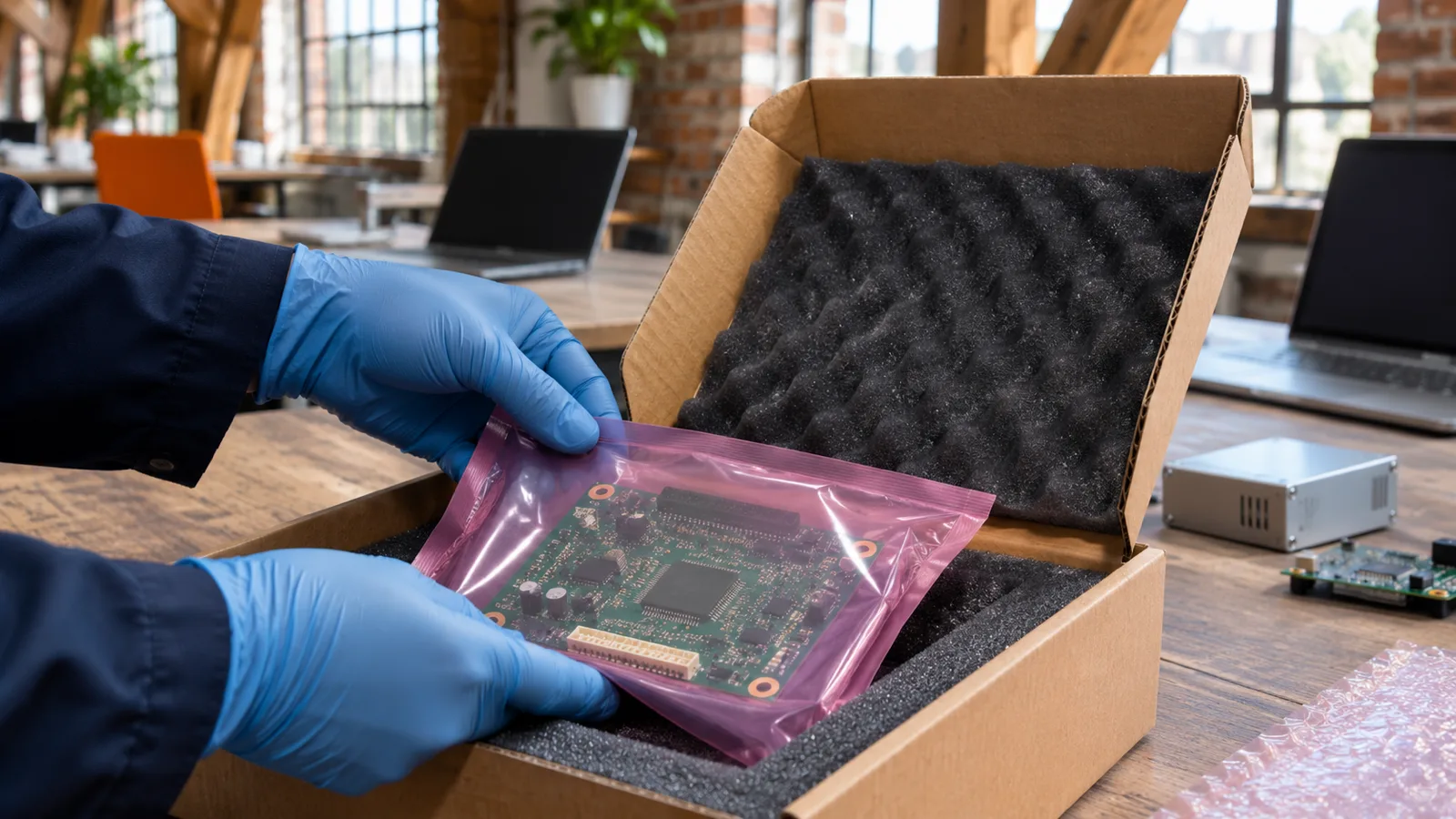
Bare printed circuit boards, modules and components should travel in static-shielding bags, usually the metallised type, sealed and labelled. Pink anti-static poly bags help reduce static build-up but do not shield against external discharge, so they are better suited to finished, enclosed products or packing material around boards.
Shock and vibration
Custom foam inserts, corrugated partitions or molded pulp trays keep devices from shifting. For sensitive instruments, consider a double-box method with at least five centimetres of cushioning between the inner and outer cartons. Drop-testing your packaging before a large shipment is cheap compared with a batch of returns.
Moisture and temperature
Southern Ontario winters are cold and its summers humid. Devices moving from a frozen trailer into a warm building can collect condensation. Desiccant packs and sealed bags help, and it is worth telling customers to let boxed equipment reach room temperature before opening it in winter.
For companies that ship many SKUs, a kitting and assembly service can build standard packs with the device, cables, power supply and printed guide in one consistent box.
Insurance and Declared Value
Most couriers limit their liability to a modest amount per package, often around $100, unless you declare a higher value and pay for it. For a $2,000 industrial controller, that gap matters. Options include declaring value with the carrier, buying third-party shipping insurance or, for larger shipments, cargo insurance. Whatever you choose, keep proof of value and photos of the packed product, as claims for concealed damage are much easier to support with evidence.
Shipping to the United States
The US is the largest market for most Kitchener-Waterloo hardware firms, and the paperwork has become more important over the past two years.
Country of origin and Section 301
Since 2018, the US has applied additional Section 301 tariffs to many goods of Chinese origin, including a wide range of electronic products and components. Country of origin is determined by where the product was last substantially transformed, not where it was shipped from. A device designed in Waterloo but manufactured and assembled in China may still be treated as Chinese-origin, and the US importer could face additional duties. Make sure your commercial invoice states origin accurately, and talk to a customs broker if your product is assembled in Canada from imported parts.
NAFTA and low-value shipments
Products that meet NAFTA rules of origin can enter the US duty-free with proper documentation. For small direct-to-customer parcels, the US Section 321 exemption allows shipments valued up to US$800 to enter without duty. Even so, products such as radio-equipped devices may still need to meet FCC requirements before they can be legally sold in the US.
Getting it across
From Waterloo Region, freight usually reaches the US via the 401 to Windsor or Sarnia for Michigan and the Midwest, or via Highway 6, the 403 and the QEW to the Niagara crossings for New York and the Northeast. Cross-border shipping services that consolidate parcels can lower costs considerably for direct-to-consumer brands.
Shipping Overseas: Export Controls and Reporting
Exports beyond the United States bring two additional steps that many start-ups miss.
Export controls. Canada's Export Control List covers a range of dual-use goods and technology, including certain encryption functions, sensors, lasers, navigation equipment and high-performance computing hardware. Exports of controlled items to most destinations other than the United States may require a permit from Global Affairs Canada. Many commercial products fall under exemptions, but the responsibility to check rests with the exporter.
Export reporting. Commercial exports to countries other than the US with a value of $2,000 or more generally must be reported to the CBSA, typically through the Canadian Export Reporting System. Controlled goods must be reported regardless of value. Our post on Canadian export reporting explains the process.
Destination markets also have their own rules, such as CE marking and battery directives in the European Union, which should be confirmed before you ship commercial quantities.
Returns, Repairs and RMAs
Hardware companies deal with returns differently from retailers. Units come back for repair, replacement or evaluation, often from other countries. A few habits make this manageable:
- Issue a return merchandise authorisation number for every unit and require it on the outside of the box.
- Provide prepaid return labels and packaging instructions, including battery guidance.
- For units returning from the US, make sure the paperwork identifies them as Canadian goods returned for repair, so they are not charged duty as if they were new imports.
- Track serial numbers in and out so you know which unit went where.
A returns management process with serial-number tracking can take this workload off your engineering team.
Questions Waterloo Hardware Teams Ask Us
Should we keep inventory in Waterloo or outsource it?
Early on, keeping stock in-house makes sense because product changes quickly. Once you ship more than a few dozen orders a week, outsourcing storage and fulfillment frees floor space and engineers' time. A GTA or Waterloo Region warehouse also gives you later carrier pickups and access to more services.
How do we ship demo units to trade shows?
For shows in the US or overseas, an ATA Carnet can allow temporary duty-free import of equipment that will return to Canada. Book freight well in advance and confirm show-site delivery windows.
What about prototypes and samples?
Even free samples need a commercial invoice with a fair market value for customs. Marking a box "no commercial value" usually leads to delays.
From Prototype Boxes to a Real Shipping Program
The difference between a hardware company that ships smoothly and one that fights its carriers is usually process, not luck: correct battery classification, protective packaging, accurate origin and value on every invoice, and a clear export compliance check. Getting these right early saves money and reputation as volumes grow across Ontario and beyond.
ShipCarte works with technology companies across Ontario to ship devices domestically and internationally, with warehousing, kitting and returns support when you are ready to outsource. Schedule a consultation to review your hardware shipping process, or request a quote for your next order.