
A pair of diamond earrings fits in a box smaller than a deck of cards. A luxury watch weighs a few hundred grams. Those small, light parcels can be worth more than a pallet of electronics, and they move through the same courier networks, sorting hubs and delivery vans as everything else. That combination, high value in a tiny package, is what makes shipping jewellery and watches different from almost any other ecommerce category.
Many independent jewellers in Canada built their businesses on walk-in customers and appointments. As more shoppers buy online, a lot of them are now leaning on ecommerce and shipping far more than they ever planned to. Others are online-first designers who have shipped from home studios for years and are now growing past what a weekly trip to the post office can handle. Both face the same questions: how do we keep parcels from being stolen, how do we get paid if one disappears, and what does the customer need to see when the box arrives?
This guide covers the security and insurance side of shipping jewellery and watches within Canada and across the border, with a practical focus on what you can control.
Understand Where the Risk Actually Is
It helps to break the journey into stages, because the risks at each stage are different.
- In your premises or warehouse. Inventory theft, mis-picks and packing errors. A missing ring discovered after the parcel ships is very hard to trace.
- At pickup and in carrier networks. Parcels pass through many hands and facilities. Packages that look valuable attract attention.
- At delivery. Porch theft, delivery to the wrong address, and parcels left in apartment lobbies are some of the most common causes of loss.
- After delivery. Claims that a box arrived empty or that an item was never received, some genuine and some fraudulent.
Insurance protects you financially, but good process prevents most losses in the first place. Both matter.
Packaging: Discreet, Tamper-Evident and Well Documented
Keep the outside boring
The outer packaging should never advertise its contents. Avoid branded boxes or tape that identify you as a jeweller or watch dealer, and do not write descriptions like "diamond ring" or a brand name on the label. Use a neutral return address, such as a company name that does not reveal the category. Your beautiful branded gift box belongs inside a plain shipping carton.
Make tampering visible
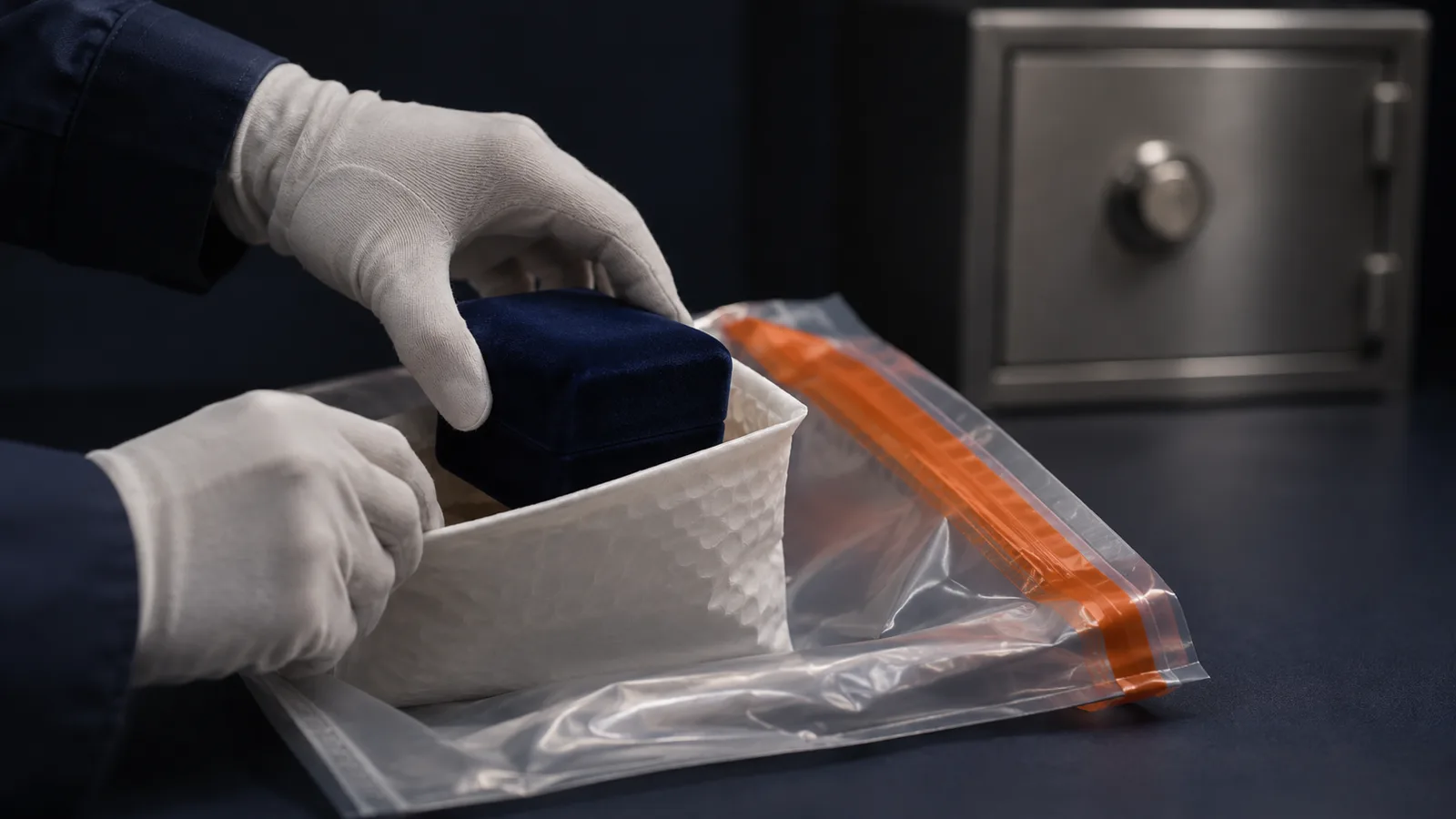
Tamper-evident security tape or security bags show quickly if a parcel has been opened in transit. They will not stop a determined thief, but they deter casual theft and, crucially, give you and your insurer evidence if a customer reports an empty box. Use a small, rigid box rather than a soft mailer so the parcel cannot be squeezed and items cannot work their way out.
Document every high-value parcel
For orders above a value threshold that you set, photograph the item, the packed inner box and the sealed outer parcel, ideally with the order number visible in the frame. Record the weight of the sealed parcel. Some sellers video the packing process for their most valuable orders. This evidence can make the difference when a carrier or insurer asks for proof of contents. Weight discrepancies between your record and the carrier's scan are one of the clearest indicators that something was removed in transit.
Choosing Carrier Services for Valuables in Canada
Not every service level is suited to high-value parcels. When you set up shipping for jewellery and watches, compare carriers and services on these points:
- Signature on delivery. Requiring a signature keeps parcels from being left on doorsteps. For higher values, consider adult signature or signature by the named recipient where offered.
- Tracking granularity. Scans at each handoff give you a better picture if something goes wrong. Services with fewer scans make investigations harder.
- Restrictions on valuables. Each carrier's terms specify limits on declared value for jewellery, watches and precious metals, and some exclude certain items from coverage entirely. Read the tariff or terms and conditions, not just the marketing page.
- Hold for pickup options. Letting customers collect from a post office or carrier location avoids porch theft. This is especially useful in dense parts of Toronto, Montreal and Vancouver where buildings have shared lobbies.
- Transit time. The less time a parcel spends in the network, the fewer opportunities for loss. Faster services can be worthwhile above a certain order value.
Using more than one carrier, and choosing the right one by value and destination, is often the best approach. A shipping platform that applies rules automatically, for example "orders over a set value ship with signature required," removes the risk of a packer forgetting.
Insurance: Carrier Liability, Declared Value and Third-Party Coverage
This is the part sellers most often get wrong. There are three distinct layers, and they are not interchangeable.
Carrier base liability
Most carriers include a limited amount of liability with each shipment by default. That amount is usually modest and is unlikely to cover a fine jewellery order. It is also subject to the carrier's conditions, including exclusions and claim deadlines.
Declared value coverage
You can usually buy additional coverage from the carrier by declaring a higher value, up to a maximum. Carriers frequently set lower maximums, or exclusions, for jewellery, watches, precious metals and stones. Declared value is also not insurance in the legal sense; it raises the carrier's liability, but the carrier still decides claims under its own terms. Claims typically require proof of value, such as the invoice, and proof that the item was properly packed.
Third-party shipping insurance
Specialist shipping insurers, and some jewellers' block insurance policies, can cover parcels in transit beyond what carriers offer. These policies have their own conditions: approved carriers and services, signature requirements, maximum values per parcel, and packaging rules. Breaching a condition, such as shipping without signature when the policy requires it, can void coverage for that parcel.
Before you rely on any policy, answer these questions in writing:
- What is the maximum covered value per parcel, and per day or per pickup?
- Which carriers and service levels are approved?
- Is signature required, and what kind?
- Are watches, loose stones or precious metals treated differently?
- Does the policy cover parcels "delivered" by tracking but reported as not received?
- What documentation do you need to file a claim, and how quickly must you report a loss?
- Does coverage include cross-border and international shipments?
For a broader overview of coverage types, our articles on getting shipping insurance and freight insurance are good starting points.
Inventory Security Before the Parcel Ships
Losses inside the building are just as damaging as losses in transit, and harder to explain to an insurer. If you are moving jewellery or watch inventory into a third-party warehouse, ask how high-value stock is protected:
- Is there a secure caged or locked area with restricted access for high-value SKUs?
- Is that area covered by cameras, and how long is footage retained?
- Are high-value orders picked and packed by designated staff, with scan verification at each step?
- Are cycle counts done frequently on high-value items rather than only at year end?
- How are discrepancies investigated and reported?
Serialised tracking, recording the serial number of each watch or certified stone against the order it ships on, is a strong control. It helps with warranty claims, returns verification and theft investigations. Good inventory management practices and scan-based pick and pack services keep errors and shrinkage low.
Compliance Points Specific to Jewellery and Watches
Precious metal markings
Canada's Precious Metals Marking Act and its regulations govern how gold, silver, platinum and palladium articles are marked with quality claims such as "14K" or "925". The Competition Bureau administers this law. If you import jewellery or relabel product descriptions, make sure markings and claims are accurate. This is a sourcing and product issue, but it affects what you can sell.
Smartwatches and batteries
Smartwatches and many fitness watches contain lithium batteries, which bring dangerous goods rules for transport, particularly by air. Most carriers accept small lithium batteries contained in equipment with proper marking, but check each carrier's policy before shipping by air, especially internationally.
Cross-border shipments
Shipping jewellery and watches into the United States or importing stock into Canada involves customs declarations, duties and taxes. Under NAFTA, qualifying goods can move duty-free between Canada, the US and Mexico, but jewellery made from imported components may not qualify, and the replacement agreement signed by the three countries is expected to bring its own rules of origin. Declare values accurately; undervaluing to save a customer duty is customs fraud and also undermines any insurance claim. Our cross-border shipping service can help you set up the right documentation.
Handling Lost, Stolen and "Empty Box" Claims
Even with every precaution, some parcels will go wrong. A consistent process protects you and keeps customers onside:
- Ask the customer to check with neighbours, building management and the household, and to review the delivery scan location.
- Open a trace with the carrier promptly, within its claim window.
- Gather your evidence: packing photos, parcel weight, tracking history, signature record and invoice.
- For "empty box" claims, request photos of the received packaging, including any security tape, before the customer discards it.
- File the claim with the carrier or insurer, following their documentation requirements exactly.
- Decide on your customer remedy, whether that is a replacement or refund, in line with your published policy.
Track claims by carrier, service, region and order value. Patterns, such as repeated losses on one service or to one area, tell you where to change your rules. Watch for repeat claims from the same customer or address too, which can indicate fraud. Our article on returns fraud covers related warning signs.
Ship Valuables With Confidence
Shipping jewellery and watches in Canada safely comes down to layering controls: secure inventory, discreet and tamper-evident packaging, the right carrier service for each order value, insurance whose conditions you actually follow, and a clear claims process. None of these is complicated on its own. Together, they keep losses rare and recoverable.
ShipCarte helps businesses across Canada set up secure fulfillment and multi-carrier shipping, with rules that match service levels to order value. If you are shipping high-value products and want to tighten your process, schedule a consultation with our team.