
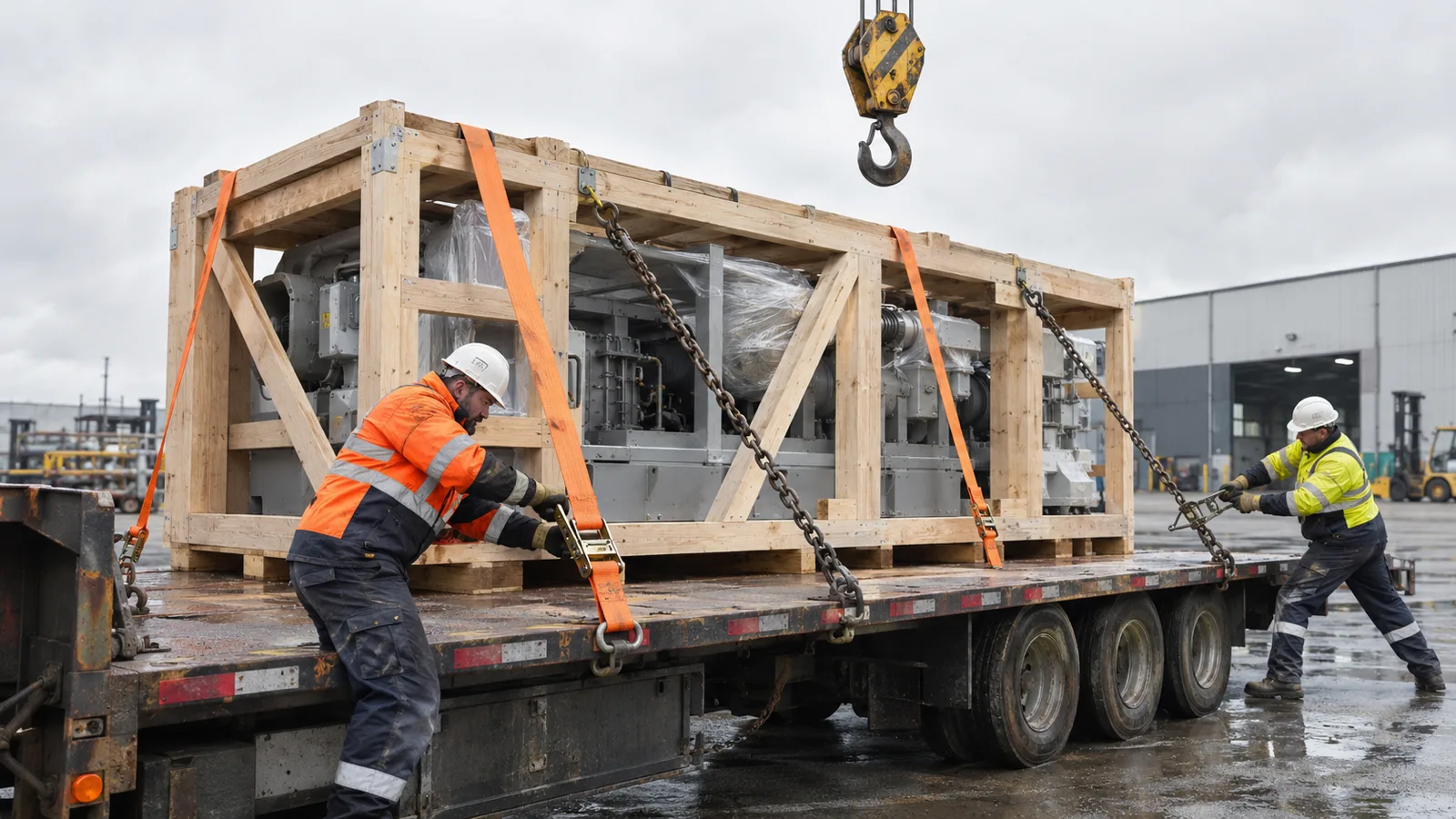
A precision machining shop in Meadowvale has sold one of its older CNC machining centres to a buyer in Quebec and is replacing it with a newer model arriving from Michigan. Both machines weigh several tonnes, neither fits through a standard dock door on a pallet jack, and both have to move within the same week so production does not stop. The owner's first instinct is to call a trucking company. The trucking company's first questions are about weight, dimensions, centre of gravity, lifting points and who is doing the rigging.
Shipping industrial equipment is a different discipline from shipping cartons or even standard pallets. The freight is heavy, often top-heavy, frequently irregular in shape and usually expensive to repair or replace. The move involves several specialists: riggers who lift and position the equipment, crating specialists who protect it, carriers with the right trailers, and sometimes permit and escort services for oversized loads. Coordination between them is where most moves succeed or fail.
Using that Meadowvale scenario as a guide, this article works through each phase of an equipment move from a Mississauga facility, from the initial survey to setting the machine down at its destination.
Phase 1: The survey (do not skip it)
Every good equipment move starts with gathering accurate information. Guesswork here leads to the wrong trailer, the wrong crane, or a machine that will not fit through the door at the other end.
Collect:
- Exact weight, from the manufacturer's documentation or a scale, including any attached tooling, fluids or accessories that will ship with it.
- Dimensions: length, width and height in shipping configuration, after any components are removed.
- Centre of gravity, which is often marked on the machine or in the manual. Machines with heavy heads or columns can be dangerously top-heavy.
- Lifting points designed by the manufacturer, and any shipping brackets or locks needed to immobilize moving parts.
- Site conditions at both ends: door sizes, floor load ratings, overhead clearances, dock heights, whether a forklift or crane can reach the machine, and the route from the machine's position to the truck.
- Disconnection needs: electrical, air, coolant and hydraulic lines, which usually require qualified trades.
In the Meadowvale example, the survey showed the outgoing machine could leave through an overhead door after a rigging crew skated it across the floor, while the incoming machine was slightly taller and needed its top guard removed to clear the door at the receiving end.
Phase 2: Prepare and protect the equipment
Decommissioning
Drain fluids that could leak in transit, secure or remove loose components, lock moving axes and attach the manufacturer's shipping brackets. Photograph the machine from all sides and record its condition. If anything is disassembled, label every part and cable, and bag fasteners with the component they belong to.
Skidding vs crating
Not every machine needs a full crate. The choice depends on the equipment, the distance and the mode:
- Skid only: the machine is bolted to a heavy timber skid that allows forklift handling and spreads the load. Common for robust machinery on dedicated flatbeds over shorter distances.
- Skid plus wrap: adds weather protection, such as heavy shrink wrap or a vapour barrier, to keep road spray and salt off sensitive surfaces. Important in Ontario winters, when highways like the 401 are heavily salted.
- Full crate: an engineered wooden crate around the skidded machine. Recommended for precision equipment, electronics, long-distance moves, LTL shipments where other freight will be nearby, and anything going by ocean or air.
For export, wood packaging generally has to meet the ISPM 15 international standard, which means heat-treated or fumigated wood carrying the official mark. Check the destination country's rules before the crate is built.
Interior protection matters as much as the crate itself. Desiccants and vapour-barrier bags help prevent corrosion. Blocking and bracing keep the machine from shifting inside the crate. Our explainer on dunnage covers the materials used for this.
Phase 3: Choose the right trailer
The trailer is chosen from the survey data, not the other way around. The most common options for industrial equipment are:
- Standard flatbed: a flat deck that allows loading from the sides and top by forklift or crane. Suitable for many machines within legal height limits once loaded.
- Step deck (drop deck): a lower rear deck that gives more vertical clearance for taller equipment while staying within height limits.
- Removable gooseneck (RGN) or lowboy: a very low deck with a detachable front so equipment can be driven or winched on. Used for the tallest and heaviest pieces.
- Enclosed van with air ride: for crated sensitive equipment that can be loaded through the rear doors. Air-ride suspension reduces vibration.
- Conestoga or curtain-side: a flatbed with a sliding tarp system, combining side or overhead loading with weather protection.
Smaller equipment that fits on a standard skid can often travel LTL, although extra care is needed with crating, and many carriers have limits on very heavy single pieces. Larger machines usually move on a dedicated full truckload, which gives you control over pickup and delivery times and avoids terminal handling.
Phase 4: Permits, routes and timing
If the loaded trailer exceeds Ontario's legal dimension or weight limits, the carrier will need an oversize or overweight permit from the Ministry of Transportation of Ontario, and from every other province or state the load travels through. Very large loads may need pilot or escort vehicles, travel-time restrictions (for example, no travel at night or on certain holidays) and specific routes.
Practical points for loads leaving Mississauga:
- Allow time for permits, especially for multi-province or cross-border moves.
- Plan the route out of the industrial park as carefully as the highway route. Tight turns, low wires and narrow driveways in older industrial areas can be harder to navigate than the 401 or 407.
- Be aware that some roads in Ontario have seasonal load restrictions in spring.
- For US-bound equipment, coordinate the crossing at the Peace Bridge, Lewiston-Queenston or the Ambassador Bridge with your customs broker in advance. Oversize loads may have specific crossing times or route requirements.
Phase 5: Rigging and loading
Rigging is the specialized work of lifting, moving and positioning heavy equipment. It should be done by an experienced, insured rigging crew using properly rated equipment: forklifts with sufficient capacity at the required load centre, gantry systems, machine skates, jacks or mobile cranes.
On loading day:
- Hold a short pre-lift meeting with the riggers, the driver and your facility contact. Confirm the lift plan, the exclusion zone and who gives signals.
- Keep non-essential staff well clear of the lift area.
- Position the machine on the trailer so its weight is distributed correctly across axles. The carrier and riggers will usually agree this in advance.
- Secure the load with chains, binders and straps rated for the weight, following Canada's National Safety Code cargo securement standard as adopted by the provinces. Edge protectors stop chains and straps from damaging the machine or crate.
- Tarp or wrap as required for weather protection.
- Inspect and photograph the secured load before the truck leaves. Make sure the bill of lading accurately records the equipment, its weight and its condition.
Phase 6: Delivery and installation
The receiving site needs the same planning as the origin. Confirm that a rigging crew and equipment will be ready when the truck arrives, because waiting time for a specialized trailer is costly. Make sure floor space is cleared, foundations or anchor points are ready, and the trades needed to reconnect utilities are booked.
Inspect the equipment before signing for delivery. Note any visible damage on the delivery receipt and photograph it. Concealed damage found during uncrating should be reported to the carrier quickly. Our article on freight insurance explains why carrier liability alone is rarely enough for high-value machinery.
Cost drivers to expect
Equipment moves are quoted individually, but the main cost drivers are predictable:
- Weight and dimensions, which determine the trailer type and whether permits and escorts are needed.
- Distance and route complexity.
- Rigging requirements at both ends, including crane time.
- Crating materials and labour.
- Insurance for the declared value.
- Waiting time, if either site is not ready when the truck arrives.
- Customs brokerage and documentation for cross-border moves.
The best way to control costs is to plan early, share accurate survey data and keep both sites ready on schedule.
Mississauga's advantage for heavy freight
For heavy freight, Mississauga's industrial base, spread across areas such as Meadowvale, Gateway, Malton and around Pearson, means there is a deep pool of carriers, riggers and crating specialists nearby. Highway access via the 401, 407, 410 and 427 makes it straightforward to reach manufacturers across southern Ontario and the US Midwest, and the QEW gives a direct route toward the Niagara crossings. For businesses in the manufacturing sector, that density shortens lead times for equipment moves.
Plan your next equipment move with ShipCarte
Industrial equipment shipping in Mississauga rewards preparation: the right survey, protection, trailer, permits and rigging plan, all coordinated around your production schedule. ShipCarte works with flatbed, step-deck and specialized carriers through its carrier management service and can help coordinate the pieces around them. Share your equipment details and dates with us through our quote request form, and we will help you plan the move.