
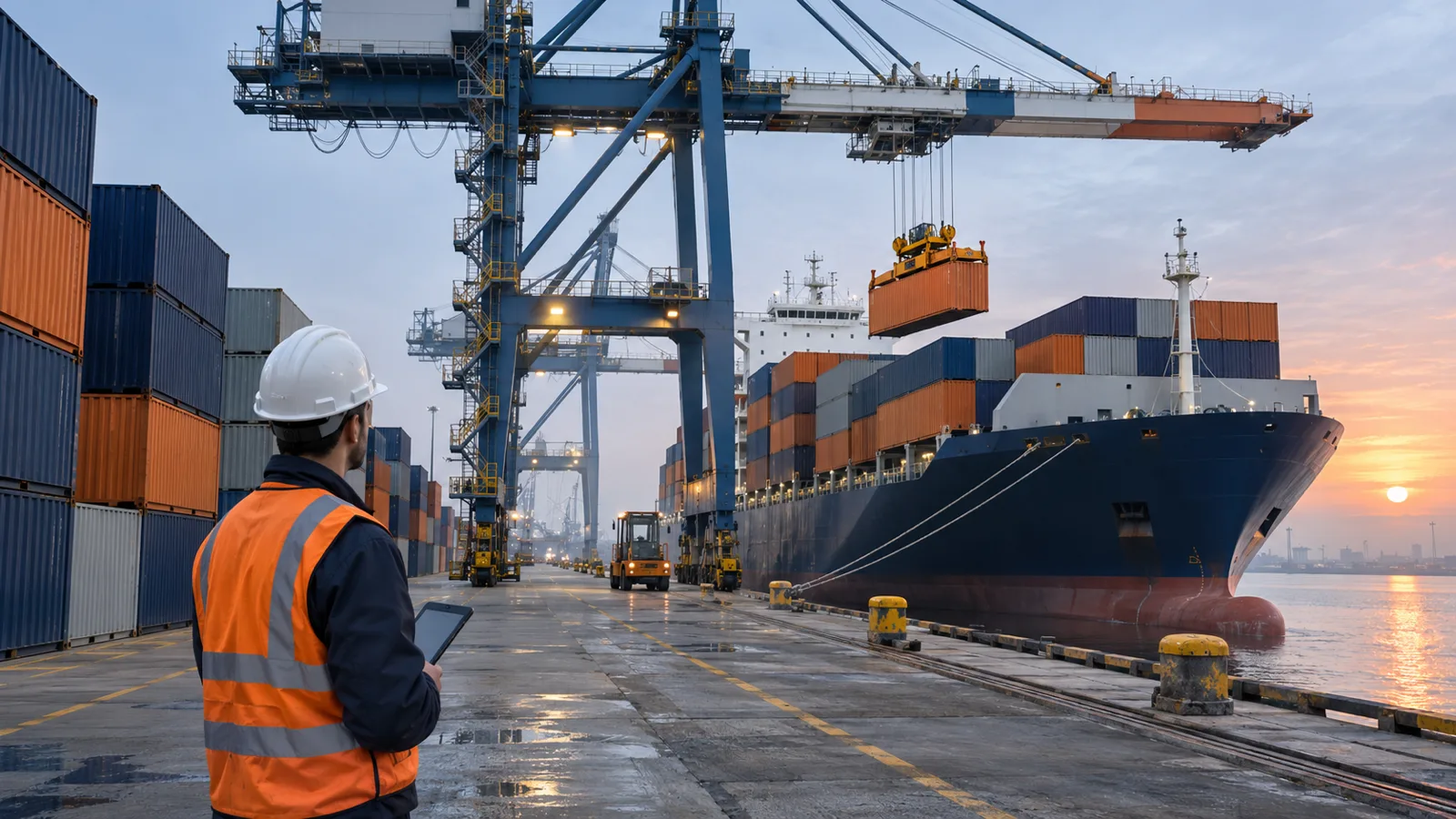
A kitchenware importer in Mississauga signs a purchase order with a factory in Asia. The unit price looks excellent, the supplier offers to "take care of shipping," and the paperwork says CIF Toronto. Six weeks later the container arrives at a rail terminal in the GTA, and the importer discovers a stack of charges nobody budgeted for: terminal handling, destination fees, drayage, customs brokerage, plus duties and GST. The supplier's "free" shipping turned out to cover only part of the journey, and the cheapest quote became an expensive container.
This happens more often than you might think, and it almost always traces back to one line on the purchase order: the Incoterm. These three-letter codes decide who pays for each leg of the journey, who carries the risk if something goes wrong, and who controls the shipment. Choosing well protects your margin. Choosing carelessly hands control of your costs to someone else.
This guide explains the Incoterms that matter most to importers in Mississauga and the wider GTA, and how to pick the right one for your situation.
What Incoterms Are (and Aren't)
Incoterms are standard trade terms published by the International Chamber of Commerce. The current version is Incoterms 2020, which includes eleven terms. Each defines:
- Delivery point. Where the seller's obligation to deliver is fulfilled.
- Transfer of risk. The moment responsibility for loss or damage passes from seller to buyer.
- Allocation of costs. Who pays for export clearance, main carriage, insurance, import clearance and delivery.
Incoterms do not cover everything. They do not set the price, determine when ownership legally transfers, or specify payment terms. Those belong in your sales contract. They also do not replace a customs broker, insurance policy or freight forwarder. They simply set out who is responsible for arranging and paying for them.
Always add the named place and the Incoterms version, for example "FOB Shanghai, Incoterms 2020" or "FCA Seller's Warehouse, Ningbo, Incoterms 2020." A bare "FOB" is an invitation to an argument.
The Terms Importers Use Most
EXW (Ex Works)
Seller's role: Makes goods available at its premises. That is it.
Buyer's role: Everything else, including loading, export clearance in the origin country, main freight, import and delivery.
EXW gives the buyer maximum control but also maximum responsibility. A practical problem is export clearance: as a foreign buyer, you may struggle to handle export formalities in the supplier's country. Many experienced importers prefer FCA instead.
FCA (Free Carrier)
Seller's role: Clears goods for export and hands them to the buyer's carrier at a named place.
Buyer's role: Main freight, insurance, import clearance and delivery.
FCA is often the most balanced choice for containerized freight. The seller handles what it is best placed to do (export paperwork and local handover), and you control the international shipment.
FOB (Free On Board)
Seller's role: Delivers goods loaded on board the vessel at the named port of shipment and clears them for export.
Buyer's role: Ocean freight, insurance, import and delivery.
FOB is the term most importers know, and it remains widely used. Strictly, it is intended for bulk or non-containerized sea freight, because risk transfers when goods are on board the vessel, and with containers the seller loses physical control well before that. FCA addresses this more cleanly, but in practice FOB is still common for container shipments. Our post What Does FOB Mean? covers it in depth.
CFR and CIF (Cost and Freight / Cost, Insurance and Freight)
Seller's role: Pays ocean freight to the named destination port (and, for CIF, minimum insurance).
Buyer's role: Takes on risk once goods are loaded at origin, plus all destination charges, import clearance and delivery.
Here is the trap from our opening example. Under CFR and CIF, the seller pays for freight, but risk passes to you at the origin port. The seller chooses the carrier and route, and destination charges at the arrival port or terminal are often yours. Some sellers offer attractive CIF prices because they select low-cost routings and the buyer absorbs the destination fees. CIF insurance is also only required to be minimum coverage, which may not be enough for your goods.
DAP (Delivered at Place)
Seller's role: Delivers to a named place in Canada, such as your warehouse, ready for unloading.
Buyer's role: Import clearance, duties and taxes, and unloading.
DAP is convenient, but you lose visibility over freight costs, which are bundled into the product price. Learn more in What Does DAP Mean?
DDP (Delivered Duty Paid)
Seller's role: Everything, including Canadian import clearance, duties and taxes.
Buyer's role: Unloading at destination.
DDP sounds ideal for the buyer, but it carries hidden risks. The foreign seller must act as a non-resident importer in Canada, and errors in classification or valuation can come back to affect the shipment. You also have very little visibility into how the goods were declared.
Comparing Control, Cost and Risk
A useful way to think about the terms is as a sliding scale:
- More buyer control, more buyer work: EXW, FCA, FOB. You pick the forwarder, negotiate freight and see every cost.
- Shared: CFR, CIF, CPT, CIP. The seller pays for main carriage but risk transfers early. You lose control of routing and transit time.
- More seller control, less buyer work: DAP, DPU, DDP. Convenient, but costs are hidden in the product price and you depend on the seller's choices.
For importers who bring in regular volumes, gaining control of freight (FCA or FOB) usually pays off. You can negotiate rates directly, consolidate shipments from several suppliers, choose carriers with reliable service into Canada, and time arrivals to suit your warehouse.
How Incoterms Affect Canadian Duty and Taxes
Incoterms do not change Canadian customs rules, but they do affect what you pay and how invoices should be read. In general terms, Canada calculates value for duty based on the transaction value of the goods, with the cost of transporting them to Canada after they leave the place of direct shipment typically excluded. That means a CIF or DDP invoice that bundles international freight into the price may need to be broken down so freight and insurance can be identified. If the invoice does not separate these costs, your duty calculation may be off.
GST, or HST where applicable, is assessed on the duty-paid value of imported goods. Since the rollout of the CBSA Assessment and Revenue Management (CARM) system, importers manage their accounts, financial security and payments through the CARM portal. Your customs broker can explain how your Incoterm and invoice structure affect your entries. For a broader view, see understanding duties and taxes.
Matching the Term to Your Situation
You are a new importer with one supplier and small volumes
DAP to your Mississauga warehouse, or CIF/CFR with a clear understanding of destination charges, can be reasonable while you learn. Ask the supplier exactly which destination charges are included.
You import full containers regularly
FCA or FOB with your own freight forwarder usually gives you better rates and visibility. You can also coordinate arrival timing with your warehouse to avoid demurrage and storage charges at the terminal.
You consolidate from several suppliers in one region
FCA to your forwarder's consolidation warehouse at origin lets you combine smaller orders into one container, often cutting cost per unit.
You need landed-cost certainty
DDP offers a single price, but weigh that against the compliance risk and lack of visibility. Many importers prefer DAP plus their own customs broker, so they keep control of the customs declaration.
Mississauga-Specific Considerations
Most ocean containers bound for the GTA arrive at a West Coast or East Coast port, then move by rail to inland terminals in Brampton or Vaughan before being drayed to warehouses in Mississauga. Air freight lands at Toronto Pearson, right on Mississauga's doorstep. A few things to keep in mind:
- If your term is "CIF Vancouver" or "CFR Montreal," the inland rail and drayage to Mississauga is on you. Budget for it.
- Terminal free time is limited. Containers left too long at rail terminals can incur storage charges. Make sure your warehouse can receive promptly.
- For air freight under FCA or EXW, Pearson-area handling and pickup charges apply. Your forwarder can quote these in advance.
- Transloading near the terminal, where container contents are moved into domestic trailers, can sometimes reduce costs when goods are destined for several locations.
Our post on drayage explains the terminal-to-warehouse leg.
Five Mistakes That Cost Importers Money
- Using a term without a named place. Always specify exactly where delivery happens.
- Assuming CIF means delivered. It does not. Destination charges and inland transport are usually yours.
- Relying on minimum insurance. CIF requires only minimal cover. Buy proper cargo insurance for valuable goods.
- Mixing up risk and cost. Under C-terms, the seller pays freight but you carry the risk in transit.
- Not aligning the term with your payment terms. If you pay before shipment, make sure the risk point and document flow protect you.
From the Port to Your Customers
Your Incoterm determines how goods reach Mississauga, but margin is also shaped by what happens next: receiving, storage, and distribution to customers. Coordinating inbound arrivals with a warehouse that can receive containers promptly reduces terminal fees and keeps stock available. ShipCarte offers distribution warehousing and inventory management for importers across the GTA. Request a quote to discuss how we can receive and distribute your imported goods.