
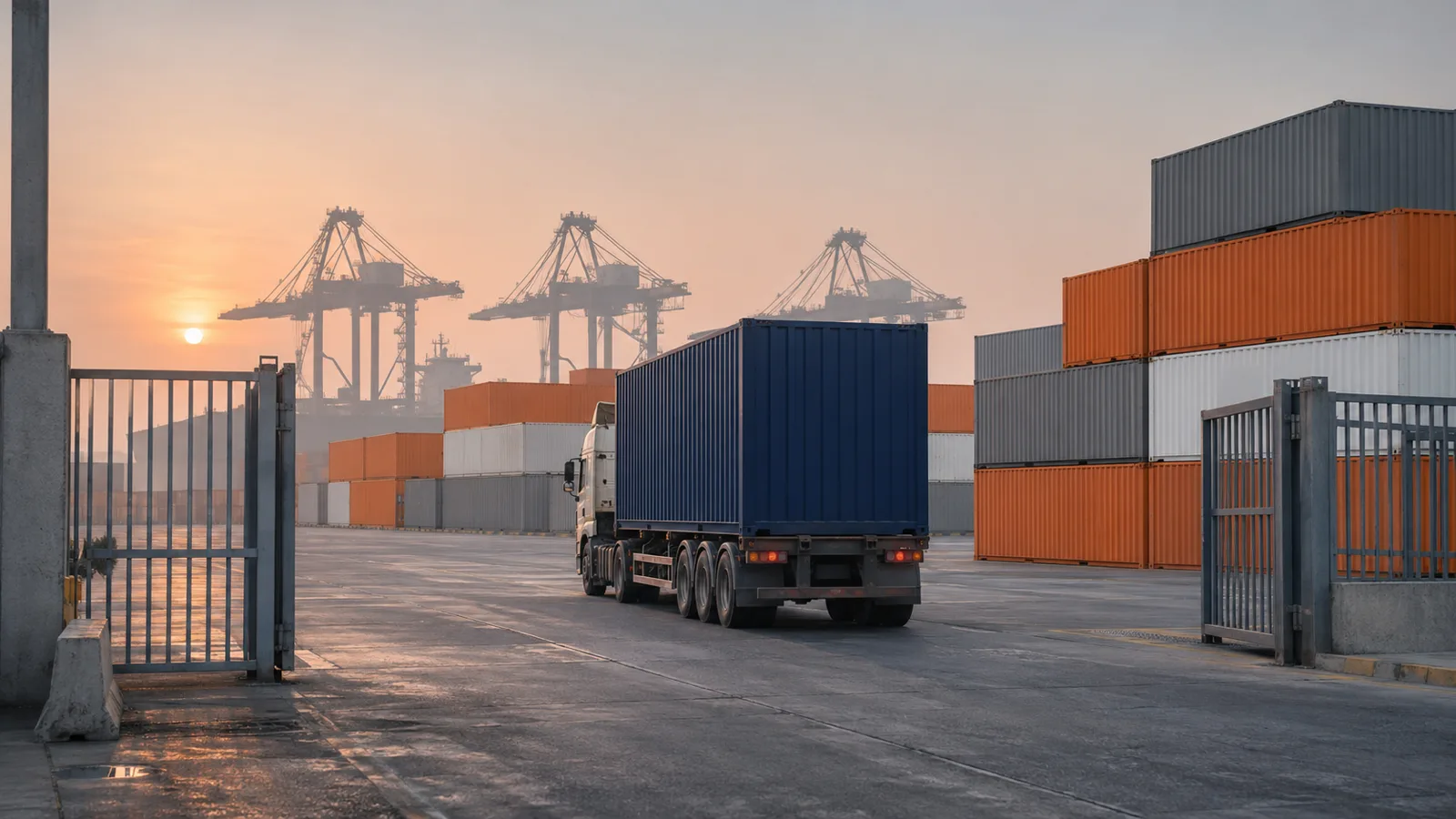
The first time a Mississauga business imports a container from China, the timeline usually looks simple on paper. The factory says production takes a few weeks, the freight forwarder says the ocean crossing takes a few more, and everyone assumes the goods will be on the shelf soon after. Then the container waits for a vessel, sits at a rail terminal longer than planned, gets flagged for an exam, and arrives at the warehouse on a Friday afternoon with no one scheduled to unload it.
Importing from China is entirely manageable, and thousands of Canadian businesses do it every year. But the journey has more handoffs than most people expect: supplier, origin trucker, origin port, ocean carrier, Canadian port, railway, inland terminal, drayage carrier, customs broker, CBSA and finally your warehouse. Each one adds time and a chance for something to slip.
This guide walks through that journey for goods ending up in Mississauga, explains the customs steps under Canada's current system, and offers a realistic way to plan timelines. It does not replace advice from a licensed customs broker, which you should have in place before your first shipment.
Before the first order: set up the basics
A few things need to be in place before goods leave China:
- A business number with an import-export program account from the Canada Revenue Agency. CBSA uses it to identify you as the importer.
- Registration in the CARM Client Portal. Under the CBSA Assessment and Revenue Management (CARM) system, importers register in the portal, manage their accounts, and, if they want goods released before paying duties and taxes, post financial security. Your customs broker can be delegated access to act on your behalf.
- A customs broker. Most importers use a licensed broker to prepare and submit customs declarations, classify goods and advise on compliance.
- Agreed Incoterms. These define where the supplier's responsibility ends and yours begins. FOB (Free on Board) at a Chinese port is common, which means you arrange and pay for the main ocean freight. Our explainer on what FOB means covers the details, and the guide to DDP explains the opposite approach.
- Product classification. Each product needs a Harmonized System (HS) tariff classification, which determines the duty rate. Getting this right before ordering helps you calculate landed cost accurately.
Choosing the mode: ocean, air or a mix
Ocean freight via the West Coast
Most China-to-Ontario containers sail to Vancouver or Prince Rupert, then travel east by rail to intermodal terminals in the GTA, including terminals in Brampton and Vaughan that are a short drive from Mississauga. This is usually the fastest ocean route to Ontario. A full container load (FCL) is typically the most economical way to move large volumes. If you do not have enough goods to fill a container, less-than-container load (LCL) consolidates your cargo with other shippers' goods, at the cost of extra handling and usually some extra time at each end for consolidation and deconsolidation.
Ocean freight via the East Coast
Some services route through the Suez Canal or Panama Canal to Montreal or Halifax, or to US East Coast ports. These sailings are longer but can make sense depending on origin port, carrier availability and rates at the time. Global disruptions to canal routes have changed these options in recent years, so ask your forwarder what is running reliably.
Air freight
Air cargo lands at Toronto Pearson International Airport, right on Mississauga's doorstep. It is much faster than ocean and much more expensive per kilogram, so it is typically used for urgent restocks, high-value small items or product samples. Many importers use a split strategy: the bulk of an order by sea, with a small portion by air to cover the gap.
Express couriers
For small parcels and samples, express couriers handle transport and customs clearance in one service. Convenient, but costly at volume.
A realistic timeline, stage by stage
Rather than quoting a single number, it is more useful to plan each stage separately and add buffer. Durations below are typical ranges for ocean freight via the West Coast and can vary widely with season, carrier and port conditions.
- Production: depends entirely on the supplier and product. Confirm in writing, and expect delays around Chinese New Year, when many factories close for an extended period.
- Origin trucking and port handling: often a week or so from cargo-ready date to vessel departure, including export customs and waiting for the booked sailing.
- Ocean transit to the West Coast: commonly a few weeks, depending on the origin port and service.
- Port discharge and rail transfer: can range from a few days to longer during congestion or labour disruptions.
- Rail to the GTA: generally several days.
- Terminal dwell and drayage: a container may wait at the inland terminal before a drayage carrier picks it up and delivers it to your warehouse. Free time at the terminal is limited, and storage charges apply after that.
- Unloading and receiving: once at the warehouse, a floor-loaded container takes hours to unload and count, plus time to put away.
Add those up and the door-to-door journey commonly runs well over a month, sometimes much longer. Build your reorder points around the longer end, not the best case. Our drayage explainer covers the short-haul leg from terminal to warehouse in more detail.
How customs clearance works in Canada
Your broker typically submits customs data electronically before the goods arrive, using the commercial invoice, packing list and bill of lading from the shipment. CBSA reviews the information and either releases the goods or flags them for examination. Most shipments are released without inspection, but exams do happen, and they add time and cost.
Under CARM, importers are responsible for accounting for their goods and paying duties and taxes owed. If you have posted financial security through the CARM Client Portal (directly or through your broker's arrangements, depending on how your account is set up), goods can be released before payment, with payment due later on a statement cycle. Without security, duties and taxes generally need to be paid before release. Talk through these options with your broker well before your first shipment.
What you will pay
- Customs duties based on the HS classification and the country of origin. Goods from China do not qualify for CUSMA preferential rates, which apply to qualifying goods from the US and Mexico.
- Additional measures such as surtaxes, anti-dumping or countervailing duties on specific products. Canada has applied measures to certain Chinese-origin goods, and these change, so check current rules for your products with your broker.
- GST (and in some cases other taxes) on the value of imported goods, which registered businesses can generally recover as input tax credits.
- Brokerage fees charged by your customs broker.
Factor all of these into your landed cost, along with freight and insurance. Our guide to calculating landed cost per unit shows how to put it together.
Other government requirements
Some products need more than customs clearance. Food products fall under the Canadian Food Inspection Agency, health products and medical devices under Health Canada, and consumer products under the Canada Consumer Product Safety Act. Prepackaged consumer goods generally need bilingual labelling under the Consumer Packaging and Labelling Act. Items containing lithium batteries or other dangerous goods need proper classification and documentation for transport. Ask your supplier to meet Canadian labelling rules at the factory; relabelling in Canada is possible but adds cost and time.
Where imports go wrong (and how to avoid it)
- Vague commercial invoices. "Parts" or "accessories" is not a description. Detailed product descriptions, materials and values help prevent holds.
- Undervaluation. Declaring a lower value than paid is illegal and risky. CBSA can reassess and penalize.
- No plan for container arrival. If the warehouse is not expecting a floor-loaded container, it may sit on the chassis, accruing charges.
- Ignoring free time. Terminal storage and equipment charges can climb if a container is not picked up and returned promptly.
- Poor packing at origin. Cartons that are too weak, unlabelled or mixed make receiving slow. Send clear carton marking instructions to your supplier.
If a shipment is ever detained, our article on what happens when customs seizes merchandise explains the next steps.
Receiving in Mississauga
When your container finally reaches the warehouse, the receiving process determines how fast inventory becomes sellable. Unloading floor-loaded cartons, palletizing, counting against the packing list, checking for damage and putting stock into locations all take labour and planning. Pre-sending your packing list and carton details to your warehouse lets them schedule the right crew and system setup.
Mississauga is a natural landing point for China imports bound for Canadian customers. The intermodal terminals in Brampton and Vaughan are close, Toronto Pearson handles air cargo, and the 401, 407, 410 and 427 make onward distribution to the rest of Ontario and Quebec straightforward. ShipCarte's distribution warehousing receives containers and holds inventory, and our distribution services move it on to retailers and customers. If you sell on Amazon, FBA prep can get inbound goods ready for fulfillment centres without another warehouse stop.
Plan your next import with ShipCarte
Importing from China gets easier with each shipment, especially when your warehouse knows what is coming and when. If you want a partner in Mississauga to receive containers, manage inventory and ship to your customers, request a quote or schedule a consultation and tell us about your products, volumes and current supply chain.