
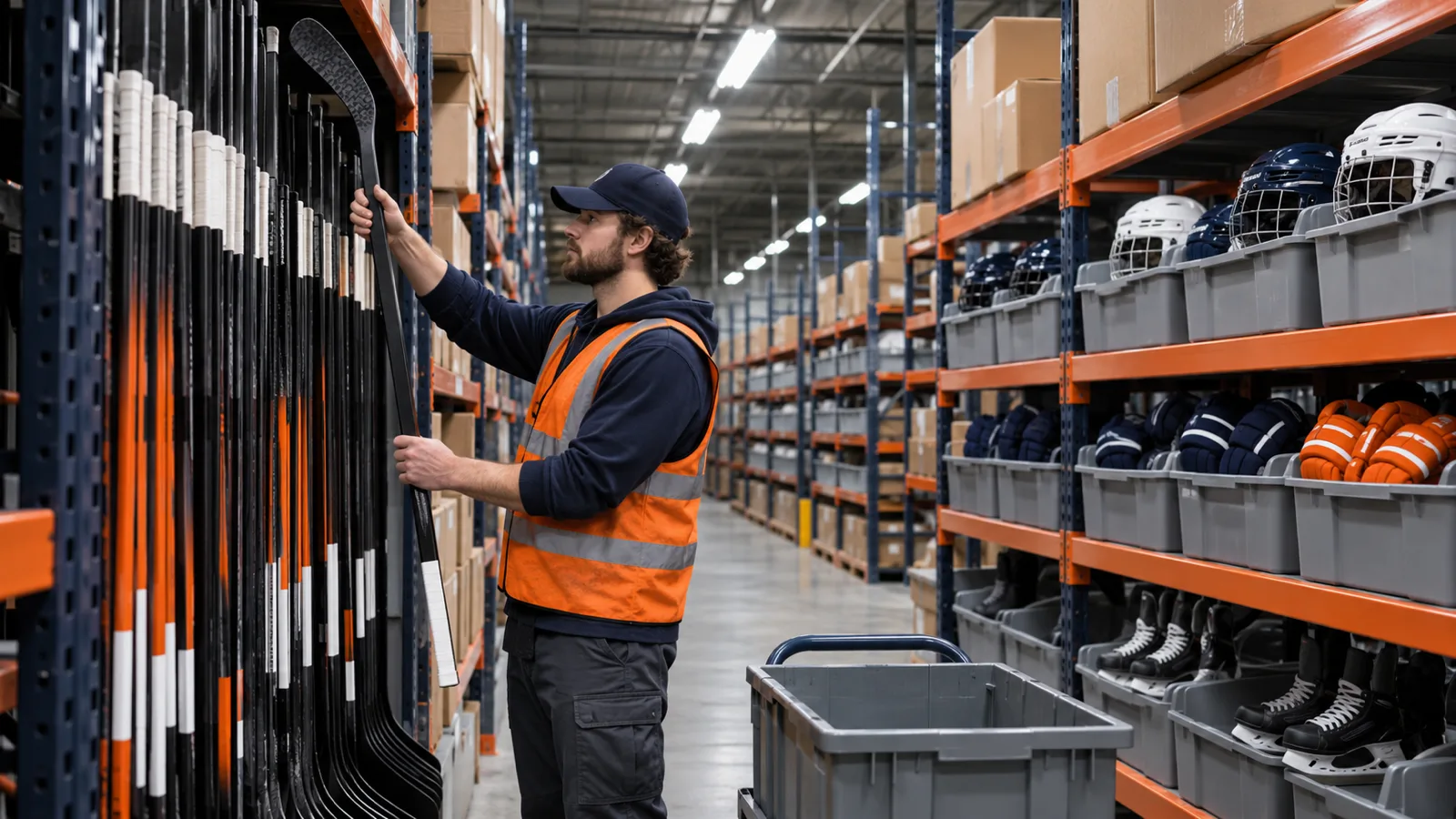
Every August, a parent somewhere in Canada realises that last year's skates no longer fit, that the helmet's certification sticker is out of date, and that tryouts start in nine days. They search, they order, and they expect the box at the door before the first ice time. Multiply that by hundreds of thousands of families from Kamloops to Corner Brook and you have the defining rhythm of hockey retail: long quiet stretches punctuated by sharp, deadline-driven spikes.
For brands and retailers selling hockey equipment online, fulfillment is not just about picking and packing. It is about having the right sizes in stock when registration opens, getting sticks across the country without snapping a blade, handling a steady flow of exchanges for skates and gloves that did not fit, and then doing it all again in December when hockey gear becomes one of the most popular holiday gifts in the country.
This article walks through the hockey year from a fulfillment point of view, with practical advice for each stage, and then answers some common questions we hear from equipment sellers.
The hockey year, seen from the warehouse
Spring: clearance and quiet planning (April to June)
Once minor hockey seasons end, demand for full kits drops. Spring is when retailers clear out last season's models, run sales on discontinued stick curves and colours, and process supplier orders for the coming year. For the warehouse, the priorities are consolidation and accuracy. Slow-moving stock should be gathered into fewer locations, damaged returns resolved, and a full cycle count completed so that the autumn forecast starts from real numbers.
Spring and summer hockey programs, power skating schools and goaltender camps create a smaller but real stream of orders, especially for skates, sticks and goalie gear. Keep enough of the core sizes on hand that these customers are not disappointed.
Summer: inbound season (July to August)
New model-year equipment typically arrives over the summer. Ocean containers land at the Port of Vancouver or Montreal and move inland by rail or truck, while some goods cross from the US. This is the most important stage to get right, because receiving errors made in July show up as cancelled orders in September.
- Check that every size and handedness variant has its own SKU and barcode. Left and right sticks in the same curve and flex are different products, and mixing them is one of the most common errors in hockey fulfillment.
- Receive against the purchase order and record discrepancies immediately rather than after the rush starts.
- Put fast-moving sizes (common youth and adult skate sizes, intermediate and senior sticks in popular curves) in the most accessible pick locations.
- Set aside space for bulky goalie pads and bags, which take up far more room than their unit count suggests.
Registration and tryouts (late August to October)
This is the main event. Orders arrive with urgency, many are full or partial kits for growing kids, and customers have a specific date in mind. Speed of fulfillment matters more now than at any other time. Same-day or next-day dispatch, accurate delivery estimates by province, and expedited options at checkout all help.
Team orders also land at this time of year. A club ordering matching gloves, pants or bags for an entire roster is a different job from a single parent buying a helmet. Team orders may need to be kitted, labelled by player, and shipped to a single address in one consolidated shipment, sometimes on a pallet. A partner with kitting and assembly capability can handle that without disrupting the regular parcel flow.
Holiday peak (November to December)
Hockey gear is a classic holiday gift: sticks, skates, jerseys, training aids and gift cards all spike. The difference from the autumn peak is that holiday buyers are often not the player, so they are more likely to guess sizes, which means more exchanges in January. They are also shopping into a period when carriers in Canada are at capacity and winter weather affects transit, especially on routes through the Rockies, Northern Ontario and the Maritimes. Publish clear order-by dates for each region and stick to them.
January to March: exchanges and the playoff tail
The new year brings a wave of size exchanges and returns from holiday gifts, followed by a steadier flow of replacement purchases (broken sticks, worn skate blades, lost gloves) through the rest of the season. Exchanges are the priority here: the faster you can get the right size back to the customer, the more likely they are to buy from you again next autumn.
Packing hockey gear without damage or overpaying
Hockey equipment is not especially fragile, but it is awkwardly shaped, and that has real cost implications.
- Sticks: a senior stick is long enough to reach the length thresholds where Canadian carriers add extra handling fees. Ship sticks in sturdy, long corrugated boxes with the blade protected, and avoid putting heavy items in the same box. When a customer buys a stick and a bag, consider whether two packages are cheaper than one oversize box.
- Skates: skates ship in their retail box, but the blades and boot can be scuffed or the box crushed. An outer shipping carton keeps the retail box presentable, which matters for gifts and for resale of returns.
- Helmets: helmets should arrive undamaged and unworn, and many are sold with a certification sticker. Never ship a helmet without enough cushioning, and treat a returned helmet with visible impact damage as non-resaleable.
- Protective gear and bags: shoulder pads, pants and hockey bags are light but bulky, so dimensional weight drives the cost. Compress where you can and choose box sizes that match the product rather than defaulting to the largest carton.
- Goalie equipment: pads, blockers and chest protectors are large and expensive. They deserve extra protection and often justify signature-required delivery.
A warehouse system with cartonization logic can suggest the right box for each order based on item dimensions, which cuts both damage and dimensional weight charges on the multi-item kits that dominate autumn orders.
Stock placement across a big country
Hockey is played everywhere in Canada, but a long stick box shipped from Central Canada to the Lower Mainland or to Newfoundland takes several days by ground and costs noticeably more than a regional delivery. During the registration rush, that delay can mean a lost sale to a local shop.
Retailers with enough volume often split inventory between a Central Canada location (the Greater Toronto Area or Montreal) and a Western location (around Calgary, Edmonton or Vancouver). The Central site serves Ontario, Quebec and the Atlantic provinces; the Western site serves the Prairies, British Columbia and the territories. Even a partial split, where only the top sizes and models are stocked in the West, can bring most western orders within a shorter ground transit time.
The trade-off is that more locations mean more inventory overall and a greater chance of having the right size in the wrong place. Real-time inventory visibility across locations, along with order routing that picks the closest site with stock, is what makes a split network work.
Exchanges: the hidden workload
Sizing in hockey is personal. Skate fit varies by brand and model, glove and pant sizes vary by manufacturer, and kids grow during the season. Exchanges are inevitable, and how you handle them shapes your customer relationships.
- Make exchanges easy to start. A self-service portal where customers choose the new size and print a label saves your support team time.
- Ship the replacement early where you can. For trusted customers or lower-risk items, sending the new size as soon as the return is scanned by the carrier can make the difference between a happy family and a missed game.
- Inspect returns carefully. Skates that have been baked or sharpened, sticks that have been cut or taped, and helmets with impact marks should not go back to sellable stock.
- Restock fast. During the autumn rush, returned skates in common sizes are valuable inventory. Inspecting and restocking within a day or two keeps them available for the next customer.
A dedicated returns management process with clear grading rules turns this workload into a manageable routine rather than a pile of boxes in a corner.
Bilingual packaging and product information
Hockey is huge in Quebec, and equipment sold to consumers in Canada falls under the Consumer Packaging and Labelling Act, which generally requires mandatory label information in both English and French. Most major brands handle this on their retail packaging, but private-label products, accessories and custom team items need attention. Inserts, sizing guides and return instructions in both languages are also good practice for customers nationwide.
A note on this unusual season
The pandemic has disrupted organised hockey this year, with many leagues delaying or modifying their seasons and provincial rules on group activities changing frequently. At the same time, many retailers have reported strong interest in skates and outdoor rink equipment as families look for ways to stay active. That uncertainty makes forecasting harder than usual, so keep purchase orders flexible where suppliers allow, avoid over-committing to slow-moving goalie and team gear, and monitor sell-through weekly rather than monthly.
Frequently asked questions
Should I ship sticks by courier or freight?
For individual consumer orders, courier or postal service is almost always the right choice, provided you use a proper stick box. For team orders or shipments to retail partners, a bundle of sticks on a pallet sent by LTL freight is often far cheaper than many individual parcels.
How early should stock arrive before tryouts?
Aim to have inventory received, counted and pickable before registration and tryout dates in your strongest markets. If your stock is moving by sea and then across the country by rail, build in a buffer for port and rail delays, which can stretch transit by days or weeks at busy times.
Can a 3PL handle both consumer orders and team orders?
Yes, if the provider has both pick and pack services for single orders and the space and labour for larger, kitted orders. Ask how they prioritise the two during the autumn rush.
What about shipping to the United States?
Many Canadian hockey brands sell into northern US states. Shipping south requires commercial invoices, accurate product descriptions and harmonized codes. Our article on duties and taxes in cross-border ecommerce covers the basics.
Get ready for the next puck drop
ShipCarte supports ecommerce and retail brands across Canada with warehousing, fulfillment, returns and multi-carrier shipping, so your stick, skate and helmet orders move on time through every peak of the hockey year. Schedule a consultation to talk through your season calendar and where your customers are.