
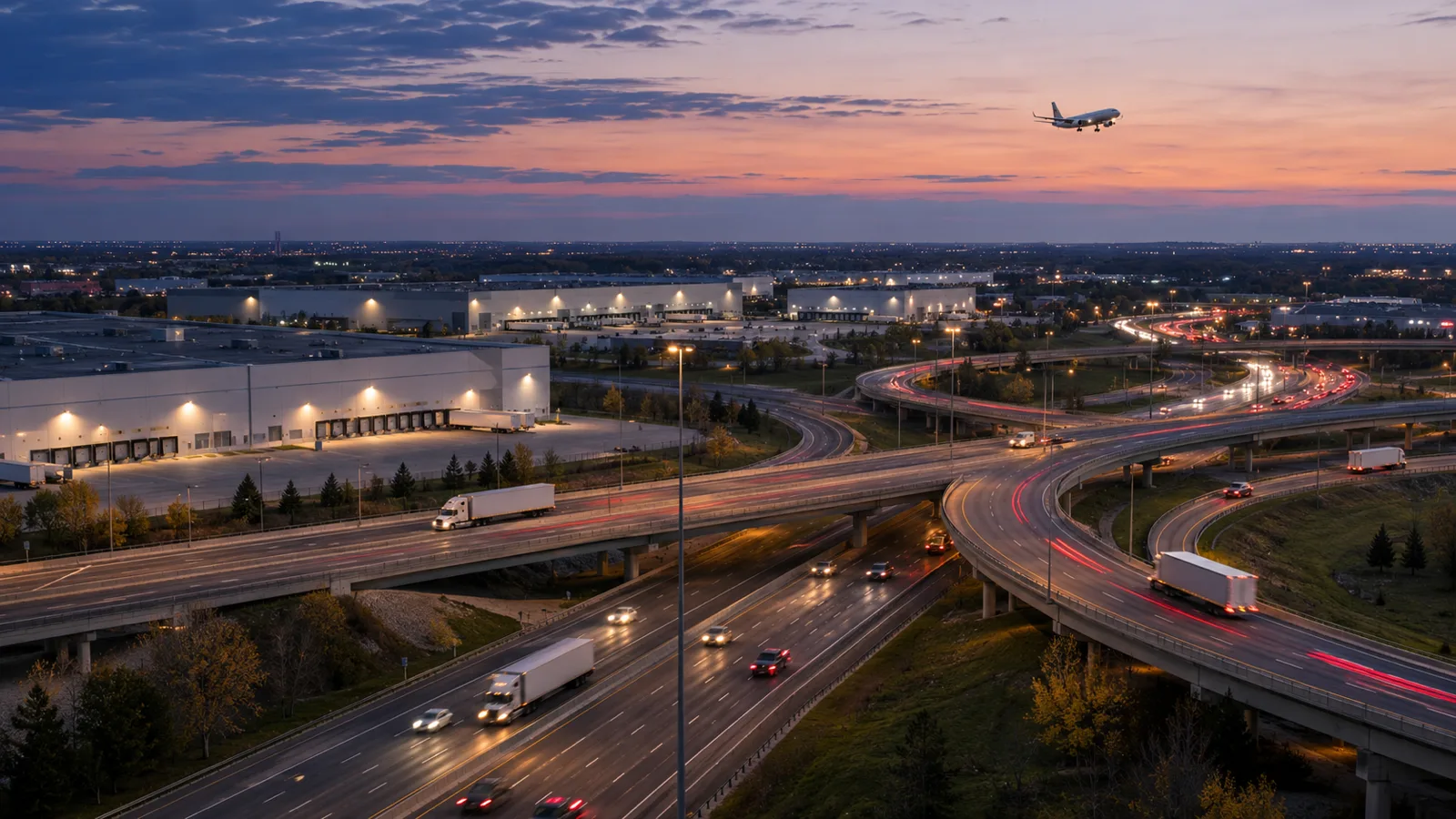
Ask a dispatcher in Mississauga what time a truck will reach a customer in Vaughan, and the honest answer is usually "it depends when it leaves." Leave at 5:30 a.m. and the run up Highway 427 and across the 407 can be quick and predictable. Leave at 7:45 a.m. on a weekday and the same trip may take far longer, with every minute of delay rolling into the next stop. For businesses shipping from Mississauga, the highway network is both the city's greatest logistics advantage and the thing that most often wrecks a delivery schedule.
Mississauga sits at the centre of one of the densest highway networks in Canada. Highway 401, the country's busiest highway, runs through the north end of the city. Highway 403 cuts across the middle toward Hamilton. Highway 407 ETR runs along the northern edge. Highway 410 heads north into Brampton, Highway 427 runs along the eastern boundary toward Toronto, and the QEW hugs the lakeshore toward Niagara and the US border. Few locations in Ontario offer so many route choices within a few kilometres.
This guide looks at each corridor from a shipper's point of view: what it connects, when it tends to work well and what to watch for. Then it covers how to turn that knowledge into better routing, pickup windows and customer promises.
Highway 401: The Backbone
The 401 runs from Windsor to the Quebec border, so it is the main route for freight heading to Montreal, Ottawa and Eastern Ontario, as well as west toward London and Windsor. In Mississauga, it passes close to major industrial areas including Gateway, Meadowvale and the Airport Corporate Centre, and links to the 403, 410 and 427 at large interchanges.
What it is good for: long-haul freight, LTL shipments heading east or west, and connections to carrier terminals throughout the GTA.
What to watch: the stretch through Mississauga and into Toronto sees heavy congestion during weekday peaks, and collisions can cause long delays with few alternatives once you are committed. Winter weather also affects travel times. Departures timed before or after peak periods tend to be more reliable.
Highway 407 ETR: The Paid Bypass
The 407 ETR is an electronic toll highway that runs across the northern GTA from Burlington to Pickering, with Highway 407 East continuing further. For trucks, tolls can be significant, but the route often offers much more predictable travel times than the 401.
What it is good for: time-sensitive deliveries across the northern GTA, especially to Vaughan, Richmond Hill, Markham and York Region, and bypassing 401 congestion when a delivery appointment is at risk.
What to watch: toll costs vary by time of day, vehicle class and distance, and they add up quickly for daily runs. Whether the 407 is worth it depends on the value of the time saved. Many shippers use it selectively for urgent or appointment-bound loads rather than for every trip.
Highway 403: The Diagonal Connector
The 403 runs from the 401/410 interchange area southwest through central Mississauga, passing near the City Centre and Square One, then continues toward Oakville, Burlington and Hamilton, where it links to routes west to Brantford and Woodstock.
What it is good for: deliveries to Hamilton, the Niagara peninsula via connections to the QEW, and Southwestern Ontario. It also serves businesses located along Hurontario Street and in central Mississauga.
What to watch: the section between the 401 and the Hurontario area can be slow at peak times, and merges near the QEW in Oakville and Burlington are frequent congestion points.
Highway 410: North to Brampton
The 410 runs north from the 401/403 area into Brampton and beyond toward Caledon. Brampton is home to many large distribution centres and manufacturing facilities, as well as rail intermodal facilities in the area.
What it is good for: short-haul shuttles between local warehouses and Brampton facilities, retail distribution centre deliveries, and container moves to and from rail terminals.
What to watch: traffic at the 401 interchange and through central Brampton can slow short trips that look easy on a map.
Highway 427: East to Toronto and the Airport
The 427 runs along the eastern edge of Mississauga, past Toronto Pearson, connecting the QEW and Gardiner Expressway in the south with the 401 and 407 in the north, and continuing up into Vaughan.
What it is good for: access to Toronto Pearson's air cargo facilities, deliveries into Etobicoke and the west end of Toronto, and connections north to Vaughan's industrial areas.
What to watch: the stretch near the airport and the 401 interchange can be busy, particularly at rush hour.
The QEW: Lakeshore Route to the Border
The Queen Elizabeth Way runs along Lake Ontario from Toronto through southern Mississauga, Oakville, Burlington, Hamilton and St. Catharines to Fort Erie. For cross-border freight, it is the main route to the Peace Bridge in Fort Erie and, via connecting highways, the Lewiston-Queenston Bridge in Niagara.
What it is good for: US-bound freight heading to New York State and beyond, deliveries to Niagara Region, and access for businesses in the south end of Mississauga near Port Credit and Lakeview.
What to watch: the Burlington Skyway and Hamilton area can slow traffic, and summer weekend traffic toward Niagara adds congestion. Border wait times are a separate factor; checking posted wait times before dispatch helps.
For shipments heading west into Michigan and the Midwest, the 401 to Windsor and the Ambassador Bridge or Blue Water Bridge are the usual routes. Our cross-border shipping team routes freight across these crossings regularly.
Turning Highway Knowledge Into Better Shipping
Knowing the network is useful only if it changes how you operate. Here are practical ways local shippers use it.
1. Set pickup windows around traffic, not just around production
If your carrier picks up LTL freight at 4 p.m., the truck is heading back to the terminal during the afternoon peak. Earlier pickups can sometimes make an earlier linehaul departure. Discuss with your carriers when pickups actually help their schedules.
2. Plan delivery appointments with realistic buffers
Retail and grocery distribution centres often enforce strict appointment windows. Planning a delivery to a Brampton or Vaughan DC at 8 a.m. from a Mississauga warehouse may look easy, but rush-hour congestion can make it tight. Building buffers or choosing off-peak slots reduces the risk of missed appointments. For more on appointments, see what a delivery appointment is in freight.
3. Decide when tolls are worth it
Rather than avoiding the 407 entirely or using it for everything, set a simple rule: for example, use it for appointment-bound loads when the 401 is congested. The cost of a missed appointment, including rescheduling fees, detention and an unhappy customer, can exceed the toll.
4. Match warehouse location to your customer map
If most of your freight goes to York Region, a warehouse near the 407 makes sense. If it goes to the US via Niagara, proximity to the QEW and 403 matters. If you ship heavily by air, being near the 427 and Pearson helps. When evaluating a 3PL or a distribution warehouse, map their location against your actual shipping lanes. Our article on why businesses need warehousing and distribution services covers other location factors.
5. Consolidate local deliveries
Instead of sending several small shipments across the GTA each day, consolidating them into scheduled routes can reduce costs and the number of trips through congestion. Our distribution services are designed for this kind of regional delivery.
6. Communicate realistic transit times to customers
A shipper based here can usually reach most of the GTA within a day by road, but "usually" is not a promise. Set customer expectations that account for traffic and weather, and update them proactively when delays happen. Live tracking helps; customers can follow their shipment with our tracking tool.
Don't Forget the Last Few Kilometres
Highways get a truck most of the way, but arterial roads finish the job. In Mississauga, roads such as Dixie Road, Airport Road, Derry Road, Britannia Road, Mavis Road and Hurontario Street carry heavy truck traffic between the highways and industrial parks. Hurontario Street has also been affected by construction of the Hazel McCallion LRT line, which has changed lane layouts and turning options along parts of the corridor. A route that saves time on the 401 can lose it again on a congested arterial, so dispatchers should look at the full door-to-door path, not just the highway segment.
Seasonal and Weather Considerations
Ontario winters bring snow, freezing rain and reduced visibility that can slow every highway in the network. Allow extra transit time from December through March, and be ready for closures after major collisions. Summer brings construction projects and lane closures. Ontario's 511 service publishes traffic and road condition information that dispatchers can check before trucks leave.
How Highway Access Supports Different Shipment Types
- Parcel shipping: fast injection into courier sortation facilities around Peel Region and the wider GTA.
- LTL freight: short drays to carrier terminals clustered near the 401, 407 and 410.
- Full truckload: direct access to long-haul corridors east, west and south to the US.
- Air freight: quick connections to Toronto Pearson via the 427, 401 and 409.
- Intermodal: drayage to rail terminals in Brampton and Vaughan.
Put Mississauga's Highways to Work for You
Highway access is one of the main reasons so many businesses choose Mississauga for warehousing and distribution. Using it well means planning around peaks, choosing the right corridor and setting realistic promises. ShipCarte helps shippers plan routes, book LTL and truckload freight and manage regional distribution from Mississauga. Request a quote for your next shipment, or talk to our team about your lanes.