
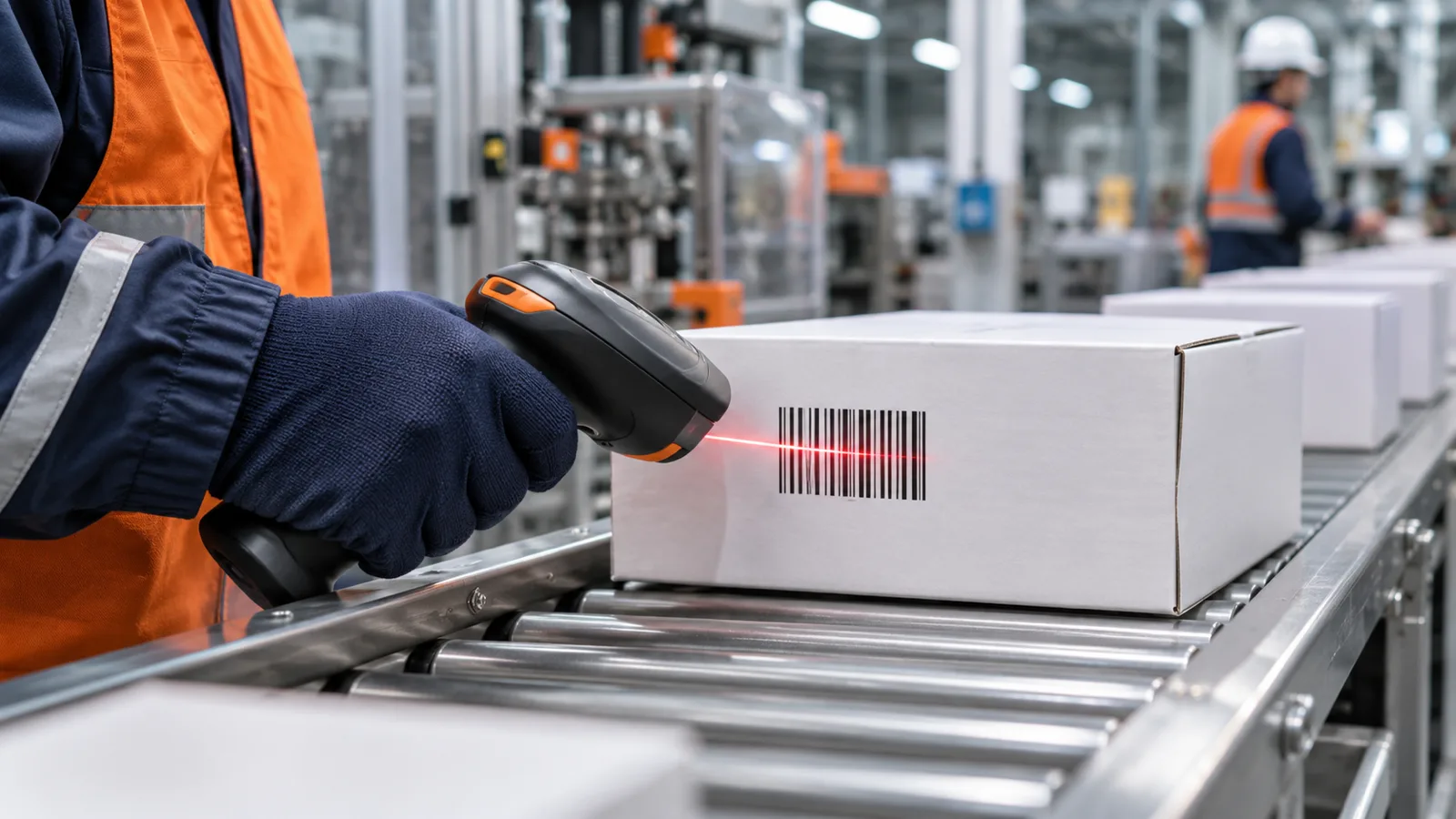
A natural snack maker in Saskatoon has spent a year perfecting its recipe and packaging. A regional grocer agrees to stock it, and the buyer asks for the product's GTINs and case codes. The founder had bought a batch of inexpensive UPC numbers online when the packaging was first designed. The grocer's system flags them: they are registered to a different company. The packaging, already printed in the thousands, has to be relabelled or reprinted before the first order can ship.
Barcodes look like a small detail until they stop a deal. For any product sold through retailers, grocers, pharmacies or major online marketplaces in Canada, the numbers behind the bars need to come from GS1, the global standards organisation that issues them, and they need to be printed and placed so scanners can read them reliably at every step from the warehouse to the checkout.
This guide explains how GS1 barcodes work in Canada, what retailers and marketplaces expect, and the common mistakes that lead to rejected listings, relabelling costs and chargebacks.
What GS1 Is and Why It Matters
GS1 is a not-for-profit organisation that maintains the most widely used supply chain standards in the world, including the barcodes found on retail products. It operates through member organisations in many countries. GS1 Canada is the member organisation for Canadian businesses: it licenses company prefixes, provides tools for creating product numbers, and offers related services such as product data and image registries used by many Canadian retailers.
The key idea is uniqueness. A GS1 barcode number identifies one specific product from one specific brand owner, anywhere in the world. Retailers rely on that uniqueness to manage inventory, pricing and ordering, which is why they want to know the number was issued to you.
The Numbers Behind the Bars
Company prefix
When you join GS1 Canada, you receive a company prefix: a unique string of digits that becomes the start of every product number you create. The length of the prefix determines how many product numbers you can assign. Annual fees are generally based on factors such as company revenue and the number of codes needed; check GS1 Canada's current fee schedule for details.
GTIN: the Global Trade Item Number
A GTIN is the number that identifies a trade item. You build it from your company prefix, an item reference you choose, and a check digit calculated from the other digits. The common formats are:
- GTIN-12, encoded in a UPC-A barcode, widely used in North America on consumer products.
- GTIN-13, encoded in an EAN-13 barcode, common internationally and accepted by most North American scanners.
- GTIN-14, often encoded in an ITF-14 barcode, used to identify cases and other packaging levels that are not sold at the till.
SSCC: the Serial Shipping Container Code
An SSCC identifies a specific logistics unit, such as a pallet or a shipping carton, rather than a product. It is encoded in a GS1-128 label and is central to the advance ship notices that retailers require. Our article on EDI compliance for suppliers explains how SSCC labels and ASNs work together.
Getting Your First GS1 Barcodes: Step by Step
- Count your products and variations. Every distinct sellable item needs its own GTIN. That includes each size, flavour, colour and pack count. A 250 g and a 500 g bag of the same coffee are two products; so are a single bar and a six-pack of bars.
- Plan your packaging hierarchy. If you sell cases or inner packs to retailers, each of those levels needs its own GTIN too.
- Join GS1 Canada and choose a membership level that gives you enough numbers for current products plus room to grow.
- Assign GTINs to each product using GS1's tools or your own system. Keep a master list linking each GTIN to its product description, size and packaging level.
- Create barcode artwork using barcode software or a designer who understands GS1 specifications. The symbol has rules for size, quiet zones (blank margins) and human-readable digits.
- Place barcodes correctly on packaging. GS1 publishes placement guidelines; generally, the consumer barcode goes on the back or bottom of the package, away from folds, seams and curved edges.
- Verify before printing in volume. Have proofs checked with a barcode verifier, which grades print quality, not just whether a phone app can read it.
- Share product data with retailers through the channels they require, which may include GS1 Canada's product data registry for many grocery and health and beauty retailers.
Why Resold Barcode Numbers Cause Problems
Websites selling cheap UPC numbers are easy to find. These numbers were often originally licensed to another company years ago. They may scan, but if a retailer or marketplace checks the GS1 database, the number will not be linked to your company. Many major retailers will not accept them, and large marketplaces have increasingly checked GTINs against GS1 records when sellers create new listings. If you plan to sell beyond your own website and farmers' markets, licensing your own prefix from GS1 Canada is the reliable route.
Print Quality and Design Rules That Trip People Up
- Colour: dark bars on a light background scan best. Black on white is safest. Red bars, or bars on a red or dark background, often fail because many scanners use red light.
- Size: shrinking a barcode to fit the design, or cropping its height, reduces readability. Stay within the allowed magnification range.
- Quiet zones: the blank space on either side of the bars is part of the symbol. Text or graphics too close to the bars can cause failures.
- Surface: glossy film, shrink sleeves and curved bottles distort bars. Test on the actual packaging material.
- Labels over labels: covering an old barcode with a sticker that does not fully hide it can lead to the wrong code being scanned.
Barcodes and Canadian Packaging Requirements
Barcodes sit alongside other mandatory label information. Prepackaged consumer products sold in Canada generally need bilingual labelling under the Consumer Packaging and Labelling Act, with additional rules for food under the Food and Drugs Act and CFIA requirements, and for textiles under the Textile Labelling Act. Plan barcode placement together with the bilingual product name, net quantity and dealer information so the package works for both regulators and scanners. Leave room for any lot or best-before coding your production line will add.
Getting Case and Pallet Codes Right
Suppliers often focus on the barcode on the consumer package and forget the shipping carton. Retail distribution centres receive goods by the case and the pallet, not the unit, so the outer packaging needs its own identification.
- Give each case configuration its own GTIN. A case of 12 and a case of 24 of the same product are different trade items.
- Print case barcodes on at least two adjacent sides so they can be scanned whichever way the carton faces on a pallet or conveyor.
- Match the case data to the retailer's records. The number of units per case, case dimensions and weight you give the retailer must match what actually arrives, or receiving systems will flag discrepancies.
- Plan for corrugated printing. Barcodes printed directly on brown corrugated board have less contrast than labels, so sizing and bar width matter more. Many suppliers use printed labels for cases to avoid scan failures.
- Use SSCC labels on pallets when your customers require them, generated by the system that also creates your ASNs.
How Barcodes Are Used in the Warehouse
Barcodes do far more than speed up checkout. In a modern warehouse they drive almost every step:
- Receiving: scanning case GTINs and SSCCs confirms what arrived against what was expected.
- Put-away and storage: location barcodes and product barcodes link each item to its place in the building.
- Picking: scan verification confirms the picker has the right product, reducing mis-ships.
- Packing and shipping: scanning items into cartons builds accurate packing lists and ASNs.
- Returns: scanning returned goods speeds restocking or disposition.
When products arrive without scannable barcodes, a warehouse has to label them before they can be handled efficiently, which adds cost and delay. Our value-added services include relabelling when it cannot be avoided, but getting barcodes right at the source is always cheaper. Accurate barcodes also underpin inventory management and pick and pack accuracy.
Frequently Asked Questions
Do I need GS1 barcodes to sell only on my own website?
Not necessarily. You can use internal SKUs for your own store. But if you expect to sell through retailers or marketplaces later, assigning GS1 GTINs from the start avoids repackaging.
Can I reuse a GTIN when I discontinue a product?
GS1 has rules about reusing numbers, and many retailers keep historical data tied to old GTINs. In general, avoid reusing GTINs and check GS1's current guidance before doing so.
Does a small change to a product need a new GTIN?
It depends on the change. A different net quantity, a new flavour or a change in pack count typically requires a new GTIN. A minor artwork refresh often does not. GS1 publishes GTIN management rules to help you decide.
What about Amazon FBA labels?
Amazon uses its own identifiers for products stored in its fulfillment centres, but it generally still expects a valid GTIN when you create a listing. Our FBA prep service handles marketplace-specific labelling.
Get Your Products Retail-Ready
Proper GS1 barcodes are a small investment that opens the door to retailers, grocers and marketplaces across Canada. Once your products are barcoded correctly, the rest of the supply chain moves faster. ShipCarte helps brands across Canada receive, store and ship barcoded inventory accurately to retail and ecommerce channels. Request a quote to get your products moving.