
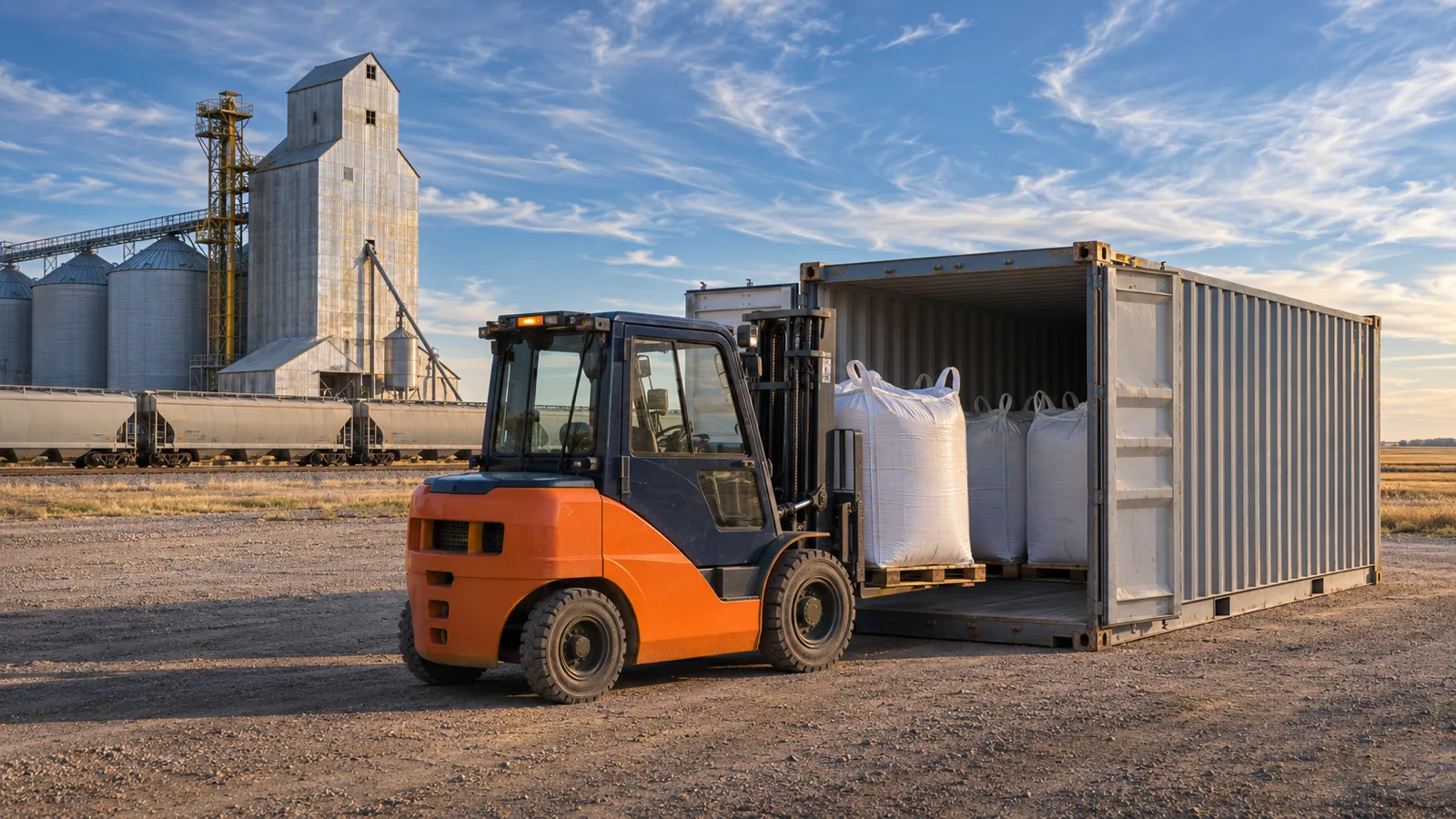
Drive across Saskatchewan in October and you see the end of one supply chain and the start of another. Combines have finished their work, bins are full, and trucks are hauling lentils, peas, canola and wheat to elevators and processing plants. From there, the crop begins a journey that can stretch more than ten thousand kilometres: by rail across the Rockies or the Canadian Shield, through a port terminal or a container yard, and across an ocean to buyers in South Asia, China, the Middle East, Europe or Latin America.
Canada is one of the world's largest exporters of grains, oilseeds and pulses. Wheat, durum, canola, barley and oats move in enormous volumes, and Canada is a leading supplier of lentils, dry peas, chickpeas, mustard seed and other special crops. Yet the logistics behind those exports look very different depending on the commodity, the volume, the buyer's requirements and whether the product moves in bulk or in containers.
This article compares the two main export routes, walks through the steps of a typical container shipment, and lays out the documentation exporters usually need. It is aimed at processors, traders, and food and ingredient companies that are building or reviewing their export programs.
Two routes to market: bulk and containers
Bulk shipping
Most of Canada's major grains move in bulk. Grain is delivered by farmers to primary elevators across the Prairies, loaded into rail hopper cars, and moved by the national railways to terminal elevators at the West Coast (Vancouver and Prince Rupert), Thunder Bay at the head of the Great Lakes, and ports on the St. Lawrence. From there, it is loaded into bulk vessels.
Bulk shipping is extremely efficient for large volumes of standardised commodities. Its trade-offs are that cargo from many sources is co-mingled and blended to meet grade specifications, minimum volumes are very large, and access to the system is largely through grain companies that own or operate elevators and terminals.
Container shipping
Pulses, special crops, identity-preserved grains, organic products and processed ingredients move heavily in containers. Containers let exporters ship smaller lots, keep a specific crop separate from others, and deliver directly to buyers' facilities inland in the destination country. Buyers of food-grade lentils, for example, often want specific sizes, colours and quality characteristics that would be lost in bulk handling.
Container shipments are typically loaded at processing plants or transload facilities, either loose (bulk in a lined container) or in bags such as 25- or 50-kilogram bags or one-tonne bulk bags. Loaded containers then move by rail or truck to a port. Inland container terminals in cities such as Saskatoon, Regina, Calgary, Edmonton and Winnipeg connect Prairie shippers to rail service toward Vancouver, Prince Rupert and Montreal.
Choosing between them
- Volume: bulk vessels carry tens of thousands of tonnes; containers carry roughly twenty-odd tonnes each, depending on product and weight limits. Smaller programs fit containers better.
- Quality control: containers keep your product separate from loading to delivery, which matters for identity preservation and premium grades.
- Buyer location: containers can be delivered inland, while bulk vessels discharge at port facilities.
- Cost: bulk usually has the lower cost per tonne for large standard commodities; containers can be competitive for pulses and specialty products, especially when backhaul container rates are favourable.
- Equipment availability: containers depend on shipping lines positioning empty boxes in the Prairies, which can be tight at times.
A container export, step by step
- Contract and specification. The sale contract sets the product, grade or quality specification, quantity, packaging, incoterm, shipment period and destination. It also determines which inspections and certificates are needed. Our explainers on FOB and DAP are useful refreshers on who is responsible for which leg.
- Booking. The exporter or its freight forwarder books space with a shipping line, specifying the port of loading, vessel and number of containers. The shipping line releases empty containers at an inland terminal or port.
- Container inspection and preparation. Containers used for food-grade products must be clean, dry and free of odours and residues. Many exporters inspect and line containers before loading.
- Loading. The product is loaded at the plant or transload facility, either loose with a liner or in bags. Weight must be accurate, and the container's total weight must comply with road and rail limits as well as the declared verified gross mass for the vessel.
- Sampling and inspection. Samples are taken for quality and, where required, for official inspection. Some destinations require official grading or analysis certificates.
- Treatment. Some destinations require fumigation or other treatment before export, with certificates issued by approved providers.
- Inland transport. The loaded container is drayed to an inland rail terminal and moved by rail to the port, or trucked directly if the distance is short. Our post on what drayage is explains this leg.
- Export declaration and documents. The exporter files the export declaration with the CBSA where required, and the documentation package is assembled: bill of lading, commercial invoice, packing list, phytosanitary certificate, certificates of origin and any quality certificates.
- Port and vessel. The container is received at the port terminal before the cut-off and loaded onto the vessel.
- Document release and payment. Documents are presented according to the payment terms, often through banks under a letter of credit, so the buyer can clear the goods at destination.
The documentation package
Exact requirements depend on the commodity, the destination country and the contract, but exporters commonly need:
- Phytosanitary certificate: issued by the Canadian Food Inspection Agency to show that plant products meet the importing country's plant health requirements. The CFIA's requirements by country should be checked before every new market.
- Canadian Grain Commission documents: the Canadian Grain Commission administers the Canada Grain Act, licenses grain companies and provides official inspection and grading. Bulk export cargoes of regulated grains receive official certificates; container shippers may also need or choose CGC inspection and certification depending on the product and buyer.
- Certificate of origin: required by many buyers and needed to claim preferential tariffs under trade agreements such as CETA with the European Union and CPTPP with partners including Japan and Vietnam.
- Fumigation or treatment certificates: where the destination requires them.
- Quality and analysis certificates: for example, moisture, protein, foreign material, or tests for pesticide residues and contaminants, often specified by the buyer.
- Commercial documents: commercial invoice, packing list, bill of lading and insurance certificate.
Errors in any of these documents can delay customs clearance or payment, and sometimes lead to demurrage and storage charges at destination. Many exporters use a checklist for each destination and have a second person review documents before release. Our article on common international shipping mistakes lists errors that apply well beyond agriculture.
Rail: the heart of Prairie exports
Almost every tonne of Prairie grain or pulses leaving Canada spends time on a train. The two national railways, CN and CP, carry hopper cars to bulk terminals and containers to ports. Rail performance shapes export timing: winter weather in the mountains, track maintenance, high demand across many commodities and disruptions such as blockades or labour disputes can all slow the network.
Exporters manage this risk by booking early, building some flexibility into shipment periods, keeping open communication with buyers about potential delays, and, where possible, having options to route through more than one port. Some Prairie shippers can use Prince Rupert, Vancouver or Montreal depending on destination and equipment availability.
Container availability and this year's pressures
Container exports from the Prairies depend on empty containers being available inland. Shipping lines decide where to reposition their equipment, and when demand for imports to North America is strong, empty containers may be prioritised for return to Asia rather than sent inland for agricultural exports. This autumn, many exporters are reporting tight container supply and higher freight rates as global shipping has been disrupted by the pandemic and shifting demand. It is hard to predict how long these conditions will last, so build longer lead times into contracts and maintain relationships with more than one forwarder or shipping line.
Domestic movements and warehousing
Not every shipment heads straight for a port. Pulse processors, millers and food manufacturers also move product within Canada, to food plants in Ontario and Quebec, to pet food manufacturers, or to warehouses where bagged product waits for orders. These movements often use full truckload or LTL freight and benefit from distribution warehousing near major food manufacturing centres. Bagged ingredients for food use need clean, dry, pest-controlled storage with lot tracking, so that any quality issue can be traced quickly.
Practical tips for exporters
- Build a destination-by-destination requirements sheet and update it whenever the CFIA or the buyer changes requirements.
- Track every container from loading to vessel with clear milestones, and share them with buyers.
- Keep retained samples from each lot for an agreed period in case of quality disputes.
- Understand demurrage and detention charges in your contracts and with shipping lines.
- Use the reporting and analytics from your logistics partners to review transit times and costs by lane.
Move your crop with fewer surprises
ShipCarte supports Canadian manufacturers and food businesses with freight, warehousing and cross-border shipping across Canada and into the United States. If you are reviewing how your products move from plant to port or to domestic customers, schedule a consultation with our team.