
Winning a government contract can transform a small or mid-sized business. A standing offer to supply a federal department, a multi-year agreement with a provincial health authority, or a contract to furnish a new school board office can bring steady volume and a credible reference. But many suppliers discover, after the celebration, that the contract's delivery terms are far more demanding than anything their commercial customers ever asked for.
Government buyers in Canada tend to specify exactly where goods must be delivered, when, how they must be packed and labelled, what paperwork must travel with them, and what happens if any of that goes wrong. Deliveries may be bound for a downtown office tower with a tiny loading dock, a military base with security screening, a hospital receiving area with strict windows, or a community in the North that can only be reached by air or seasonal sealift. Every one of those destinations has rules.
This article walks through the logistics requirements suppliers commonly encounter when delivering on government contracts in Canada, at the federal, provincial and municipal levels, and how to plan for them before you bid rather than after you win. It is general guidance; the contract in front of you always governs.
The Procurement Landscape in Brief
Public procurement in Canada happens at many levels. Federally, Public Services and Procurement Canada (PSPC) is the main purchasing agent for many departments, and federal opportunities are published on the government's tendering service, Buyandsell.gc.ca. Some departments buy directly for smaller requirements. Provinces and territories run their own procurement, often through their own portals, such as BC Bid, the Alberta Purchasing Connection and Quebec's SEAO, while many municipalities, school boards, universities and hospitals publish through services like MERX or their own sites. Broader public sector organisations, including health authorities and group purchasing organisations, buy large volumes of supplies.
Contracts take several forms. A one-time contract buys a specific quantity. A standing offer sets prices and terms, and departments then issue call-ups as they need goods. A supply arrangement pre-qualifies suppliers to compete for future requirements. From a logistics point of view, standing offers are particularly demanding, because you may receive call-ups from many different locations with little notice and must deliver within the stated timelines each time.
Trade agreements, including the Canadian Free Trade Agreement between provinces and territories and international agreements, shape how many opportunities are run, but the delivery terms are set in each solicitation.
Requirements You Are Likely to Encounter
1. Delivery terms and destination
Most government contracts require delivery to the buyer's premises, with the supplier responsible for transportation costs and risk until delivery. Federal contracts often express this using Incoterms such as Delivered Duty Paid (DDP) to a named destination, meaning you deliver to that address with any duties and taxes handled, and the risk stays with you until then. Our explainers on what DDP means and what FOB means describe how these terms divide cost and risk.
Pay close attention to whether the destination is a single central warehouse or many end-user locations. Shipping one truckload a month to a central depot in Ottawa is very different from shipping cartons to dozens of offices across ten provinces.
2. Delivery dates and windows
Contracts typically specify a delivery date or a number of days after contract award or call-up. Many receiving locations accept deliveries only during certain hours and require appointments. Late delivery can be a breach of contract and may lead to the contracting authority buying elsewhere and charging you the difference, depending on the terms. Build realistic lead times into your bid, including manufacturing, inbound freight and the final delivery leg.
3. Packaging and marking specifications
Government buyers often specify how goods must be packed and marked: carton strength, unit quantities per carton, pallet sizes and heights, stretch wrapping, and markings that show the contract number, call-up number, item description, quantity and destination. Defence contracts can reference detailed military packaging standards. Health sector contracts may require lot numbers and expiry dates on every carton. Follow these specifications exactly; non-compliant packaging can be grounds for rejection.
4. Bilingual requirements
Federal institutions operate under the Official Languages Act, and products, manuals and labels supplied to the federal government often need to be available in both English and French. Consumer packaging generally requires bilingual mandatory information anyway, but government contracts may extend this to instructions, training materials and carton markings. Quebec public bodies have their own French language requirements.
5. Documentation
Expect each shipment to need specific documents: a packing slip referencing the contract and call-up numbers, a bill of lading, certificates of conformance or test reports, and sometimes safety data sheets. Invoices usually must reference the same numbers and match delivered quantities exactly, or payment can be delayed. If you are unfamiliar with freight documents, our article on the purpose of a bill of lading is a good primer.
6. Inspection and acceptance
Goods are often subject to inspection on receipt, and acceptance may depend on quantity, condition, conformity to specifications and correct documentation. Rejected goods may have to be collected and replaced at your expense. Damaged shipments can trigger the same outcome, which makes careful palletising and carrier selection important.
7. Security requirements
Some federal contracts include security requirements administered through PSPC's Contract Security Program. Depending on the contract, your organisation or individual personnel, including drivers, may need a security screening level to access certain sites or information. Deliveries to military bases, correctional facilities, airports and some government buildings involve screening, escorts or advance notification of driver and vehicle details. If you supply goods covered by the Controlled Goods Program, such as certain defence articles, registration and handling rules apply to everyone who examines, possesses or transfers them.
8. Reporting and performance management
Larger contracts frequently require regular reports on orders, deliveries, backorders and performance against service levels. Some buyers track on-time delivery and fill rates and use them in supplier evaluations or future awards. Having systems that can produce these reports easily is a real advantage. Reporting and analytics tools make it far easier to show you met your commitments.
Geography: Delivering Across a Large Country
National or multi-region contracts bring the full challenge of Canadian geography. A few scenarios deserve particular attention:
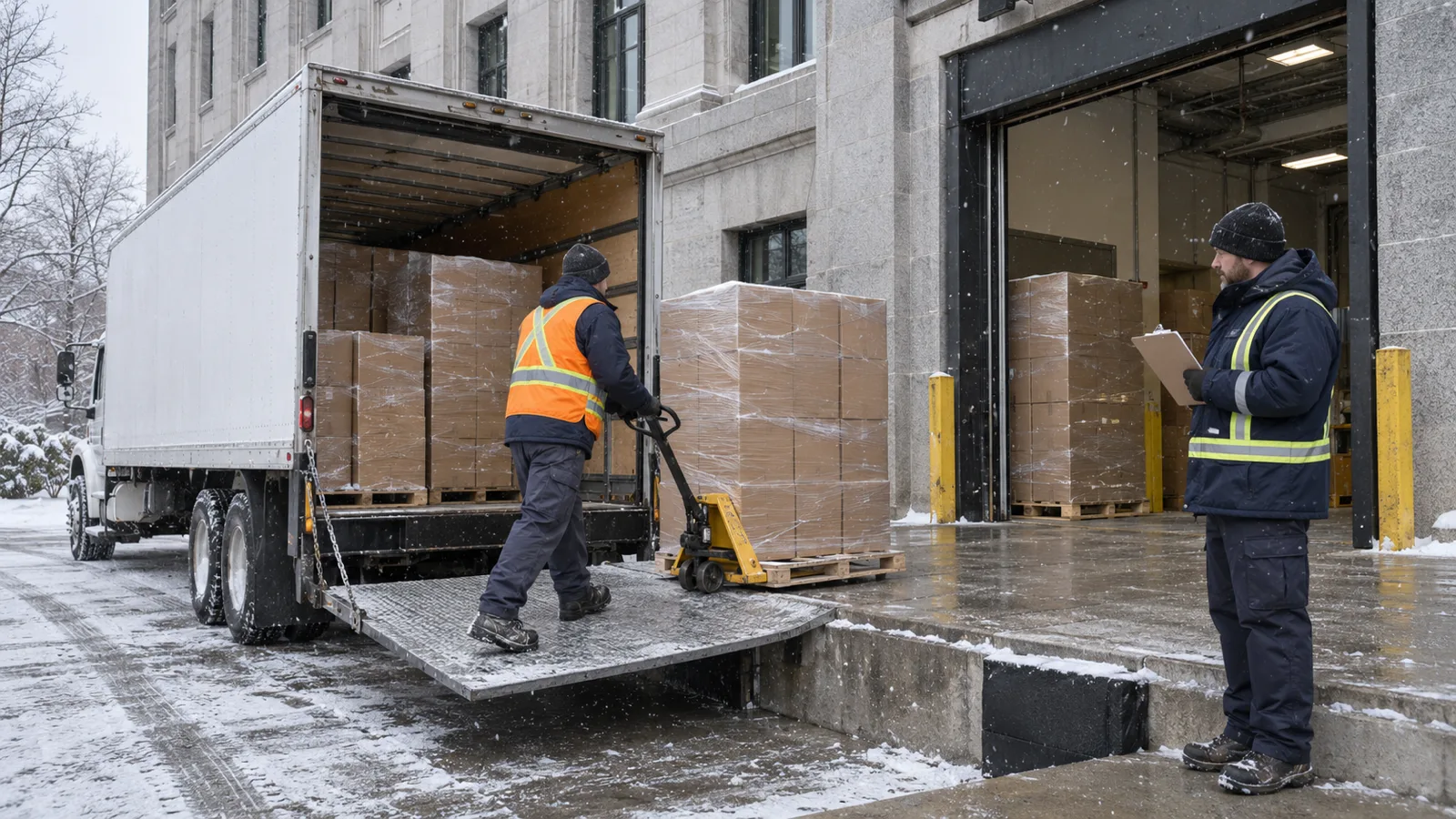
- Dense urban sites. Downtown government offices in Ottawa-Gatineau, Toronto, Montreal and Vancouver may have small loading docks, strict booking systems and limited parking. Deliveries may need smaller vehicles or tail-lift trucks.
- Regional and rural offices. Service Canada centres, RCMP detachments and provincial offices in smaller communities may only be reachable by LTL carriers on certain days of the week.
- Northern and remote communities. Destinations in Nunavut, the Northwest Territories, northern Quebec, northern Manitoba and Labrador may be served by air freight, by winter roads when they are open, or by annual sealift. Missing a sealift deadline can delay delivery by months. Plan these early and confirm the buyer's expectations.
- Seasonal weather. Winter storms on the Trans-Canada Highway, closures through the Rockies and delays in Atlantic Canada are normal risks. Contracts rarely excuse ordinary weather.
Choosing the right mode for each destination matters. Large orders to central depots may justify full truckload service, while distributed deliveries to many sites often move by LTL freight or parcel. A mix is common.
Warehousing for Government Contracts
Many suppliers hold inventory in Canada specifically to meet contract delivery timelines. Standing offers with short delivery windows are almost impossible to meet if every order must be produced or imported on demand. A warehouse strategy for public sector work usually involves:
- Safety stock sized to expected call-up volume and lead times.
- Lot and expiry tracking for regulated goods, such as medical supplies.
- Kitting or assembly where contracts require bundles, such as office starter kits or emergency supply kits, which kitting and assembly services can handle.
- Labelling capability to apply contract-specific carton markings.
- Accurate inventory records to support reporting and audits.
Some suppliers dedicate space to a single large contract, while others share space with commercial inventory. Dedicated warehousing can make sense where security, segregation or volume justify it.
Before You Bid: A Logistics Checklist
- List every delivery destination, or the regions call-ups could come from.
- Confirm delivery terms, who pays freight, and when risk transfers.
- Read the packaging, marking and labelling specifications line by line.
- Identify any security clearances or site access requirements.
- Estimate transit times to each destination, including remote ones, by season.
- Price freight realistically, including accessorial charges such as tail-gate, inside delivery and appointment fees.
- Decide where inventory will be held and how much.
- Confirm you can produce the required documentation and reports.
- Understand the consequences of late or non-compliant deliveries.
- Line up logistics partners who can meet these requirements before you submit.
Freight costs, in particular, are easy to underestimate. Accessorial charges for liftgates, residential or limited-access sites, appointments and inside delivery can add up quickly. Our overview of shipping surcharges lists common ones.
Responding to Urgent Requirements
Government needs are not always predictable. Emergencies, from wildfires and floods to public health events, can lead to urgent requirements for supplies with very short delivery timelines. In recent days, many public bodies have been seeking supplies quickly as the country responds to the spread of the new coronavirus. Suppliers who can mobilise inventory, transportation and documentation quickly are valuable partners in those moments, but urgency rarely relaxes the paperwork. Keep your processes ready before the call comes.
Deliver What the Contract Promises
Government contracts reward suppliers who are reliable, documented and compliant. The logistics requirements can look daunting at first, but they are manageable when you read the terms carefully, plan inventory and transportation in advance, and work with partners who are used to delivery windows, specifications and paperwork.
ShipCarte supports suppliers across Canada with distribution services, warehousing and freight to sites from urban offices to remote communities. If you are preparing a bid or have just won a contract, request a quote and we will help you plan the delivery side.