
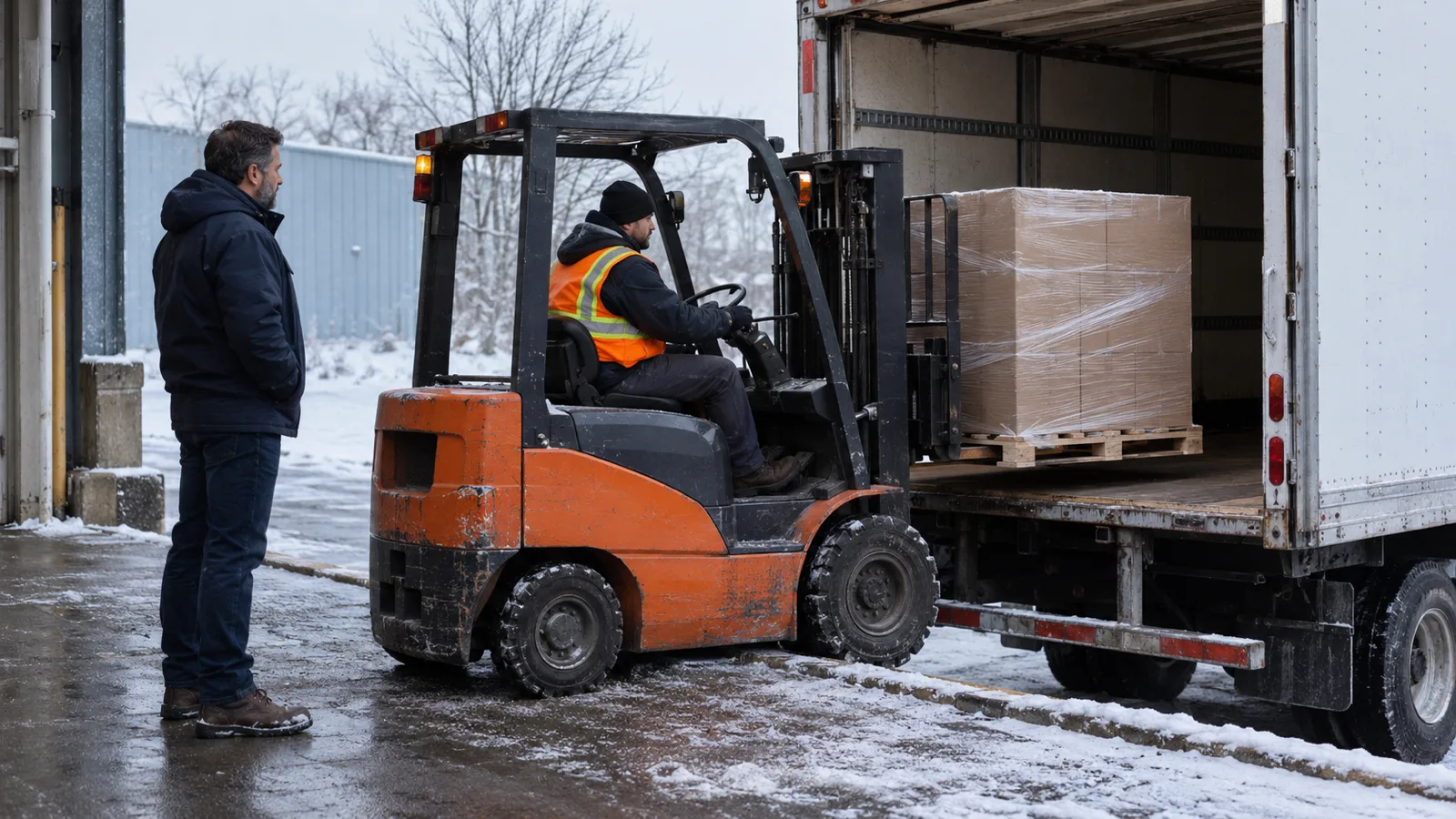
For most small businesses in Canada, freight arrives as a surprise. You have been shipping parcels for a year or two, the boxes have always fit in the back of a car or a courier van, and then a retailer in Calgary places a wholesale order for forty cases. Or your supplier in Montreal says the next run of product will come on a pallet instead of in cartons. Suddenly you are being asked questions you have never had to answer: freight class, accessorials, liftgate, BOL, dock or no dock.
The good news is that a first pallet is not complicated once you understand how the freight world thinks. Carriers that move pallets across Canada run on a different model from parcel couriers, and most of the confusion small businesses feel comes from trying to apply parcel logic to freight. This guide walks through the shipment the way it actually happens, from deciding whether you even need freight to the moment the truck pulls away.
We will use one realistic example throughout: a small skincare brand working out of a shared industrial unit in the Greater Toronto Area that needs to send 36 cases of product to a regional retailer's distribution centre outside Edmonton. The details will change for your business, but the decisions are the same.
Step 1: Decide Whether This Is Really a Freight Shipment
The first question is whether you should ship as parcels or as a pallet. There is no universal cut-off, but a few signals point clearly toward freight:
- Total weight. Once a shipment heads past a few hundred pounds, sending it as a pile of individual parcels usually becomes more expensive and riskier than one consolidated pallet.
- Number of boxes. Ten or more cartons going to one address are good candidates for palletizing, because every separate parcel is another chance for something to go missing.
- Receiver requirements. Many retailers and distribution centres in Canada will only accept wholesale orders on pallets, booked by appointment. If your customer's routing guide says pallets, the decision is made for you.
- Product fragility. Cases that are stacked, wrapped and handled by forklift often take less abuse than loose parcels moving through sortation belts.
In our example, 36 cases at roughly 12 kilograms each is over 400 kilograms going to a distribution centre that receives by appointment. That is clearly freight. If you want a deeper comparison, our guide on how freight differs from small package shipping covers the trade-offs in more detail.
Step 2: Understand LTL Versus Full Truckload
A single pallet almost always moves as less-than-truckload, or LTL. That means your pallet shares a trailer with freight from other shippers. A local pickup truck collects it, brings it to a terminal, and it is loaded onto a linehaul trailer heading toward the destination region. On a Toronto-to-Edmonton lane, that linehaul could travel by road along the Trans-Canada corridor or by intermodal rail, depending on the carrier. At the far end it is unloaded at another terminal and put on a local delivery truck.
That hub-and-spoke model explains almost everything about LTL pricing and timing. You are paying for a share of the trailer space, plus handling at each terminal. Transit times are estimates rather than guarantees, and every extra touch is a small opportunity for damage, which is why pallet build quality matters so much.
Full truckload is a dedicated trailer that goes straight from pickup to delivery. It only makes sense when you are filling most of a trailer or when speed and minimal handling outweigh cost. For a first pallet, LTL freight is almost always the right answer. As you grow into multi-pallet orders, it is worth knowing that full truckload exists for larger volumes.
Step 3: Build a Pallet That Survives the Trip
Freight carriers expect you to hand over something stable, square and easy to move with a forklift. A poorly built pallet is the most common reason first-time shippers see damage or get reweighed and rebilled.
Choose the right pallet
The standard footprint in North America is 48 by 40 inches. Use a sound wooden pallet with no broken deck boards or protruding nails. Many receivers will reject damaged pallets, and some retail distribution centres specify pallet grade or type in their vendor guides, so check before you build.
Stack for stability
- Put the heaviest cases on the bottom and stack in a column or interlocking pattern so the weight sits on the corners of the boxes below.
- Keep every case inside the edges of the pallet. Overhang crushes carton walls and adds width that the carrier may charge for.
- Aim for a flat top. A pyramid-shaped load cannot be stacked on and may be billed as if it took the full height of the trailer.
- Keep height reasonable. Many LTL shipments travel well under about six feet tall; check with the carrier or your 3PL before going higher.
Wrap and protect
Stretch wrap the load several times, starting by twisting the film around the pallet itself so the boxes are locked to the base. Corner boards help hold the load square and protect edges. If your cases are light or slippery, a couple of straps add extra security. In a Canadian winter, think about whether your product can freeze. LTL freight is not heated by default, and a pallet can sit in an unheated trailer or terminal overnight in sub-zero temperatures. Liquids, creams and some foods may need a heated or protect-from-freeze service between roughly November and March.
Step 4: Measure and Weigh Accurately
Your quote is built on the dimensions and weight you supply. Once the pallet is built, measure length, width and height including the pallet itself, and weigh it if you can. If you do not own a pallet scale, add up case weights and add the weight of the pallet, which is often in the range of 30 to 50 pounds for a standard wooden one.
Carriers increasingly check dimensions at their terminals. If the pallet is bigger or heavier than declared, you will receive a correction charge, and occasionally a reclassification fee as well. Accurate numbers at the start are the cheapest insurance against invoice surprises.
Step 5: Know What Drives the Quote
LTL rates in Canada are built from several components, and they vary widely by lane, carrier and time of year. Rather than look for a single "price per pallet," it helps to understand the levers:
- Lane. Busy corridors such as the Highway 401 between Windsor, Toronto and Montreal tend to have more competition and capacity than remote or northern lanes. Shipments into smaller communities or the territories can involve interline partners and longer transit.
- Weight and density. Heavier and bulkier freight costs more. Density, meaning weight relative to the space it takes, matters because carriers sell trailer space.
- Fuel surcharge. Most carriers apply a fuel surcharge that moves with diesel prices and is shown as a percentage on top of the base rate.
- Accessorial charges. These are extras for anything beyond a dock-to-dock move: residential delivery, liftgate, inside delivery, appointment booking, limited access sites, heated service or redelivery.
- Timing. Rates and capacity can tighten in busy periods such as the run-up to the holidays.
A shipping platform that compares multiple carriers on the same lane can save a great deal of guesswork. ShipCarte's shipping platform lets you enter the pallet details once and see options side by side, which is particularly useful when you do not ship freight often enough to know which carriers are strong on which lanes.
Step 6: Be Honest About Pickup and Delivery Locations
This is where first-time shippers get caught most often. A freight truck is built to back up to a loading dock. If either end of your shipment lacks a dock, you need to say so when you book.
In our example, the skincare brand's shared unit has a drive-in door but no dock, so the pickup truck needs a liftgate to lower the pallet onto the ground and lift it back up. The retailer's distribution centre has docks but requires an appointment. Both of those details need to be on the booking. If they are left off, the driver may refuse the pickup or the carrier will add the charge afterward, often at a higher rate than if it had been quoted up front.
Other location details to flag include residential addresses, construction sites, schools, farms, military bases and remote or limited-access areas. Many carriers treat these differently, and some will not serve them at all without notice.
Step 7: Prepare the Bill of Lading and Labels
The bill of lading, or BOL, is the contract between you and the carrier and the receipt for your goods. It lists shipper, consignee, piece count, weight, a description of the goods and any special instructions. If you book through a platform, the BOL is usually generated for you. Our explainer on the purpose of a bill of lading goes through each field.
Print two copies of the BOL for the driver, and attach a shipping label to at least two sides of the wrapped pallet. If the receiver has a purchase order number, put it on the label and the BOL. Retail distribution centres can refuse freight that does not reference a valid PO. When the driver signs the BOL at pickup, check that the piece count matches what you are handing over.
Step 8: Track the Shipment and Inspect on Delivery
After pickup, the carrier will give you a PRO number, which is the tracking reference for the shipment. Share it with your customer so they can plan for the appointment. If you are curious about where that number comes from, read what a PRO number is in freight shipping.
The most important moment in the whole process is delivery. The receiver should count the pieces and look for visible damage before signing. Any damage or shortage must be noted on the delivery receipt. A clean signature makes a later damage claim much harder to win. If you are the receiver, take photographs of the pallet before unwrapping it and keep the packaging until any claim is settled.
Common First-Pallet Mistakes to Avoid
Most problems with a first freight shipment trace back to a short list of avoidable errors:
- Booking dock-to-dock when one end has no dock, then paying for a liftgate after the fact.
- Guessing dimensions or weight and receiving a correction invoice weeks later.
- Building a pallet with overhang, a pyramid top or loose cases that shift in transit.
- Forgetting freeze protection for liquids during a Canadian winter.
- Missing the receiver's PO number or appointment requirement, leading to a refused delivery and a redelivery charge.
- Signing for damaged freight without noting the damage.
- Choosing a carrier only on price without checking whether it actually serves the destination directly or hands off to a partner.
Freight Insurance and Carrier Liability
Carrier liability in Canada is limited. Unless you declare a higher value, the amount a carrier is responsible for is often calculated by weight, which can be far below the value of light but expensive goods such as cosmetics, electronics or supplements. Ask what the default liability is on your shipment and decide whether to purchase additional coverage. Our guide to freight insurance in shipping explains how this works.
What Happens After Your First Pallet
Once your business is shipping pallets regularly, several new questions open up. Should you keep inventory closer to customers in Western Canada? Should retail orders be built and shipped by a partner warehouse rather than from your own unit? Should you consolidate inbound freight from suppliers to cut costs? Many growing brands reach a point where it makes sense to hand both parcel and pallet shipping to a single partner, especially when wholesale accounts start to demand compliance with labelling and appointment rules. ShipCarte offers retail fulfillment for exactly that situation, alongside freight booking for businesses that want to keep doing the packing themselves.
Shipping your first pallet is a milestone. It usually means a customer trusted you with a bigger order. Treat it as a chance to learn how freight works, get your process right, and build habits that will make the fiftieth pallet routine.
Get Help With Your First Freight Shipment
If you have a pallet ready to move anywhere in Canada, or you are not sure whether your next order should go as freight at all, ShipCarte can help you compare carriers, flag the accessorials you will need and book the shipment properly the first time. Request a freight quote and tell us about your pallet, your pickup location and where it needs to go.