
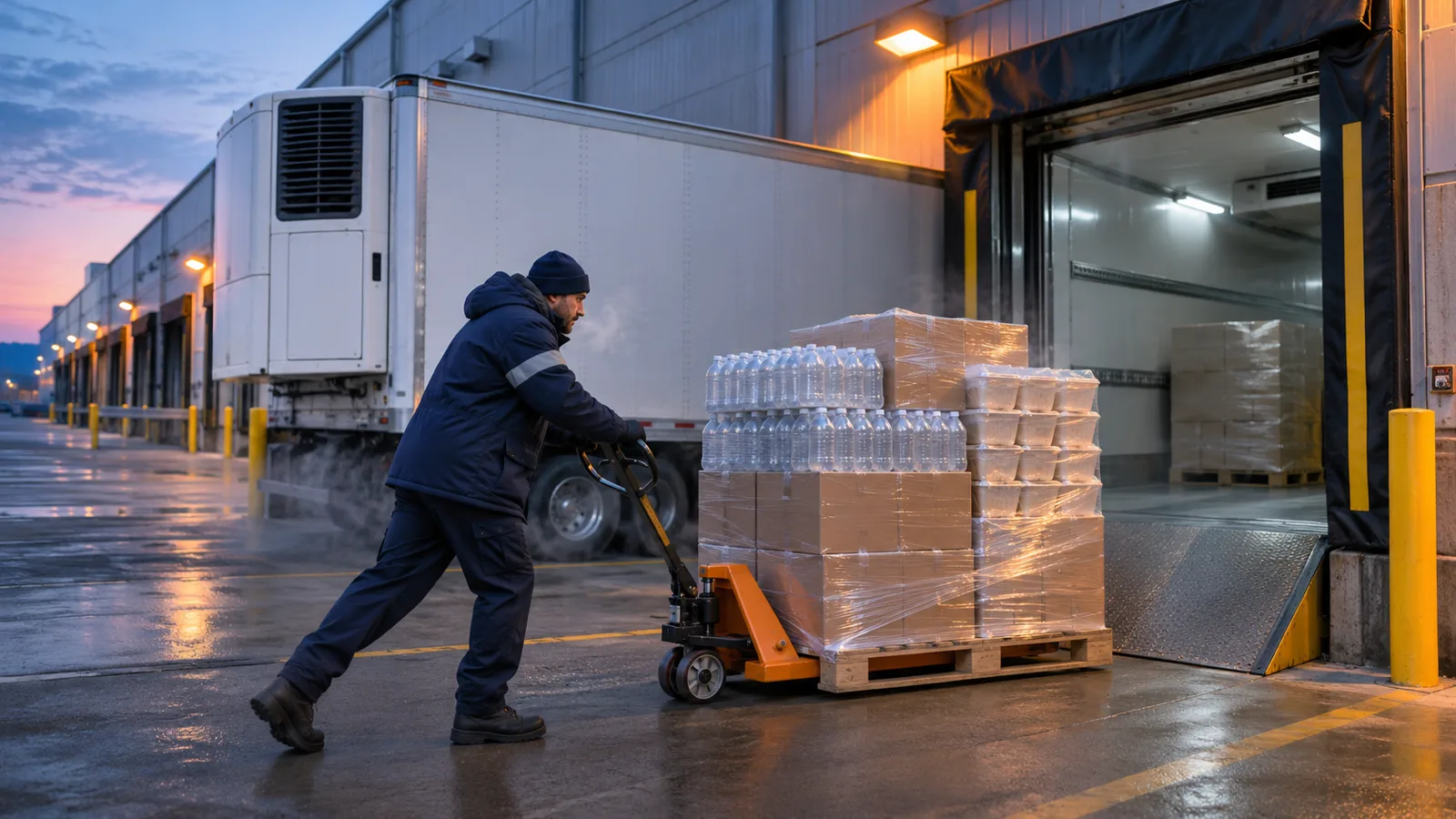
A small producer of cold-pressed juices rents a commercial kitchen off Dixie Road. Production is the easy part: the team knows its recipes, its suppliers and its bottling line. The hard part arrives when a regional grocery chain says yes to a listing. Suddenly the producer needs to deliver chilled pallets to a distribution centre on a fixed appointment, with specific labels, a minimum remaining shelf life on every bottle, and paperwork that proves where each batch came from. One late truck or one warm pallet can mean the whole delivery is refused.
That story repeats across the food and beverage businesses that cluster in Peel Region, from bakeries and sauce makers to beverage brands and specialty importers. Food and beverage distribution in Mississauga benefits from a strong location: the city is surrounded by grocery and foodservice distribution centres, it connects to every major highway in the GTA, and it is close to Toronto Pearson for imported ingredients and export shipments. But the location only pays off if every step between production and the shelf is handled with care.
This article follows a product through each stage of that journey and highlights what tends to go wrong and how to prevent it.
Stage 1: Leaving the Production Floor
Distribution starts the moment finished goods come off the line. Decisions made here affect everything downstream.
Case and pallet configuration
Grocery and foodservice buyers usually specify how product should arrive: case pack quantities, how many cases per layer, how many layers per pallet, and maximum pallet height. Building pallets to those specifications at the plant avoids rework later. Stable, well-wrapped pallets also travel better, with less crushing of lower layers. If you are unsure, ask your buyer for their vendor or supplier guide before your first production run.
Lot coding
Every case should carry a lot code and a best-before or production date that is legible and consistent. Under the Safe Food for Canadians Regulations, many food businesses need to maintain traceability records that track food one step forward and one step back, meaning who you received ingredients from and who you sold product to. Clear lot codes on cases make it possible for your warehouse and your customers to record what they received.
Pre-cooling
For chilled products, the product should be at its target temperature before it is loaded. Refrigerated trailers and cold rooms are designed to maintain temperature, not to pull heat out of warm product quickly. Loading warm goods into a reefer is one of the most common causes of temperature excursions.
Stage 2: Into the Warehouse
Many producers lack the space or staff to store finished goods and fill orders from their plant. Moving product into a third-party warehouse frees up production space and gives access to dock doors, racking and systems built for distribution.
Choosing the right temperature zone
Food and beverage products fall into three broad categories: ambient (shelf-stable goods like canned beverages, dry snacks, sauces), refrigerated (dairy, fresh juice, prepared foods) and frozen (ice cream, frozen meals). Some products, like chocolate or certain wines, are technically shelf stable but still benefit from controlled temperature to protect quality. Match each SKU to the right zone. ShipCarte offers temperature-controlled warehousing and cold storage for products that need it.
Receiving checks
At receiving, the warehouse should verify quantities, record lot codes and dates, check product temperature for chilled and frozen loads, and inspect for damage. Discrepancies need to be flagged immediately, not discovered weeks later during a count.
Stock rotation
Food inventory should move on a first-expired, first-out basis, so the product with the nearest best-before date ships first. A warehouse management system that records dates at receiving and directs pickers to the right lot removes guesswork. Our post on handling perishable goods in fulfillment goes into more detail on rotation and shelf-life management.
Sanitation and pest control
Food-grade warehousing needs documented cleaning schedules, pest control programs and separation from incompatible goods such as chemicals. Ask any warehouse partner how it manages these and whether it has handled products like yours before.
Stage 3: Order Processing for Retail and Foodservice
When a purchase order arrives, the warehouse picks the required cases, builds pallets and prepares documentation. Grocery and foodservice orders often differ from retail orders in one critical way: they care about remaining shelf life.
Minimum remaining shelf life
Many grocery buyers specify a minimum number of days of shelf life that must remain when product arrives at their distribution centre. If your stock is too close to its date, it may be refused. Your warehouse system should be able to filter out lots that do not meet a customer's threshold when picking their order. This is especially important for chilled products with short shelf lives.
Labels and documents
Expect requirements such as GS1-standard pallet labels, a bill of lading, a packing list and an advance ship notice sent electronically before the truck arrives. Getting these right avoids delays at the receiving dock. If you are new to freight paperwork, our article on the purpose of a bill of lading explains the basics.
Mixed orders
Independent grocers and specialty stores often order smaller quantities across many SKUs. These orders may ship as mixed pallets or as individual cases by courier. Plan how you will handle both, as the packaging and costs differ.
Stage 4: Transportation to the Customer
Moving food from Mississauga to a grocery distribution centre or a restaurant involves choosing the right transport mode and protecting product along the way.
Full truckload vs LTL
Large orders to a single distribution centre often justify a dedicated truck, especially for refrigerated product where co-loading carries risk. Smaller orders may travel as less-than-truckload (LTL) freight, sharing a trailer with other shippers. Refrigerated LTL is available but less common than dry LTL, so lead times and availability vary. ShipCarte arranges both full truckload and LTL freight.
Delivery appointments
Most large grocery distribution centres require delivery appointments. Arriving late can mean waiting hours for another slot or being turned away. Mississauga's road network, with the 401, 403, 407, 410, 427 and QEW, gives carriers multiple route options to work around congestion, but appointment times still need realistic planning, particularly during rush hour.
Temperature monitoring
For chilled and frozen loads, setting the reefer to the right temperature and recording it during transit provides evidence that the cold chain was maintained. Some shippers add data loggers to individual pallets. If a dispute arises at delivery, that record can be the difference between an accepted load and a rejected one.
Stage 5: Direct-to-Consumer and Ecommerce
Many food and beverage brands now sell online as well as in stores. Shipping individual orders of coffee, snacks, sauces or beverages to consumers is very different from shipping pallets to a distribution centre. Products need protective packaging to avoid breakage and leaks, perishable items may need insulated boxes and ice packs, and shipping costs become a much larger share of order value. If you are considering ecommerce, ShipCarte's food and beverage logistics team can help design packaging and pick carrier services for both channels from the same inventory.
Stage 6: Recalls and Traceability After Delivery
Responsibility does not end when the product reaches the shelf. If an ingredient supplier issues a recall, or if a quality problem is identified, you need to identify which lots are affected, where they went, and how quickly you can stop further distribution. The Canadian Food Inspection Agency (CFIA) oversees food recalls in Canada, and businesses are expected to act quickly when one is required.
The groundwork for that response is laid in Stages 1 and 2. If lot codes were recorded at receiving and captured at shipping, the warehouse can produce a list of affected shipments within hours. If they were not, the response turns into a manual search through paperwork.
What Commonly Goes Wrong
Looking across the journey, a few problems come up repeatedly for producers:
- Pallets built too tall or with overhang, causing refusal or damage.
- Missing or unreadable lot codes, making traceability difficult.
- Warm product loaded into refrigerated trailers.
- Stock arriving at a grocery DC with too little shelf life remaining.
- Missed delivery appointments due to unrealistic scheduling.
- Bilingual labelling gaps on imported or private-label products, discovered only when a buyer flags them.
Each of these is preventable with clear specifications, good systems and a distribution partner who understands food.
Why Producers Choose Mississauga
The GTA is Canada's largest consumer market, and many national grocers and foodservice distributors run major facilities nearby. Distributing from Mississauga typically means shorter transit to those facilities and more flexibility on appointment times. The proximity to the rail intermodal terminals in Brampton and Vaughan, Toronto Pearson and the Niagara and Windsor border crossings also helps producers who import ingredients or export finished goods to the US.
There is a practical labour and service angle too. Because so much food manufacturing and distribution already happens in Peel Region, carriers that specialize in refrigerated freight, pallet suppliers, packaging distributors and food-safety consultants are close at hand. When a production run finishes late or a buyer moves an appointment forward, having those partners nearby makes it easier to adapt the same day rather than losing a delivery window. For a growing producer, that local depth can matter as much as the highway map.
Move Your Products Forward With ShipCarte
Whether you are a new beverage brand preparing for your first grocery listing or an established producer looking to free up plant space, ShipCarte can help you plan food and beverage distribution in Mississauga, from ambient and temperature-controlled storage to retail-compliant shipping. Learn more about how we support the food and beverage industry, or request a quote with your product list and delivery requirements.