
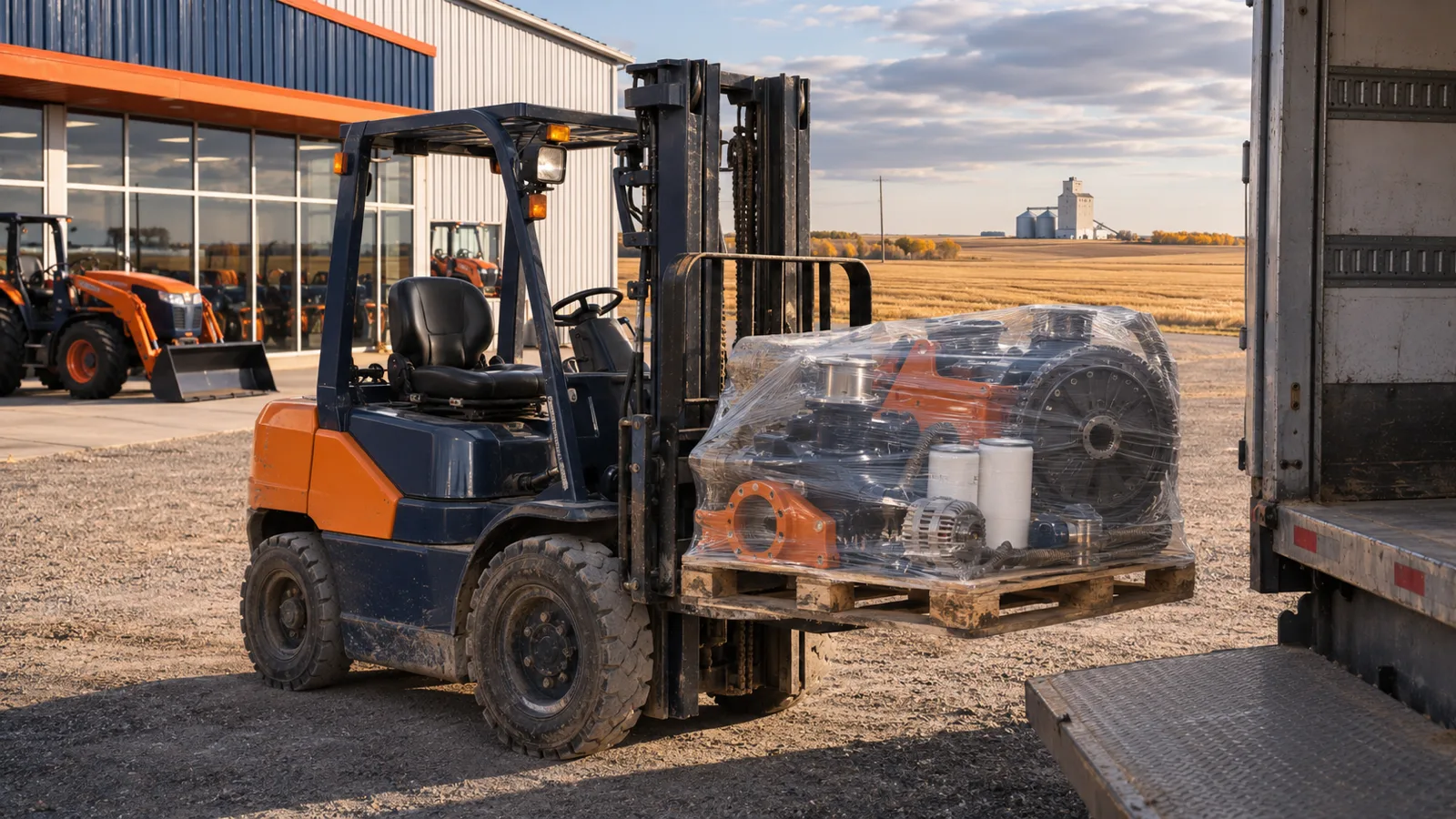
It is the third week of September somewhere south of Swift Current. The canola is swathed, the weather forecast shows rain in four days, and a combine has just stopped in the middle of a field with a failed bearing on the feeder house. The farmer calls the dealer. The dealer does not have the part on the shelf. Whether that machine is running again tomorrow morning or next week depends entirely on how quickly the part can travel from a distribution centre hundreds or thousands of kilometres away.
Moments like this happen across rural Canada every harvest, from the Peace River country in Alberta and British Columbia to the cash crop farms of southwestern Ontario and the Montérégie in Quebec. For equipment manufacturers, parts distributors and dealers, the ability to get parts to farms quickly is a major part of the value they offer. A missed delivery is not just an inconvenience; it can mean lost crop quality and a customer who remembers.
This article looks at the practical side of shipping farm equipment parts across Canada: the seasonal rhythm of demand, how to position inventory, which shipping methods fit which parts, and how to deal with the realities of rural addresses.
Understanding the Agricultural Parts Calendar
Parts demand on Canadian farms follows the growing season closely. Planning logistics around it is the first step to dependable service.
Late winter and early spring: preparation
Farmers and dealer service shops repair and prepare seeding equipment, sprayers and tractors before fieldwork begins. Demand is steady and predictable, and many orders can move by economical ground service. This is also the time to restock dealer shelves for the busy months ahead.
Seeding: speed becomes critical
From April into June, depending on the region, air drills, planters and tractors run long hours. Breakdowns create urgent orders for openers, hoses, seed meters, hydraulic components and electronics. Shipping speed matters more than cost.
Summer: spraying and haying
Sprayer parts, nozzles, pumps and baler components dominate. Hay and forage operations in Ontario, Quebec, the Maritimes and Alberta drive demand for knotters, belts and bearings.
Harvest: the peak
From late July through October, and later in some years, combines, headers, grain carts and augers are under maximum strain. Harvest is when parts logistics is truly tested, and overnight or same-day delivery can make the difference between a crop harvested on time and one left to the weather.
Late fall and winter: rebuild season
After harvest, many farms and dealers rebuild equipment for the next year. Larger orders for wear parts, major components and planned overhauls can be consolidated and shipped by freight.
Where to Hold Inventory
Canada's farmland is spread over enormous distances, and a single national distribution centre will struggle to serve all of it overnight. A tiered approach usually works best.
- National or central hub. Holds the complete catalogue, including slow-moving and expensive parts. Often located near major freight corridors such as the Greater Toronto Area, Winnipeg or the Calgary–Edmonton corridor.
- Regional depots. Hold the parts that fail most often for the machines common in that region. A depot serving Saskatchewan and Manitoba will stock a different mix than one serving Ontario dairy country.
- Dealer stock. Each dealer keeps the fast-moving wear parts and filters on its own shelves, replenished from the regional depot.
Winnipeg is worth highlighting: its position on both national rail networks and the Trans-Canada Highway, plus its connection to US routes through the Emerson crossing, makes it a natural distribution point for the eastern Prairies. Regina, Saskatoon, Calgary and Edmonton serve similar roles further west.
The key to this structure is visibility. When a dealer in rural Manitoba cannot find a part on its own shelf, staff should be able to see immediately whether a regional depot or the central hub has it and how fast it can arrive. Centralized inventory management software makes that possible without phone calls between locations.
Pre-Season Stocking: Using History to Prepare
The most effective way to reduce emergency shipments is to have the right part already nearby. Before each season:
- Review last year's urgent orders by region and by machine model.
- Identify parts that failed repeatedly, especially those that caused rush shipments.
- Account for changes in the local equipment population, such as new models sold over the past year.
- Move stock forward to regional depots and dealers a few weeks before the season starts.
- Agree on a plan to pull back unsold seasonal stock after the season so it does not tie up dealer capital.
This kind of planning is what inventory management services are designed to support, especially when parts are spread across several locations.
Matching Parts to Shipping Methods
Farm equipment parts range from a small sensor that fits in an envelope to a combine rotor that needs a flatbed. Each needs the right mode.
Small and medium parts: parcel and overnight services
Bearings, belts, sensors, filters, seals and electronics generally travel well by parcel. Overnight and express services reach many rural communities by the next business day, though delivery times to remote areas can be longer. Rate-shopping across carriers through small parcel shipping keeps rush costs in check while picking the fastest service available to each postal code.
Heavy and bulky parts: LTL freight
Tires, auger flighting, sickle sections in bulk, gearboxes and header components typically ship palletized by LTL freight. Regional LTL carriers often run scheduled routes through rural areas on specific days, so knowing a dealer's service days helps set realistic expectations.
Oversize components: flatbed and dedicated moves
Very large components or whole machines need flatbeds or step-decks. Over-dimensional loads may require provincial permits and can be limited by seasonal road restrictions. Many provinces impose spring weight restrictions on secondary highways during thaw, which can affect heavy deliveries to farms in March, April and May.
Hot-shot delivery for emergencies
When the clock is running during harvest, a dedicated hot-shot vehicle that drives a single part directly from depot to dealer or farm can be worth the premium. It is not a model for every order, but it should be available for critical breakdowns.
The Rural Address Problem
Delivering to farms is different from delivering to city addresses. Some challenges come up again and again:
- Land locations rather than street addresses. In much of the Prairies, farms are identified by legal land descriptions (section, township, range and meridian), and GPS tools used by drivers may not locate the yard.
- Rural routes and post office boxes. Parcel carriers may only deliver to a community post office or depot rather than the farm itself.
- Long yard approaches and gates. Drivers may not be able or willing to enter certain yards, especially with larger trucks.
- No one at home. During busy seasons, everyone is in the field.
Practical solutions include shipping to the dealer instead of the farm, using secure drop boxes or after-hours drop points at dealerships, adding detailed delivery instructions and contact numbers to every shipment, and confirming whether a location requires terminal pickup. Many rural dealers set up an after-hours lockbox so that overnight parts are waiting when staff arrive in the morning.
Cross-Border Parts Supply
A large share of farm equipment and parts sold in Canada is manufactured in the United States or overseas. Parts often move north through crossings such as Emerson–Pembina in Manitoba, North Portal–Portal in Saskatchewan, Coutts–Sweetgrass in Alberta and the Windsor–Detroit and Sarnia–Port Huron crossings in Ontario. With CUSMA in force since July 1 of this year, importers should make sure certification of origin documents reflect the new agreement so qualifying goods continue to receive preferential treatment.
Delays at the border can disrupt even the best stocking plan, so it pays to work with experienced customs brokers and to keep commercial documents accurate and complete. ShipCarte's cross-border shipping service can help coordinate inbound moves. Our article on what happens when customs holds a shipment explains why paperwork matters.
Practical Tips for Dealers and Distributors
- Publish realistic cut-off times. Tell dealers exactly when an order must be placed to ship the same day.
- Provide tracking on every shipment. A farmer waiting on a part wants to know where it is. Shared tracking through ShipCarte tracking reduces calls to the dealer counter.
- Consolidate stock orders. Regular, scheduled stock orders by LTL are far cheaper than many small rush shipments.
- Label clearly and consistently. Include part numbers, dealer reference and the end customer's name where appropriate, so parts reach the right bench quickly.
- Measure and review. Track the percentage of urgent orders delivered on time during each season, and use the results to adjust stocking for next year.
For a broader view of choosing freight options, our guide on choosing the right freight solutions is a helpful starting point.
Conclusion
Agriculture is one of Canada's most important industries, and it runs on machines that cannot afford to sit idle during short, weather-driven windows. Shipping farm equipment parts well comes down to anticipating seasonal demand, placing stock where it will be needed, choosing the right mode for each part and solving the practical problems of rural delivery. When those pieces come together, dealers can answer that harvest-time phone call with confidence.
Get Help With Agricultural Parts Logistics
ShipCarte supports manufacturers and distributors serving manufacturing and equipment markets across Canada with warehousing, parcel and freight shipping. To talk about faster parts delivery to your rural dealer network, request a quote from our team.