
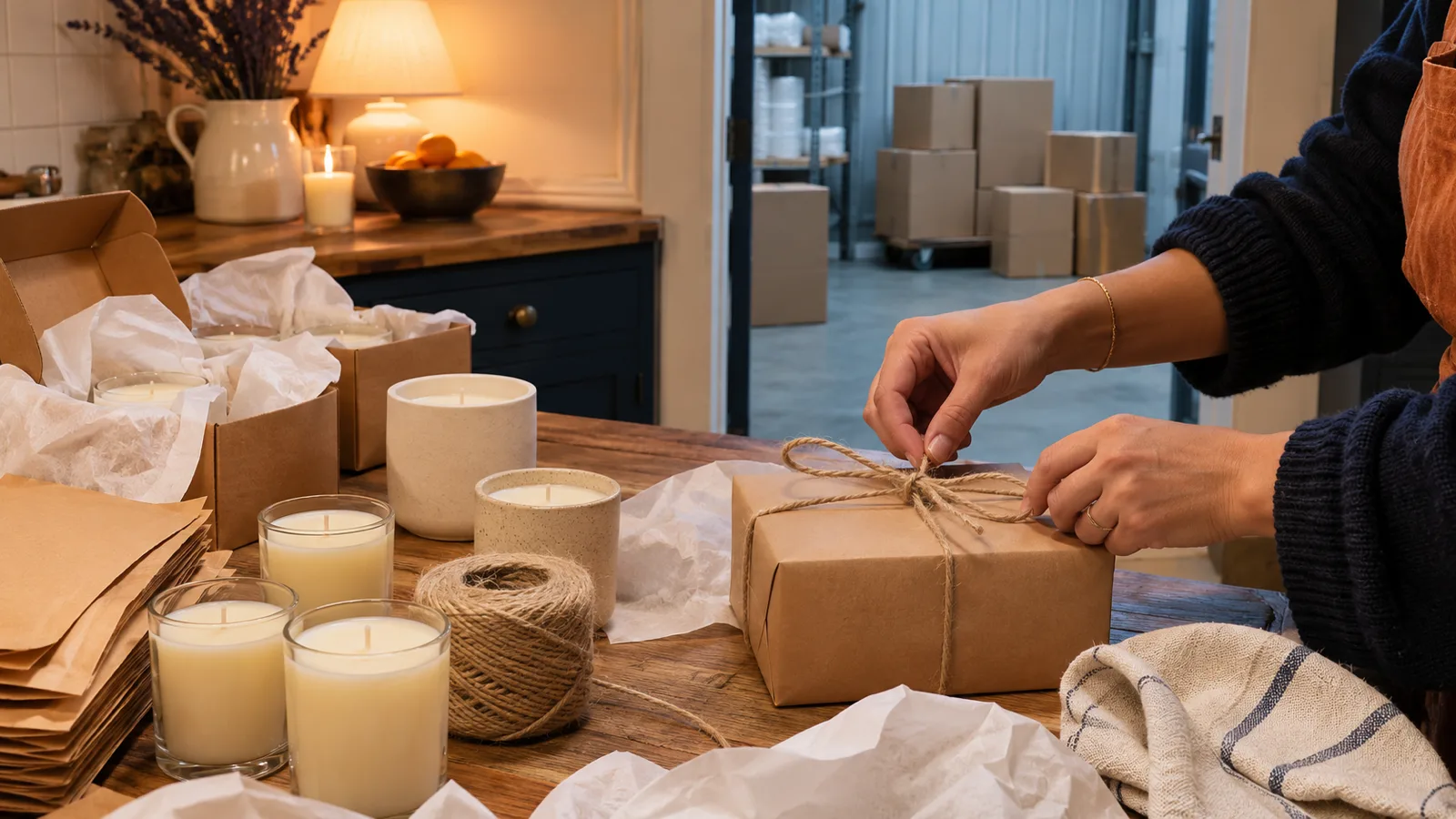
It usually starts with a hobby. A Streetsville maker pours soy candles in the kitchen on weekends, lists a few on Etsy, and is thrilled when the first order comes from a stranger in Halifax. A year later, the dining table has disappeared under kraft mailers, the basement is full of wax and glass jars, and evenings are spent printing labels instead of making product. The shop is doing well. The shipping is quietly eating the business.
This is one of the most common growth stories among small online sellers in Mississauga, and it has a predictable shape. Each stage needs a different approach to packing, labelling and carriers, and the hardest part is recognising when you have outgrown the stage you are in. Hold on too long and fulfillment crowds out the creative work that made the shop successful. Move too early and you add cost before the volume can carry it.
Below we walk through the three stages most Etsy sellers pass through, what good shipping looks like at each one, and the honest signals that it is time to take the next step.
Stage one: the kitchen table (a handful of orders a week)
At the start, the goal is simply to ship reliably and professionally without overspending. A few habits set you up well.
Use Etsy's label tools and tracked services
Canadian sellers can buy postage directly through Etsy for many services, which keeps tracking numbers attached to orders automatically. Tracking matters on Etsy: it protects you in "item not received" cases and supports your shop's performance standing. Even when an untracked lettermail option is cheaper for a small flat item, think about whether the savings are worth the risk of a dispute you cannot prove.
Set realistic processing times
Etsy lets you state how long you need to prepare an order before it ships. Handmade sellers often underestimate this. If your candles need curing time, or your jewellery is made to order, say so. Shipping late against a promise you set yourself hurts your reviews far more than an honest, slightly longer processing time.
Standardise your packaging
Pick two or three box or mailer sizes that fit most of your catalogue and buy them in bulk. Weigh and measure each packed product once, then record it in your listings so that calculated shipping is accurate. Many small sellers lose margin by guessing weights and absorbing the difference. Our guide on how package dimensions affect shipping costs explains why a box that is slightly too large can cost more than you think.
Know your local drop-off options
Mississauga has plenty of post offices and courier counters inside pharmacies and retail plazas, from Square One to Meadowvale Town Centre. At this stage, dropping parcels off on your way to other errands is usually fine. Once you are making a dedicated trip every day, take note: that is your first sign of growth.
Stage two: the spare room (dozens of orders a week)
When orders climb, the kitchen-table approach starts to break. Items go missing among household clutter, labels get printed twice, and a busy weekend leaves you a day behind. Stage two is about turning shipping into a small, organised operation.
Give fulfillment its own space
Set up a dedicated packing station: a sturdy table, shelves for finished stock with each product in a labelled bin, a thermal label printer, a scale and your packaging supplies within reach. Our roundup of shipping label printers is a good place to start if you are still printing on sheet labels.
Batch your work
Pick and pack in batches at set times rather than shipping each order the moment it arrives. Batching cuts errors and frees up uninterrupted blocks for making product. Many sellers find that one packing session in the morning, with a pickup or drop-off right after, is the sweet spot.
Book pickups and compare carriers
With steady volume, carrier pickups from your home become worthwhile. You can also start comparing rates across more than one carrier rather than defaulting to a single option. For heavier items, such as ceramics or furniture pieces, courier rates may beat postal rates on certain lanes. A multi-carrier shipping platform lets you compare services side by side and print labels in one place.
Track your true cost per order
Add up postage, packaging, inserts, tape and an honest estimate of your time for each order. Many makers are surprised to find that fulfillment takes up a large share of their week. That number is the one you will compare against outsourcing later.
Watch the US and international details
Etsy exposes your shop to buyers worldwide, and US customers are often a large share of orders for Canadian sellers. Cross-border parcels need accurate customs descriptions, values and tariff codes, and duty and tax rules for low-value parcels differ from country to country and can change. Make sure your shipping profiles reflect current costs and that buyers understand whether duties may be due on delivery.
Signs you have outgrown doing it yourself
Every shop is different, but these signals tend to show up when a seller is ready to move fulfillment out of the house:
- You spend more hours packing than making, designing or marketing.
- You turn down wholesale orders or skip sales events because you could not ship the volume.
- Inventory and supplies have taken over rooms you need for other things.
- Late shipments or packing mistakes are showing up in your reviews.
- You are selling on more channels, such as your own Shopify store or Amazon, and juggling stock across them is getting messy.
- Holiday peaks are so intense that you dread November and December.
- You cannot take a week off without the shop grinding to a halt.
If three or more of these sound familiar, it is worth at least pricing out a third-party logistics (3PL) partner. Our explainer on what a 3PL does for an online business covers the basics.
Stage three: the warehouse
Moving to a fulfillment warehouse does not mean giving up the handmade character of your shop. You keep making the product. The warehouse stores finished goods, receives your orders automatically from Etsy and other channels, picks and packs each one to your standards, and hands it to the right carrier.
What changes
- Order flow: orders sync from Etsy into the warehouse system, and tracking numbers flow back to Etsy automatically when they ship.
- Inventory: you send finished stock to the warehouse in batches. You see live stock levels online rather than counting jars in the basement.
- Shipping rates: a 3PL typically ships on negotiated volume rates across several carriers, which can offset part of the fulfillment fee.
- Your time: the hours you spent packing go back into making, photographing and growing the shop.
What to keep in-house
Fully personalised or made-to-order items, such as custom engraving or hand-lettered gifts, often stay at home because they cannot be made in advance. Many makers run a hybrid model: ready-made bestsellers live in the warehouse, while custom orders are still made and shipped from the studio. That split frees up a large share of the workload without changing what makes the shop special.
Protecting the unboxing experience
Handmade buyers care about presentation. A good fulfillment partner can reproduce your tissue wrap, stickers, thank-you cards and samples, as long as you document how you want each order packed. Photograph your ideal packed order and write short packing instructions. Our list of package insert ideas has suggestions for keeping orders personal at scale.
Preparing your shop for the move
The switch to a warehouse goes much more smoothly when a few things are tidied up first:
- Give every product a SKU and a barcode. Etsy listings with many variations, such as colours, scents and sizes, need a unique code for each variation so the warehouse picks the right one.
- Clean up your listings. Make sure weights, dimensions and processing times reflect reality, since they will now drive automated label buying.
- Do a full count of what you will send, and label cartons clearly by SKU before they leave your home.
- Plan the handover around a quiet week, not the week before a big sale or the holiday rush.
- Write down your exceptions: gift notes, fragile items, products that must not be shipped together, and anything else you currently handle by memory.
Expect the first couple of weeks to involve some fine-tuning. Check a sample of orders as they arrive with customers, ask a few friends to place test orders, and adjust packing instructions as needed.
Why a Mississauga warehouse makes sense for GTA makers
If you live in Mississauga, Brampton, Oakville or Etobicoke, a fulfillment partner close to home makes restocking easy: you can drive a carload of finished goods over in an afternoon rather than booking freight. Mississauga's position on the 401, 403 and 410, near Toronto Pearson, also means parcels enter the major carrier networks quickly, which helps delivery times to the rest of Ontario and Quebec as well as to US buyers.
How ShipCarte supports growing Etsy shops
ShipCarte works with small and growing brands across the GTA. Our e-commerce fulfillment service connects to marketplaces and storefronts through our integrations, and our pick and pack services follow your packing instructions order by order. If you also sell through your own store, Shopify fulfillment runs from the same pool of inventory. New to selling on the platform? Our post on how to sell on Etsy in Canada covers setup basics.
Get your evenings back
Growing out of the kitchen table is a good problem to have. The trick is to make each move at the right time, with clear numbers on what your shipping really costs. If you are a Mississauga maker wondering whether outsourcing makes sense yet, book a consultation and we will walk through your order volume and products with you, or request a quote to compare against your current costs.