
A refurbished laptop seller working out of an industrial unit near Dixie and Eglinton has three kinds of bad day. On the first, a parcel arrives with a cracked screen because the laptop shifted in an oversized box. On the second, a courier refuses a carton of spare batteries because it isn't marked correctly. On the third, a high-value shipment of graphics cards disappears in transit, and the claim pays a fraction of its worth because no extra coverage was declared. Each problem is preventable, and each one is specific to electronics.
Electronics are among the most common products shipped from Mississauga. The city is home to technology distributors, computer resellers, repair depots and online sellers of everything from phone accessories to smart home devices. Its location next to Toronto Pearson International Airport and at the junction of the 401, 403, 407 and 410 makes it a natural base for shipping across Canada. But electronics bring three risks that ordinary goods don't: batteries that are regulated as dangerous goods, components that can be damaged by static electricity, and high values that make loss and theft expensive.
Here's how to manage each one.
Part 1: Batteries
Almost every portable electronic device contains a lithium battery, and lithium batteries are regulated as dangerous goods (Class 9) for transport. Shipping them by ground in Canada falls under the Transportation of Dangerous Goods Regulations; shipping them by air falls under the stricter international air rules. Courier companies add their own policies on top.
Know which category you're shipping
Lithium batteries are grouped by chemistry and by how they're packed:
- Lithium-ion batteries packed alone (UN3480), such as spare batteries or power banks sold on their own.
- Lithium-ion batteries packed with equipment (UN3481), such as a drone sold with a separate spare battery in the same box.
- Lithium-ion batteries contained in equipment (also UN3481), such as a laptop or phone with its battery installed.
- Lithium metal batteries (UN3090 and UN3091), which are non-rechargeable and found in some watches, trackers and devices.
Batteries installed in equipment are generally the easiest to ship. Batteries shipped on their own face the most restrictions, especially by air, where lithium-ion batteries shipped alone are forbidden on passenger aircraft and must meet state-of-charge limits on cargo aircraft.
Check the watt-hour rating
Requirements depend on the battery's size, measured in watt-hours (Wh) for lithium-ion or lithium content for lithium metal. Smaller batteries below set thresholds can often ship with simplified requirements, while larger ones need fully regulated handling. The rating is usually printed on the battery; if it isn't, the manufacturer's specification or test summary should state it.
Ask for the UN 38.3 test summary
Lithium batteries must be of a type that has passed the UN Manual of Tests and Criteria, section 38.3. Manufacturers should provide a test summary. Keep it on file for every battery or battery-powered product you sell. Carriers and regulators can ask for it, and a supplier who can't provide one is a warning sign.
Mark and pack correctly
- Protect terminals from short circuits with caps, tape or individual bags.
- Secure devices so they can't switch on accidentally during transit.
- Use strong outer packaging that prevents crushing.
- Apply the lithium battery mark where required, and the Class 9 label for fully regulated shipments.
- Never ship damaged, swollen, recalled or defective batteries through normal channels. They have their own strict rules.
For a wider look at regulated products, see our guide to shipping hazardous materials in Mississauga.
Part 2: Static Protection
Electrostatic discharge (ESD) is the small spark you feel when you touch a doorknob after walking across a carpet. It's harmless to people but can damage or weaken circuit boards, memory modules, processors and other sensitive components. Damage isn't always immediate; a component can be weakened and fail weeks later, which makes ESD problems hard to trace.
Static risk rises in dry air, and Ontario winters are dry, especially indoors when buildings are heated. A packing station that never had problems in July can start causing them in January.
Packaging materials that help
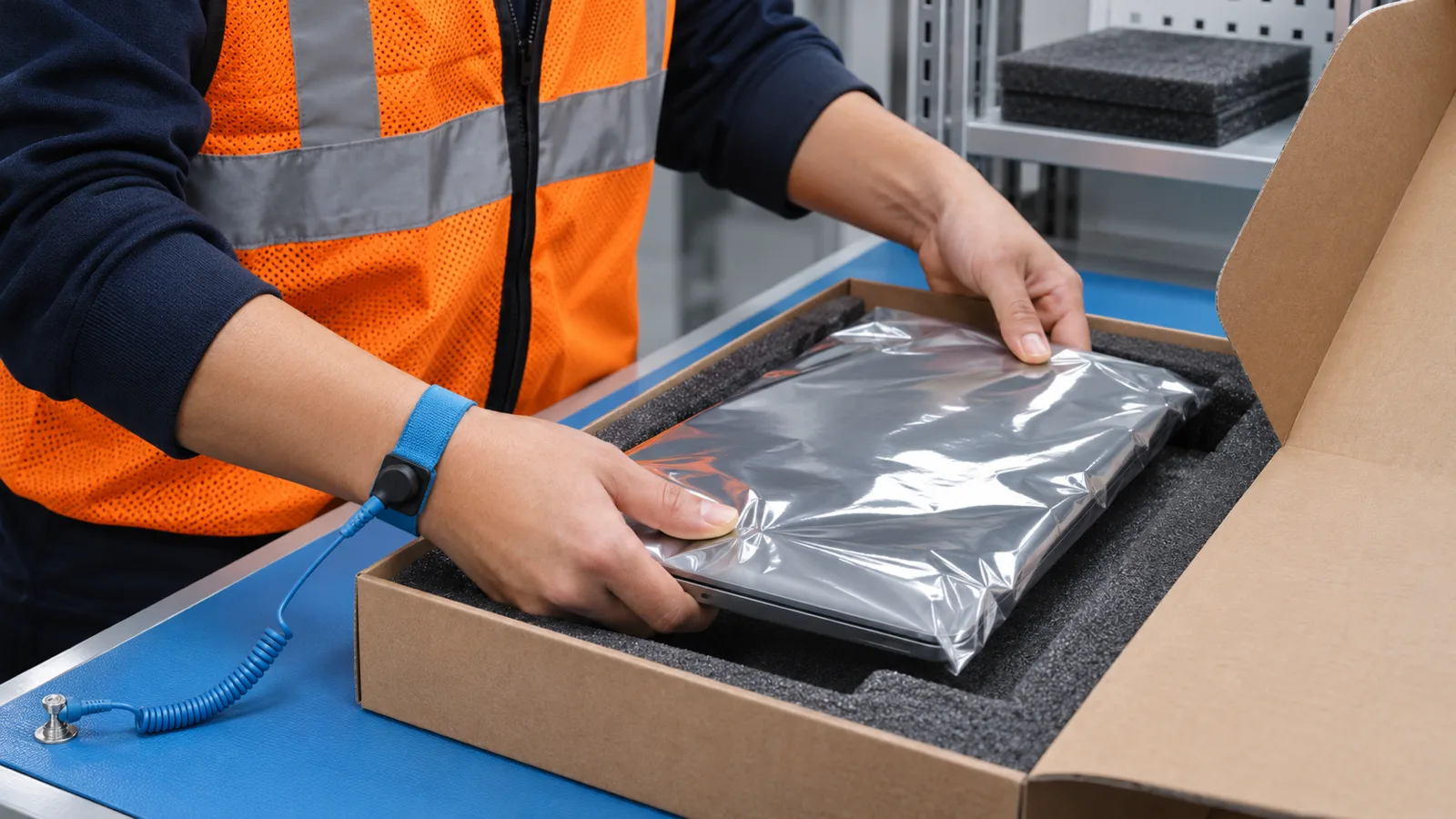
- Static shielding bags, the metallic silver bags, protect components from external static fields and discharge. Use them for bare circuit boards, drives, memory and cards.
- Static dissipative materials, often pink poly bags and foam, prevent static from building up on the packaging itself but don't shield against external discharge. They're suitable for items that aren't directly sensitive, or as outer cushioning.
- Conductive foam for holding components with exposed pins.
Ordinary bubble wrap and polystyrene peanuts can generate static, so avoid putting them in direct contact with bare components.
Handling practices
- Pack sensitive items at a workstation with a grounded mat.
- Have staff wear grounded wrist straps when handling bare components.
- Keep sensitive items in their protective bags until they're inside the shipping box.
- Store components in ESD-safe bins and shelving.
Finished consumer devices in sealed retail packaging are generally well protected already. The biggest ESD risks are with components, open-box items and refurbished goods that have been handled during testing.
Part 3: Physical Protection
Electronics are vulnerable to shock, vibration and pressure. Screens crack, connectors bend and internal parts work loose. Good practice:
- Ship in the original manufacturer packaging inside an outer shipping box whenever possible.
- Leave at least five centimetres of cushioning on all sides for items without custom inserts.
- Use molded foam or fitted inserts for repeat shipments of the same product.
- Don't ship devices in boxes that are much larger than needed; movement inside the box causes damage.
- Seal with the H-taping method and use quality corrugated boxes.
Our article on packing fragile items has more detail on cushioning and box selection. Box size also affects cost, since couriers charge by dimensional weight. Choosing the smallest box that still protects the product saves money on every shipment.
Part 4: Theft Prevention
High-value electronics attract theft at every stage of the supply chain. Simple steps reduce the risk:
- Use plain outer packaging with no brand names or product images visible.
- Avoid writing product descriptions on the outside of the box.
- Require a signature on delivery for high-value shipments.
- Use tamper-evident tape so you can tell if a box has been opened.
- Choose services with full tracking scans, and monitor exceptions closely.
- Ship to business addresses or secure pickup points when possible.
Part 5: Insurance
Couriers include a small amount of liability coverage with most services, but it's usually far below the value of electronics. If a $2,000 laptop is lost, default coverage won't come close to replacing it.
Your options:
- Declared value with the carrier. You declare a higher value and pay an extra fee. Read the carrier's terms; some limit the maximum declared value, and some exclude certain categories of goods or have conditions on packaging.
- Third-party shipping insurance. Policies purchased through a shipping platform or insurer often cost less than carrier declared value and may have broader coverage.
- Your business insurance. Some commercial policies cover goods in transit. Check limits and exclusions.
Whatever you choose, claims depend on evidence. Keep invoices showing value, photograph packed items before sealing, and record serial numbers. Our guide to the best shipping insurance for e-commerce stores compares options in more detail.
Part 6: Shipping Across the Border
When shipping electronics from Mississauga to the US or abroad, add the following to your checklist:
- Specific product descriptions on the commercial invoice, including battery type.
- Correct HS codes and country of origin, which for electronics is often not Canada.
- Any product compliance requirements at destination, such as radio equipment certification.
- Carrier rules on batteries for international services, which can be stricter than domestic.
A cross-border shipping partner can handle the documentation and carrier selection.
Part 7: Returns, Refurbished Goods and Repairs
Electronics generate more returns and repair shipments than most product categories, and inbound shipments need the same care as outbound ones. A customer returning a tablet probably won't pack it as well as you did, and a device coming back for warranty repair may have a damaged battery.
- Send customers clear packing instructions, or a prepaid return kit with suitable packaging for high-value items.
- Ask customers whether the item has any visible battery damage, swelling or heat before issuing a return label. Damaged batteries can't travel through normal parcel networks.
- Record serial numbers on receipt so you can match returns to the original order and spot fraud, such as a different unit being sent back.
- Test and grade returned units before restocking, and keep refurbished stock separate from new stock in your inventory system.
A structured returns management process makes this consistent instead of case by case.
A Quick Electronics Shipping Checklist
- Battery type, watt-hour rating and UN 38.3 summary on file for every product.
- Correct battery marks and labels for the service being used.
- Static shielding bags for bare components and open-box items.
- Fitted cushioning and a right-sized box.
- Plain outer packaging with tamper-evident tape.
- Signature required and declared value or insurance for high-value parcels.
- Serial numbers recorded before shipping.
Ship Electronics the Right Way
Electronics shipping comes down to three disciplines: treat batteries as regulated goods, protect sensitive components from static, and insure what you can't afford to lose. Add solid packaging and discreet handling, and most problems disappear.
If you're shipping electronics from Mississauga and want help with packaging, battery compliance and carrier selection through our small parcel shipping service, request a quote from ShipCarte.