
A food manufacturer in southwestern Ontario wins its first listing with a national grocery chain. The buyer is thrilled with the product. A few weeks after the first deliveries, the supplier's accounts receivable team notices that the retailer's payments are short. Attached to the remittance are deductions: an advance ship notice that arrived after the truck, pallet labels the distribution centre could not scan, an invoice quantity that did not match what was received. None of it was about the product, and all of it came straight out of the margin.
This is how many Canadian suppliers discover vendor compliance. Large retailers, distributors and many institutional buyers run their supply chains on electronic data interchange, or EDI, and on strict rules for how shipments are labelled, documented and delivered. When a supplier gets it wrong, the retailer's receiving process slows down, and the cost of that slowdown is passed back as a chargeback.
This guide follows a retail order through its life cycle to show where EDI and labelling requirements apply, what typically triggers chargebacks, and how suppliers across Canada can build processes that keep deductions to a minimum.
What EDI Is and Why Retailers Insist on It
EDI is the computer-to-computer exchange of business documents in a standard format. Instead of emailing a PDF purchase order and typing it into your system, the retailer's system sends a structured file that your system can read automatically. Most North American retailers use the ANSI X12 standard, which identifies documents by number. Some international trading partners use the UN/EDIFACT standard instead.
Retailers rely on EDI because it lets their distribution centres plan receiving before a truck arrives, match what was ordered against what was shipped and what was billed, and process thousands of deliveries a day with minimal manual work. For a supplier, being "EDI capable" is often a condition of doing business with a major retail chain, and the retailer will usually test your setup before going live.
Following an Order From PO to Payment
Stage 1: The purchase order (850)
The retailer sends a purchase order specifying products, quantities, prices, the ship-to location and requested ship or delivery dates. Products are identified by item numbers, usually including the GTIN on your barcode. If the retailer's item data does not match yours, problems start here, so make sure your product catalogue is aligned during onboarding.
Stage 2: The PO acknowledgement (855)
Many retailers require you to confirm the order within a set time, stating whether you accept it as sent or with changes, such as a substituted quantity or a later ship date. Some also expect a functional acknowledgement (997), an automated receipt confirming their file reached you.
Stage 3: Picking, packing and labelling
Your warehouse picks the order and builds cartons and pallets according to the retailer's routing guide or vendor compliance manual. That document typically specifies:
- Pallet type, maximum height and weight, and whether mixed-SKU pallets are allowed.
- Carton labelling requirements, often including a scannable barcode on each case.
- A GS1-128 shipping label on each pallet or carton, encoding a unique Serial Shipping Container Code (SSCC).
- Label placement, size and print quality.
- Whether products must be stacked in a particular way, or cases turned with labels facing out.
Stage 4: The advance ship notice (856)
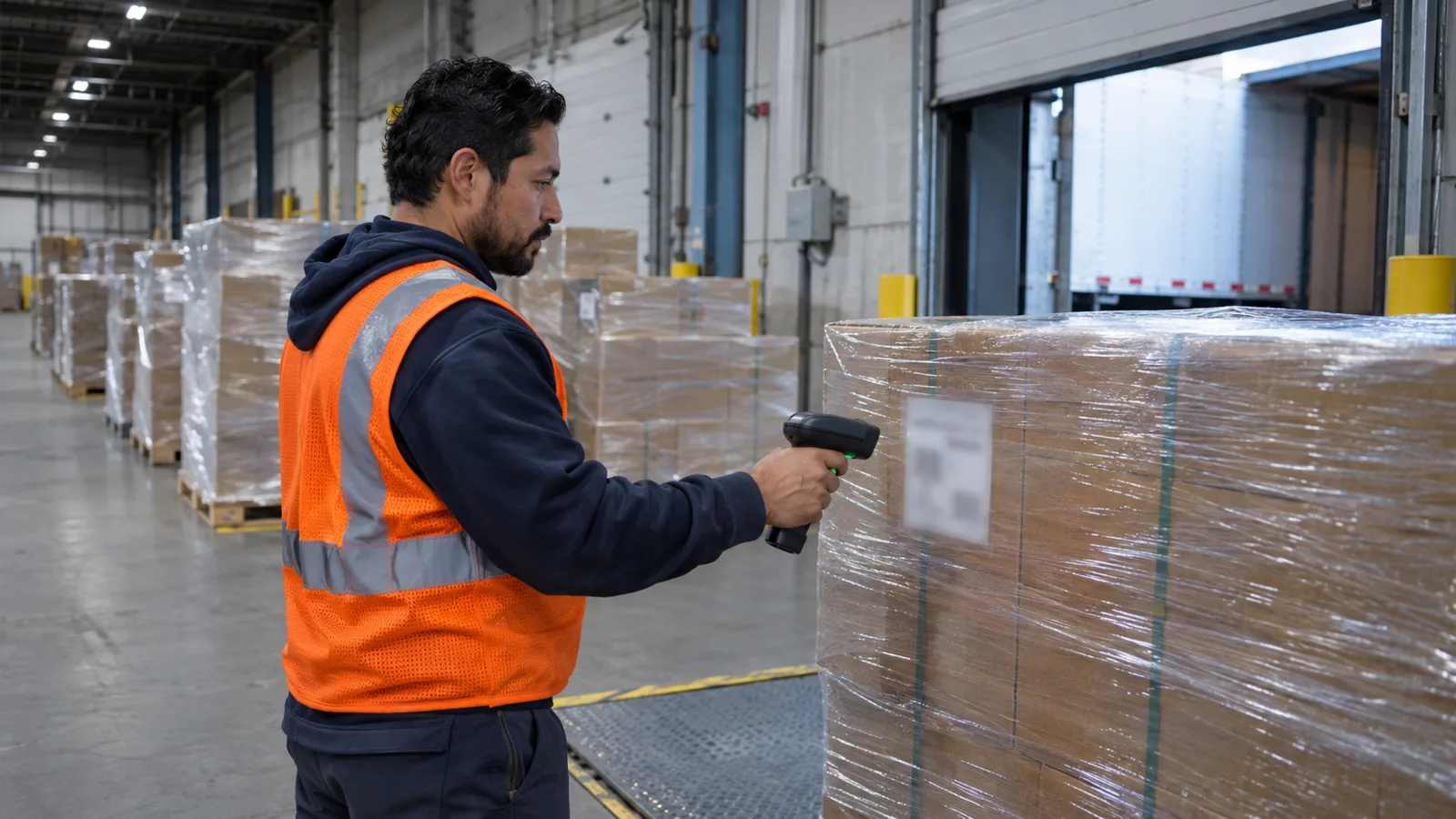
The ASN is where most compliance problems happen. It tells the retailer exactly what is on the truck: which pallets and cartons, identified by SSCC, contain which products and quantities, for which purchase orders. The receiving dock scans the label on each pallet and pulls its contents from the ASN instead of counting by hand. For that to work, the ASN must be accurate, must be sent before the truck arrives (often within a set window after shipping), and must match the physical labels exactly.
Stage 5: Transportation and delivery
Retailers usually specify how goods must be shipped. Some arrange pickup through their own carriers (collect), while others require the supplier to book with approved carriers and make a delivery appointment at the distribution centre. Arriving early, late or without an appointment can lead to refused loads or fees. In Canada, many large retail distribution centres are clustered in the Greater Toronto Area, the Montreal region, the Calgary and Edmonton area and the Lower Mainland of British Columbia, so lanes into those hubs are often where appointment discipline matters most.
Stage 6: The invoice (810)
Your invoice must reference the PO and match what was shipped and received, at the agreed prices. Mismatches lead to payment holds or deductions.
Stage 7: Remittance and deductions
The retailer pays the invoice, minus any chargebacks for compliance failures, allowances or shortages. Some send a remittance advice electronically (820). This is where you see the cost of every error in the earlier stages.
The Most Common Chargeback Triggers
Every retailer has its own penalty schedule, and the amounts and rules vary. The types of failures that commonly lead to chargebacks include:
- Missing or late ASN: the truck arrives before the retailer has the electronic record of its contents.
- Inaccurate ASN: quantities, items or SSCCs on the ASN do not match the physical shipment.
- Unscannable or missing labels: poor print quality, labels on the wrong side, labels covered by stretch wrap, or duplicate SSCCs.
- Pallet non-compliance: wrong pallet type, overhanging cartons, excessive height or mixed products where not allowed.
- Delivery failures: missed appointments, early or late delivery, or using an unapproved carrier.
- Order fill problems: short shipments, overages, substitutions without approval.
- Invoice errors: pricing or quantity differences from the PO or receipt.
Disputing Deductions Without Damaging the Relationship
Not every chargeback is valid. Receiving docks make mistakes too: a pallet scanned twice, a label damaged by a forklift after delivery, a shortage that turns out to be a misplaced case. Suppliers who never question deductions often give away money they are owed. Suppliers who dispute everything can wear out their welcome with the buyer. A balanced approach works best.
- Log every deduction as it appears on a remittance, with the PO, invoice, reason code and amount.
- Check the deadline. Most retailers set a window for disputes; after it closes, the deduction usually stands.
- Gather proof. Signed bills of lading, proof of delivery with appointment times, ASN transmission records, pallet photos taken at the dock and scan data from your warehouse are your strongest evidence.
- Submit through the retailer's official process, not by email to the category buyer, who usually cannot reverse finance deductions.
- Look for patterns. If the same error repeats on one lane or from one shift, fix the process rather than disputing the same problem every month.
This is where good records pay off. Photographing every outbound pallet and keeping the scan history behind each ASN costs little, but it turns a disagreement into a quick, documented resolution.
Shipping to Retailers on Both Sides of the Border
Many Canadian suppliers sell to retailers in the United States as well as at home, and the same retail banner can have different requirements for its Canadian and US operations. Routing guides, approved carriers, appointment systems and even label formats may differ. Cross-border retail shipments also need customs documentation, and the timing of an ASN has to account for the time a truck spends at the border. Treat each trading partner and country as its own setup, and test both before the first live order.
Ways to Connect to EDI
Suppliers generally choose one of three routes:
- Web-based EDI portals, where you log in, view POs and key in ASNs and invoices. Low cost and suitable for small volumes, but manual entry increases the risk of errors.
- Integrated EDI, where an EDI provider translates retailer documents directly into your ERP or accounting system and back. More setup, but far fewer keying errors as volume grows.
- Fulfillment partner integration, where your 3PL's warehouse management system generates ASNs and compliant labels from the actual scanned shipment data. This ties the electronic record to what physically left the dock.
Documents typically travel through a value-added network or a direct connection such as AS2, depending on what the retailer supports.
A Supplier's Compliance Checklist
- Obtain and read the current vendor compliance manual and routing guide for each retail customer, and note any differences between their Canadian and US requirements.
- Confirm your GS1 company prefix, GTINs and product data with each retailer before the first order. Our guide to GS1 barcodes in Canada covers this.
- Generate SSCC labels from your system rather than by hand, so every label is unique and tied to the ASN.
- Scan every carton and pallet at packing, not just at shipping.
- Test-print labels and check them with a barcode verifier if possible.
- Send ASNs automatically when the shipment is confirmed, and monitor for transmission failures.
- Book delivery appointments as soon as orders are ready, and track on-time performance.
- Review every deduction, dispute those that are incorrect within the retailer's deadline, and fix the root cause of valid ones.
Where a Warehouse Partner Fits
Much of EDI compliance is physical: the right labels, on the right pallets, built the right way, matched to an accurate electronic record. That is why many suppliers hand the work to a warehouse with experience shipping to major retailers. A warehouse management system that scans every case can produce ASNs from real data, not from what the order said should ship. Combined with retail fulfillment processes built around routing guides and EDI integrations, it takes much of the risk out of retail compliance.
For a broader view of how B2B shipping works alongside retail, see our article on shipping bulk orders to business buyers.
Protect Your Retail Margins
Winning a retail listing is hard work. Losing margin to avoidable chargebacks is frustrating, especially when the product itself is selling well. ShipCarte helps suppliers across Canada ship retail-compliant orders with accurate ASNs, GS1-128 labelling and disciplined pallet building. Schedule a consultation to review your retail requirements with our team.