
A consumer products supplier in Ontario has just landed a regional listing with a retail chain that has stores in every province. The buyer's purchase order is broken down by store: a few cartons for a location in Kelowna, a pallet for Regina, mixed cartons for twenty stores across Quebec and a handful for Charlottetown. Shipping each store order separately by parcel or LTL would be expensive and slow. Storing everything in a warehouse in each region would tie up inventory the supplier cannot afford.
This is the kind of problem cross-docking was invented to solve. In a cross-dock, freight arrives at a facility, is sorted and moved directly to outbound trucks bound for its destinations, typically within hours and rarely more than a day or two. Nothing goes into long-term storage. For a country as large and spread out as Canada, a well-designed cross-dock network can be the difference between profitable national distribution and a logistics bill that wipes out the margin.
This guide explains how cross-dock networks work, the different models, the operational requirements, and when cross-docking is the right choice compared with traditional warehousing.
The Core Idea
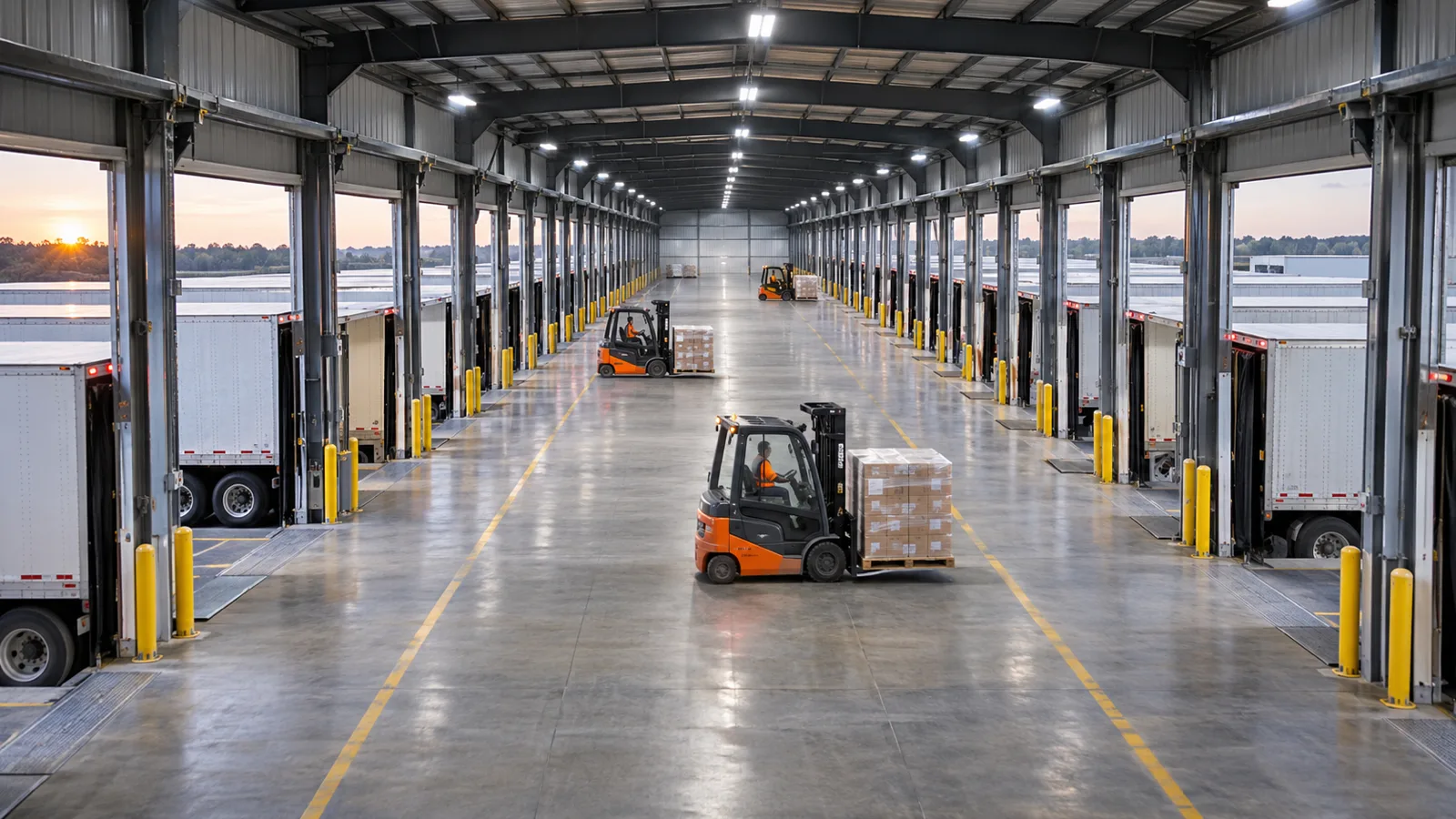
A cross-dock is usually a long, narrow building with dock doors on both sides. Inbound trailers back in on one side; outbound trailers on the other. Freight is unloaded, scanned, sorted by destination and loaded onto the appropriate outbound trailer. The building is designed for flow rather than storage, with plenty of floor space for staging and few or no racks.
The benefits are straightforward:
- Lower inventory. Goods are not held, so less capital is tied up in stock and less space is needed.
- Faster delivery. Eliminating storage and pick steps reduces the time between production and the store shelf.
- Consolidated transport. Many small shipments become a few full trucks for the long-haul leg, and are then broken down for local delivery.
- Fewer touches. Freight is handled once at the cross-dock instead of being put away, picked and packed.
Three Cross-Docking Models
Pre-distributed cross-docking
The supplier picks and labels each store's order before shipping, so freight arrives at the cross-dock already separated by destination. The cross-dock simply sorts the pre-labelled cartons or pallets onto the correct outbound trucks. Many Canadian retailers ask suppliers to ship this way into their own distribution centres, with labels showing the store number and a scannable shipping container code.
Post-distributed cross-docking
The supplier ships in bulk, and the cross-dock operator breaks the freight down and allocates it to destinations after arrival, based on current orders. This is more flexible but requires more handling, more labour and better systems at the cross-dock.
Consolidation cross-docking
Freight from multiple suppliers is combined into full loads for a single destination. A retailer's western stores might receive one consolidated trailer per week from a cross-dock in the Greater Toronto Area containing product from dozens of suppliers, instead of dozens of separate LTL deliveries.
How a National Cross-Dock Network Fits Canada's Geography
Canada's population and retail activity is concentrated in a long, thin band near the US border, with long distances between major markets. Cross-dock networks typically follow that pattern.
The central hub
For many suppliers, freight originates in or passes through the Greater Toronto Area, where a large share of Canadian manufacturing, importing and distribution is concentrated. A cross-dock there can receive inbound freight from manufacturers, importers and transload facilities, and build outbound loads for every region. Highway 401 connects it to southwestern Ontario and to Montreal.
Eastbound lanes
Freight for Quebec moves along the 401 and Highway 20 to Montreal and Quebec City. For Atlantic Canada, loads often travel to a regional cross-dock in or near Moncton, which sits at the centre of the Maritimes highway network, where they are broken down for Halifax, Saint John, Fredericton, Charlottetown and onward, with Newfoundland and Labrador served by ferry.
Westbound lanes
Westbound freight crosses northern Ontario to Winnipeg, a natural break point for Manitoba and Saskatchewan, then continues along the Trans-Canada and Yellowhead highways to Regina, Saskatoon, Calgary and Edmonton. A cross-dock in Calgary or Edmonton can serve Alberta and, in some networks, the BC interior. The final leg to the Lower Mainland crosses the mountains on routes that can be affected by winter conditions. Long-haul westbound legs are often moved by domestic intermodal rail rather than truck, which can be cost-effective for consolidated, non-urgent freight.
The west coast
Imports arriving through the Port of Vancouver can be cross-docked directly on the coast for stores in BC and Alberta, rather than travelling east to a central warehouse and then back west. This is often combined with transloading, where ocean containers are unloaded and the goods sorted directly into outbound loads.
What Suppliers Need to Get Right
Cross-docking only works if freight arrives exactly as expected. Because there is no buffer of stored inventory, errors show up immediately at the store. Retailers that operate cross-dock distribution centres typically have strict vendor compliance rules, and chargebacks for non-compliance are common. The essentials include:
- Advance ship notices (ASNs) sent electronically before the freight arrives, matching exactly what is on the truck.
- Compliant labels, usually including a GS1 serial shipping container code barcode, store number and purchase order.
- Accurate pallet builds to the retailer's specifications for height, weight, wrapping and pallet type.
- Delivery appointments booked and kept. Our article on delivery appointments in freight covers what retailers expect.
- Bilingual product labelling that meets Canadian requirements, such as the Consumer Packaging and Labelling Act, so goods can go straight to the shelf.
- EDI integration with the retailer for purchase orders, ASNs and invoices.
Many suppliers find it easier to have a third-party logistics provider handle this. A provider with retail fulfillment experience can receive bulk inventory, pick and label store orders, transmit ASNs and book delivery appointments, while EDI and system integrations connect the supplier, the 3PL and the retailer.
Cross-Docking Versus Warehousing: A Comparison
Inventory
Cross-docking: minimal; freight flows through.
Warehousing: stock held for weeks or months to buffer demand.
Speed
Cross-docking: very fast once freight arrives, but depends on suppliers shipping on time.
Warehousing: very fast from stock to customer, but goods sit longer overall.
Demand fit
Cross-docking: best for predictable, planned replenishment and promotional orders.
Warehousing: better for unpredictable demand, ecommerce orders and slow movers.
Information needs
Cross-docking: high; requires accurate ASNs and real-time coordination.
Warehousing: moderate; inventory can be counted and corrected while stored.
Cost profile
Cross-docking: lower storage costs, higher dependence on transport efficiency.
Warehousing: storage and handling costs, but more flexibility and resilience.
In practice, most Canadian distribution networks use both. Fast-moving, predictable retail replenishment flows through cross-docks, while safety stock, ecommerce inventory and slow movers sit in a distribution warehouse.
Is Your Business Ready for Cross-Docking?
Before committing a retail program to a cross-dock model, it is worth an honest self-assessment. Work through these questions with your sales, operations and finance teams:
- How predictable are your orders? Cross-docking works best when purchase orders arrive with enough lead time to plan inbound and outbound loads. If orders arrive with only a day's notice, a stocked warehouse may serve you better.
- Do you have enough volume on each lane? A weekly full trailer to western Canada makes consolidation easy. A few cartons every month may be better served by LTL or parcel.
- Can your systems produce accurate ASNs and labels? If not, plan to use a provider who can, or invest in the integration first.
- Is your supply reliable? If production or imports often arrive late, you will need some buffer stock somewhere, which may mean a hybrid of warehousing and cross-docking.
- Do you know the retailer's compliance rules? Read the vendor manual in full, including chargeback schedules, before you ship the first order.
- Who will monitor the flow? Someone needs to track inbound arrivals, outbound departures and exceptions daily, with clear escalation when something misses a connection.
If several answers are uncertain, starting with a single region or a single retailer is a sensible way to test the model before expanding across Canada.
Common Pitfalls
- Inaccurate ASNs. If the notice does not match the freight, the cross-dock must stop and investigate, and the store receives the wrong goods.
- Late inbound freight. Outbound trucks leave on schedule. Late inbound freight misses its connection and waits for the next departure.
- Poor packaging. Cartons that collapse under stacking or pallets that are unstable slow down handling and cause damage.
- Insufficient volume. Cross-docking relies on consolidation. Very small, irregular flows may not fill trucks efficiently.
- Weather. Winter storms on the Trans-Canada or through the Rockies can disrupt tight schedules. Plan for contingency, especially from November to March.
Cross-Docking in a Changing Retail Landscape
Recent years have tested retail distribution in Canada. Temporary store closures during the pandemic, rapid growth in online ordering and, more recently, tariff-driven swings in import timing have forced many retailers and suppliers to reconfigure flows at short notice. Cross-dock networks, which depend on predictable store replenishment, needed to adapt alongside warehouses supporting ecommerce. Suppliers that had flexible partners able to switch between store-bound cross-docking and direct-to-consumer ecommerce fulfillment coped better than those locked into a single channel. For more on balancing channels, see our post on omnichannel fulfillment.
Build Your Distribution Network With ShipCarte
ShipCarte helps suppliers and retailers across Canada move freight efficiently, combining warehousing, retail fulfillment and freight coordination so goods reach stores and customers on time. If you are preparing for a new retail listing or looking to cut storage and transport costs, schedule a consultation or request a quote.