
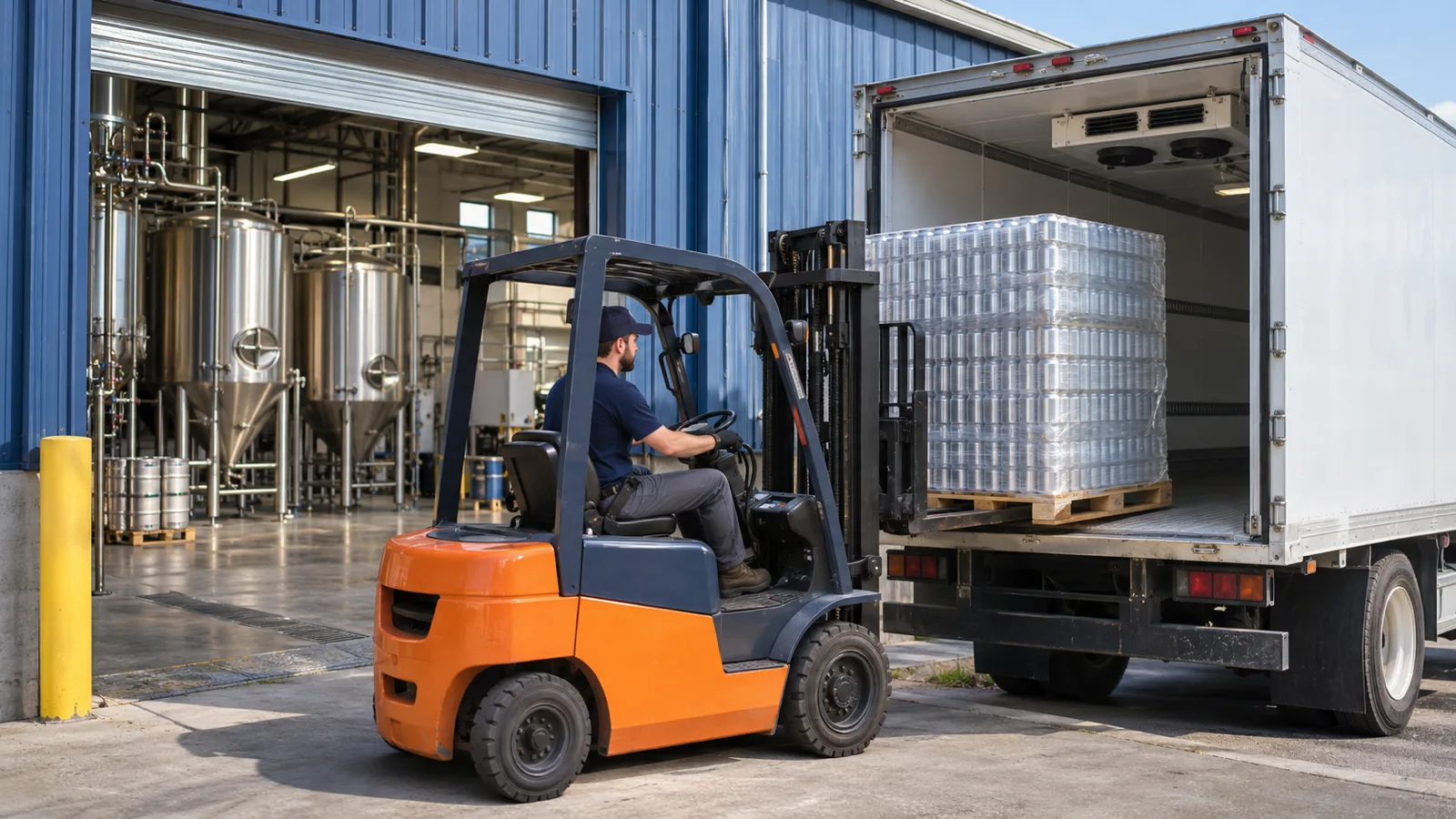
A small brewery in Canada usually starts by selling everything it brews out of its own taproom and to a handful of bars down the street. Then a listing comes through at the provincial liquor board, a grocery chain wants a four-pack on its shelves, and a beer shop two provinces away asks about a pallet. Suddenly the brewery that knew every keg by name has to think about pallet configurations, freight bookings, warehouse temperatures and delivery appointments.
Craft beer distribution in Canada is shaped by two forces that do not exist in most other consumer product categories. The first is regulation: alcohol sales are controlled by the provinces and territories, each with its own system of liquor boards, private retailers and permits. The second is freshness: many craft styles, especially hop-forward beers, start to lose their character within weeks if they are kept warm.
This article looks at how breweries move beer from the brewhouse to the shelf, what the main channels look like across the country, and how warehousing and transport choices protect both quality and margins.
A patchwork of provincial systems
There is no single national route to market for beer in Canada. Each province or territory decides how beer is sold, who can sell it and how it reaches stores. The details change often, so always confirm current rules with the relevant liquor authority, but the broad picture looks like this:
- Ontario: beer is sold through the LCBO, The Beer Store, licensed grocery stores and brewery retail stores. Each channel has its own listing process, delivery requirements and receiving rules.
- Quebec: beer is widely available in grocery stores and dépanneurs, with distribution often handled by the breweries themselves or by distributors. The SAQ plays a smaller role for beer than for wine and spirits.
- British Columbia: a mix of government and private liquor stores, with the Liquor Distribution Branch central to wholesale distribution, alongside direct delivery options for breweries.
- Alberta: retail is private, with the provincial regulator overseeing the system and a network of private warehouses involved in distribution.
- Prairies and Atlantic Canada: provincial liquor corporations in Saskatchewan, Manitoba, Nova Scotia, New Brunswick, Prince Edward Island and Newfoundland and Labrador each run their own listing and distribution systems, with varying roles for private stores and agency outlets.
For a brewery, that means a product that is ready for shelves in one province may need a separate listing, different labelling details, and a different delivery method in the next. Selling outside your home province also involves the provincial rules on importing alcohol, which usually route product through the receiving province's liquor authority. Federal excise duty on beer applies on top of the provincial markups and fees.
Freshness: the clock starts at packaging
Beer is not a perishable food in the food safety sense, but it is a fragile product in terms of flavour. Warm storage accelerates staling, and light and oxygen degrade aroma. Hoppy styles such as IPAs are particularly sensitive. Lagers and darker styles are more forgiving, but no beer improves in a hot trailer.
Practical steps that protect freshness through distribution:
- Keep beer cold from the brewery to the retailer whenever possible. Refrigerated storage and transport cost more, but they protect the brand.
- Date every can or case with a packaged-on or best-before date, and rotate stock first-in, first-out.
- Keep pallets out of direct sun on docks, and avoid leaving them in unrefrigerated trailers on hot days.
- Agree with retailers and distributors on how long beer can sit before it is pulled from shelves.
- Set production volumes for each SKU based on realistic sell-through, rather than brewing large batches that age in a warehouse.
A temperature-controlled warehouse with lot tracking gives breweries a place to hold finished goods at stable conditions, and FIFO rotation (see our explainer on what FIFO means) makes sure the oldest product ships first.
Packaging for distribution
Cans have become the dominant format for craft beer in Canada because they are light, block light and stack well. That said, cans are easily dented, and dented cans can be rejected by retailers. Distribution packaging needs to protect the primary package as well as the beer inside.
Case and tray choices
Four-packs and six-packs are usually bundled into trays or cases for shipping. Full corrugated cases protect better than open trays but cost more. Whatever you choose, the case should fit the pallet footprint without overhang, which causes crushed corners and leaning stacks.
Pallet build
Pallets should follow the receiving requirements of each customer: standard dimensions, maximum height, tie and tier patterns, corner boards and stretch wrap. Liquor boards and large retailers often publish detailed pallet specifications and may refuse pallets that do not comply. A well-built pallet also travels better by LTL freight, where it will be handled several times.
Kegs
Kegs for bars and restaurants are heavy, returnable and need to be tracked. Keg logistics is a cycle: full kegs out, empty kegs back, cleaning and refilling. Losing track of kegs is an expensive problem for growing breweries, so many use scanning or tagging to know where every keg is.
A scenario: expanding from one province to three
Consider a brewery in Ontario that has been selling to bars, its own retail store and a few LCBO and grocery listings. It decides to expand into Quebec and Manitoba. Here is how distribution changes:
- Listings and labels. The brewery obtains listings or agreements in each province, adjusts labels for bilingual requirements (which apply nationally but receive closer scrutiny in Quebec), and confirms any province-specific labelling or deposit marks.
- Inventory planning. Instead of brewing to fill one market, the brewery now needs forecasts for three. Each province's orders arrive on different schedules and with different minimums.
- Storage. The brewhouse cold room cannot hold three markets' worth of finished goods. The brewery moves overflow stock to a third-party temperature-controlled warehouse, freeing brewery space for production.
- Transport. Shipments to Quebec move along the Highway 401 and Highway 20 corridor in a day; shipments to Winnipeg take longer and cross the Canadian Shield, where winter weather can delay trucks. The brewery uses refrigerated LTL for smaller loads and full truckload when volumes justify it.
- Delivery appointments. Liquor board warehouses and distribution centres require booked appointments, and missing one can mean waiting days for another. Planning freight around those slots becomes part of the routine. Our explainer on delivery appointments in freight covers why they matter.
- Reporting. The brewery now needs clear visibility on stock by location and lot, plus sales by province, to decide when to brew and where to send each batch.
Direct-to-consumer delivery
Several provinces have expanded the ability of breweries to deliver directly to consumers, and many breweries started or grew home delivery when taprooms closed during the pandemic. The rules on who can deliver, what can be delivered and how age must be verified vary by province, and some changes were introduced as temporary measures. Before launching a delivery program, check:
- Whether your licence allows delivery and over what area.
- Whether you can use a third-party carrier, or must deliver with your own staff.
- How age verification at the door must be handled and documented.
- Whether you can deliver outside your province (generally much more restricted).
Parcel carriers often have their own policies on shipping alcohol, including account agreements and adult signature requirements, so confirm before shipping anything by courier.
When a third-party warehouse makes sense
Breweries often reach a point where finished goods outgrow the cold room and the brewers are spending time loading trucks instead of brewing. A third-party logistics partner can take over storage, order picking, pallet building and freight coordination. That typically makes sense when:
- Space at the brewery is needed for tanks, a canning line or an expanded taproom.
- You sell in multiple provinces and need product closer to those markets.
- Orders from liquor boards, grocers and distributors require consistent pallet builds and appointment-based deliveries.
- You want better visibility on stock and lots than spreadsheets provide.
Be aware that storing alcohol in a third-party warehouse can require specific licences or approvals depending on the province, and federal excise rules affect where duty-unpaid product can be held. Discuss this with your provincial regulator and your logistics partner before moving stock. ShipCarte's distribution warehousing and distribution services are built around the kind of B2B, pallet and case-level shipping that beer distribution involves.
Seasonality in beer
Beer demand in Canada rises in summer, around long weekends such as Victoria Day, Canada Day and the August civic holiday, and again in the holiday season with gift packs and seasonal releases. Seasonal styles (summer sours, autumn harvest ales, winter stouts) have short selling windows, and unsold seasonal beer is hard to move later. Plan seasonal volumes conservatively, ship them early enough to hit shelves at the start of the window, and keep a close eye on sell-through.
Damaged, dated and returned beer
Every distribution channel produces some product that cannot be sold: dented cans rejected at receiving, cases crushed in transit, and beer pulled from shelves after it passes the retailer's freshness window. Breweries that do not plan for this end up with mystery pallets in the corner of the cold room and write-offs nobody can explain.
- Record the reason for every rejection or return, so you can tell a packaging problem from a carrier problem or an over-ordering problem.
- Photograph damaged pallets at receiving before signing the delivery receipt, and note the damage on the paperwork; freight claims are much harder without it.
- Agree in advance with each retailer or liquor board who pays for stale-dated product and how it is collected or destroyed.
- Remember that destroyed or returned beer can have excise and provincial reporting implications, so keep records that match your filings.
Over time, those records show which SKUs are being over-produced, which lanes damage the most product, and whether a change in case design or pallet pattern would pay for itself.
Get your beer to the shelf fresh
ShipCarte supports food and beverage businesses across Canada with temperature-controlled warehousing, distribution and freight, helping breweries spend more time brewing and less time chasing pallets. Request a quote to talk about your provinces, volumes and storage needs.