
An importer of home furnishings sources most of its range from factories in Asia and a smaller collection from suppliers in Europe. Its customers are spread from British Columbia to Nova Scotia, and its main warehouse is in Ontario. For years the freight forwarder has simply routed everything through whichever port was quoted cheapest that month. Then a season of congestion strands several containers for weeks, and the company realises it has never actually thought about which port suits its business.
Canada has a handful of major container gateways on three coasts, plus the St. Lawrence River. Each has a different geography, different rail connections and different strengths. For an importer, the port your containers arrive at affects ocean transit time, inland transport cost, how quickly goods reach your warehouse, and how exposed you are when one gateway gets backed up.
This guide compares the country's main container ports from an importer's point of view and offers a framework for choosing, or for splitting volume between them. Over the past year, the surge in imports and the disruption to global shipping during the pandemic have made these choices more consequential than usual.
The questions that should drive the decision
Before comparing ports, get clear on what matters most to your supply chain:
- Where is your freight coming from? Asia, Europe, the Mediterranean, South Asia or South America all favour different coasts.
- Where is it going? The location of your warehouse or your customers decides how far each container has to travel inland.
- How time-sensitive is it? Seasonal products and fast-moving ecommerce SKUs reward speed. Stable replenishment can trade time for cost.
- How much risk can you tolerate? A single-port strategy is simpler; a two-port strategy gives you a fallback.
- What do your carriers offer? Not every shipping line calls every port, and service frequency varies.
Port of Vancouver
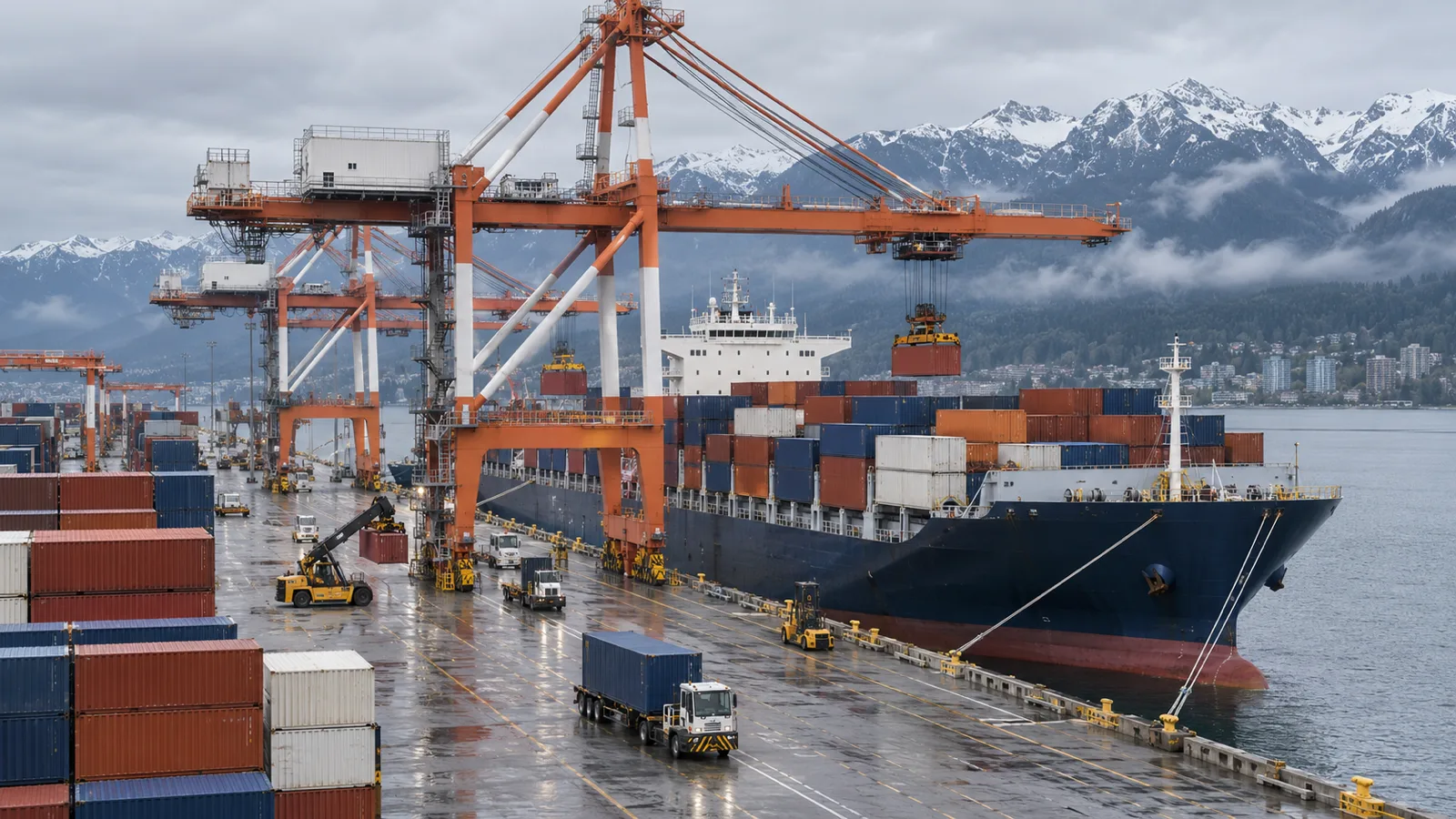
The Port of Vancouver is Canada's largest port and the country's main gateway for trade with Asia. It handles containers at several terminals around Burrard Inlet and at Roberts Bank in Delta, along with large volumes of bulk and breakbulk cargo.
Strengths for importers:
- Extensive service from trans-Pacific shipping lines and frequent sailings.
- Direct access to the Lower Mainland market, the largest consumer market in Western Canada.
- Rail connections from both national railways to the Prairies, central Canada and the US.
- A large ecosystem of customs brokers, transload warehouses and trucking companies.
Things to weigh: Because so much Asian freight funnels through Vancouver, it can see congestion when import volumes spike, and space at terminals and on inland trains can tighten. The rail route east crosses mountain passes that are occasionally disrupted by weather, slides or fire. Local warehouse space and drayage in the Lower Mainland are in high demand.
Best for: Asian imports destined for British Columbia and Alberta, and for importers who value frequent sailings and broad service choice.
Port of Prince Rupert
Prince Rupert on British Columbia's north coast is a deep-water port that sits closer to major Asian ports in sailing time than other West Coast gateways in North America. Its container terminal is designed primarily for transferring containers directly between ship and rail, with a rail line running east across northern BC to the Prairies and on to central Canada and the US Midwest.
Strengths for importers:
- Shorter ocean transit from Asia compared with ports further south.
- A rail-oriented model that can move containers inland efficiently, often with less local road congestion.
- A useful alternative when Vancouver is congested.
Things to weigh: Prince Rupert serves a small local market, so nearly everything moves inland by rail. That makes it excellent for containers headed to Edmonton, Winnipeg, Toronto or Chicago, but less useful if your goods are destined for the BC coast. Fewer shipping lines call there than at Vancouver, so check whether your carrier offers the routing.
Best for: Asian imports moving to inland destinations by rail, especially the Prairies, Ontario and the US Midwest.
Port of Montreal
The Port of Montreal sits on the St. Lawrence River, deep inside the continent, and is the main container gateway for Quebec and Ontario on the Atlantic side. It has long specialised in transatlantic trade with Northern Europe and the Mediterranean, and it operates year-round thanks to icebreaking on the river.
Strengths for importers:
- Proximity to the largest consumer markets in Canada: Montreal, the Greater Toronto Area and the Quebec City–Windsor corridor are a short truck or rail move away.
- Strong service from European shipping lines.
- Good road connections, including Highway 401 and Highway 20 toward Ontario, and rail links west and south.
Things to weigh: Because ships must travel up the river, there are limits on vessel size compared with deep-water ocean ports. Asian freight can reach Montreal via the Suez Canal or via transhipment, but transit times are usually longer than via the West Coast. Like any port, it has seen periods of labour uncertainty, which is worth factoring into a risk plan.
Best for: European and Mediterranean imports destined for Quebec and Ontario.
Port of Halifax
Halifax is a deep-water, ice-free harbour on the Atlantic and can handle some of the largest container ships calling on the East Coast of North America. It is often the first inbound or last outbound North American call on certain Atlantic and Suez services. Rail links connect Halifax to Montreal, Toronto and the US Midwest.
Strengths for importers:
- Ability to receive very large vessels.
- Services connecting to Europe, the Mediterranean, and Asia via the Suez Canal.
- Direct access to Atlantic Canada markets: Halifax, Moncton, Saint John, Fredericton, Charlottetown and St. John's.
- An alternative East Coast gateway when Montreal is congested or disrupted.
Things to weigh: For goods destined for Ontario or Quebec, Halifax adds a long inland rail move. Total transit may still compare well with other options, especially on Suez routings from South and Southeast Asia, but compare door-to-door timelines rather than port arrival dates.
Best for: Imports for Atlantic Canada, freight on large-vessel Suez services, and importers wanting an East Coast alternative to Montreal.
Port Saint John
Port Saint John in New Brunswick is a smaller but useful Atlantic gateway with container service and rail connections. For importers serving New Brunswick and parts of Nova Scotia, it can shorten the inland leg. Service options are narrower than at Halifax or Montreal, so it is usually part of a broader plan rather than a main gateway for national importers.
A side-by-side view
- Asia to BC or Alberta: Vancouver is usually the natural choice; Prince Rupert is a strong option for rail-bound freight to Alberta.
- Asia to Ontario or Quebec: Vancouver or Prince Rupert plus rail is usually fastest; Halifax via Suez or Montreal via transhipment can be competitive on cost and offers diversification.
- Asia to the Prairies: Prince Rupert or Vancouver with rail to Winnipeg, Regina, Saskatoon, Calgary or Edmonton.
- Europe to Ontario or Quebec: Montreal first, with Halifax as an alternative.
- Europe to Atlantic Canada: Halifax, or Saint John depending on service.
- Any origin to Western Canada with time pressure: Avoid East Coast routings unless pricing is compelling.
Beyond the port: what happens next
Arrival at the port is only half the journey. Importers should plan the inland leg with as much care as the ocean leg:
Customs clearance
Every commercial import must be reported to and released by the Canada Border Services Agency. Working with a licensed customs broker, filing accurate commercial invoices, and having your business number and import account in order all speed release. Products regulated by the CFIA, Health Canada or other agencies may need permits or additional documentation, so line those up before the container sails. The CBSA is modernising its commercial systems through its CARM initiative, and importers should keep an eye on announcements about how that will affect accounting and payment.
Inland rail and drayage
Containers move from port terminals inland either by rail to an intermodal terminal near your warehouse, or by truck directly. Drayage covers the short truck moves between terminal and warehouse. Our guide to rail intermodal across Canada explains how this works and what it costs.
Transloading and deconsolidation
Some importers unload ocean containers near the port and reload the goods into 53-foot domestic trailers, sorting by destination as they go. This can reduce inland costs and allow a single ocean shipment to feed several regional warehouses. It also lets you return ocean containers to the port quickly, limiting per diem charges.
Receiving and storage
Once goods reach your warehouse, they need to be received, checked and put away quickly so they are available to sell. A distribution warehousing partner with container unloading experience can turn a container around in a day, while a bonded warehouse lets some importers defer duties until goods are released into the Canadian market.
Reducing risk with a multi-port strategy
The past year has shown how quickly a single gateway can become a bottleneck. Importers with meaningful volume should consider:
- Qualifying a second port before you need it. Have your forwarder quote both routings regularly.
- Splitting volume between coasts for products sold nationally, so West Coast arrivals serve Western Canada and East Coast arrivals serve the East.
- Holding regional inventory. Stock in a western and an eastern warehouse reduces the distance each order travels and the impact of any one port's disruption.
- Monitoring dwell times. Ask your forwarder for regular updates on container dwell at the port and at inland rail terminals.
- Building buffer into lead times during periods of congestion, rather than assuming standard transit.
Plan your imports with a partner who sees the whole route
There is no single best port for importing into Canada. Vancouver offers unmatched service frequency for Asian trade, Prince Rupert excels at moving containers straight onto rail, Montreal sits on the doorstep of central Canada's markets, and Halifax brings deep water and an Atlantic gateway. The right choice depends on where your goods come from, where they need to go and how much disruption you can absorb.
ShipCarte helps importers across Canada with the inland side of the journey, from truckload and distribution services to warehousing and fulfilment. Schedule a consultation to talk through your import flows and where your containers should land.