
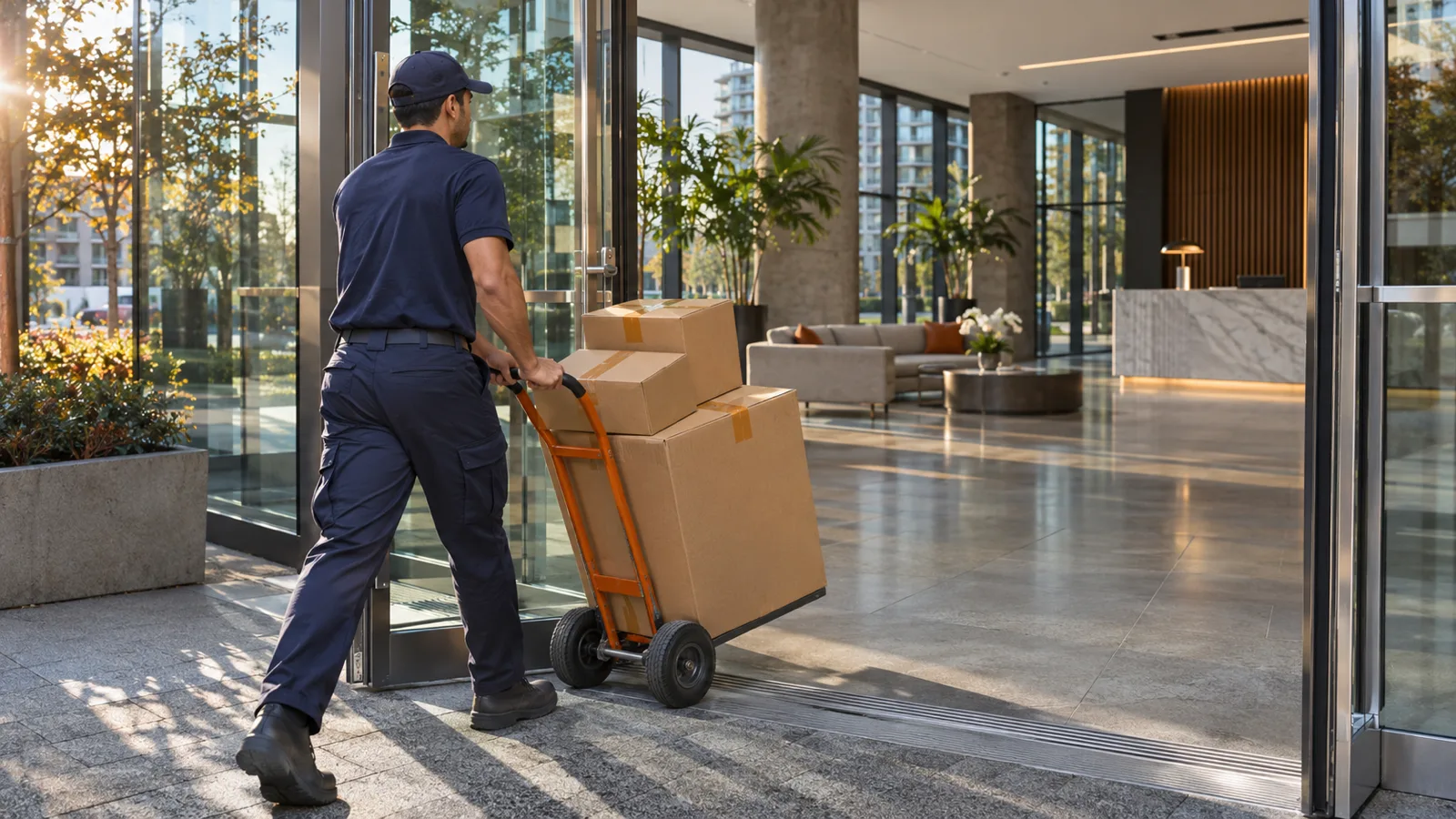
A meal kit company delivers to a customer on the thirty-second floor of a condo tower beside Square One. The driver arrives at 6:15 p.m., circles twice looking for somewhere to stop on Burnhamthorpe Road, finally parks in a short-term spot, and finds the concierge desk unstaffed. The buzzer list shows unit numbers but no names. The customer does not answer. The box goes back to the van, and the next morning the customer posts a complaint about a missed delivery that they were home for.
Mississauga City Centre has changed enormously over the past two decades. The area around Square One, Hurontario Street, Burnhamthorpe Road, Rathburn Road and Confederation Parkway now holds a dense cluster of residential towers, office buildings, the Civic Centre, Sheridan College's Hazel McCallion campus and a busy retail core. With the Hurontario LRT bringing more transit and development to the corridor, the number of people living and working there keeps growing, and so does the volume of parcels heading into those buildings.
Delivering into vertical buildings is a different job from suburban doorstep delivery. This guide answers the questions businesses most often ask about courier service for City Centre offices and condos, whether you ship to customers there or run an office that needs reliable courier pick-ups.
Why is delivering to City Centre towers harder than a house?
On a suburban street in Churchill Meadows or Meadowvale, a driver pulls up, walks to the door, and leaves the parcel or hands it over. In a high-rise, the same delivery involves several extra steps, each of which can fail:
- Finding legal, safe parking or the building's loading area.
- Getting into the lobby, which may require a buzzer, a fob or a concierge.
- Deciding whether the parcel goes to the concierge, a parcel room, a smart locker, or the recipient's unit.
- Waiting for elevators, sometimes shared with move-ins or service traffic.
- Obtaining a signature or proof of delivery.
Each step takes time. A driver who can do eight or ten suburban stops in an hour may manage far fewer in towers, which is why some carriers price dense urban zones differently or route them separately.
Where do parcels actually end up in a condo building?
It depends on the building's policy, and policies vary widely across City Centre towers:
- Concierge acceptance. Many buildings have a concierge or security desk that signs for parcels and holds them for residents. Some limit how long they will hold items, or refuse oversized or perishable deliveries.
- Parcel rooms. Secure rooms where couriers drop parcels and residents collect them with a fob.
- Smart lockers. Lockers where the courier deposits the parcel and the resident receives a code. They work well for standard parcels but can fill up quickly during peak season, and large items may not fit.
- Door delivery. Some buildings allow couriers up to units, others do not, and some only allow it when the resident comes down or authorizes access.
For shippers, the lesson is to collect enough information at checkout to support whichever method the building uses: unit number, buzzer code, a phone number the driver can actually reach, and a delivery instructions field.
What about perishable or temperature-sensitive deliveries?
This is where tower deliveries get tricky. Meal kits, groceries, flowers, pharmaceuticals and specialty foods cannot sit at a concierge desk all day. A few practical approaches:
- Offer delivery windows that match when residents are home, often evenings.
- Use insulated packaging and refrigerants sized for the longest realistic dwell time, not the ideal case. Our article on shipping temperature-sensitive products explains how to plan for that.
- Send proactive notifications with live tracking so the customer knows when to go down to the lobby.
- Check whether buildings in your delivery area allow refrigerated lockers or have policies against holding perishables.
For food and health brands, cold chain fulfillment starts in the warehouse with correct pack-outs, long before the parcel reaches a tower lobby.
How should City Centre offices manage outbound courier?
Offices in the City Centre and nearby business parks, including the Airport Corporate Centre and Heartland, send contracts, samples, equipment and documents every day. Common problems include missed pick-ups, packages left at reception with no paperwork, and inconsistent carriers chosen by whoever happens to book them.
Practical fixes include:
- Set up scheduled daily pick-ups with one or two carriers rather than booking each one on demand.
- Agree on where outbound parcels are left, and make sure building security knows the courier is coming.
- Use one shipping account or shipping platform so rates, labels and tracking are centralized instead of spread across personal accounts and credit cards.
- Check the building's loading dock rules. Many office towers require couriers to use the dock and to book freight elevator time for larger shipments.
- Note your building's dock hours and the cut-off for same-day pick-up.
Are there parking and loading challenges?
Yes. City Centre streets carry heavy traffic, and on-street stopping is restricted in many places. Construction associated with new towers and transit has also changed lane configurations at times. Couriers delivering here rely on building loading docks where available, designated short-term spots, and timing routes to avoid rush hours on Hurontario Street, Burnhamthorpe Road and the ramps to Highway 403.
For shippers, this mostly shows up as delivery time variability and, occasionally, as failed attempts. Accurate address data, including the building's delivery entrance where it differs from the street address, helps drivers find the right door first time.
What delivery speed should customers in City Centre expect?
Parcels shipped from a warehouse in Mississauga to a City Centre address often qualify for next-day ground delivery with the major carriers, and same-day service is available through local courier companies. Because the distance is short, the main variables are cut-off times at the shipping warehouse and the carrier's route planning, not distance. For e-commerce brands, holding inventory locally is what makes these fast delivery promises possible. Read our guide to first-mile and last-mile delivery for more on how those legs fit together.
How can e-commerce brands reduce failed deliveries to towers?
Failed deliveries cost money and frustrate customers. A checklist for brands shipping to dense residential areas like City Centre:
- Make the unit or suite number a required, clearly labelled field at checkout.
- Collect a mobile phone number and pass it to the carrier.
- Add a delivery instructions field and transfer its contents onto the label or carrier data.
- Offer pick-up point or locker delivery as an alternative where your carriers support it.
- Use signature options thoughtfully. Requiring signatures on low-value items increases failed deliveries in buildings where concierges are not always present.
- Send tracking notifications that include an estimated delivery window.
What about large items like furniture or appliances?
Oversized items need more planning. Many condo buildings require residents to book the service elevator and loading dock for large deliveries, sometimes with a deposit. Standard parcel carriers may not handle items above certain size or weight limits, so these deliveries usually move by LTL or a specialized home delivery service with two-person crews. Coordinate the delivery appointment with the customer before the item ships, so they can book the elevator. Our article on delivery appointments in freight covers the basics.
What should property managers know?
Building managers and condo boards in City Centre are dealing with parcel volumes their lobbies were never designed for. Concierge desks fill with boxes, residents complain about lost items, and couriers block driveways. A few approaches tend to help everyone:
- Publish clear delivery instructions, including the delivery entrance, dock hours and where couriers should go, and share them with residents so they can add them to their online orders.
- Set a clear policy for parcels the concierge will and will not accept, such as perishables, oversized items and signature-required deliveries.
- Consider parcel rooms or lockers sized for actual volumes, including peak season between November and January.
- Keep a short-term loading spot clear for couriers, which reduces illegal stopping on busy streets.
- Ask residents to collect parcels promptly so storage space does not run out.
For businesses shipping into these buildings, knowing that each tower may have its own rules is half the battle. Customer service teams can save time by recording building-specific instructions when customers mention them, so repeat orders go smoothly.
Do offices still need document couriers?
Less than they used to, since e-signatures replaced many paper contracts. But law firms, medical offices, engineering consultancies and government-facing businesses around the Civic Centre still send original documents, sealed bids, prototypes and equipment. For these, same-day courier service across the GTA remains useful, and chain-of-custody details such as signatures and timestamps matter. Choose a courier that provides proof of delivery with the recipient's name and time, and keep those records with the file.
How does a 3PL help with City Centre deliveries?
A third-party logistics partner in Mississauga does not drive every last-mile route itself, but it controls the parts of the process that determine success. ShipCarte stores inventory locally, picks and packs orders with the right packaging, and selects carriers through its platform based on service level and cost. Our small parcel shipping service connects with multiple carriers, and carrier management helps compare performance across them so you can see which ones handle dense urban deliveries best. Customers and your support team can follow parcels through our tracking page.
Deliver to the towers with confidence
City Centre is one of the fastest-growing delivery areas in Mississauga, and getting it right takes better data, smarter packaging and the right carrier mix. If you ship to customers or offices there and want fewer failed deliveries, request a quote or schedule a consultation with ShipCarte.