
A procurement manager at a national retailer sends a supplier questionnaire to a consumer goods company in Mississauga. Most of it is familiar: pricing, lead times, insurance. Then comes a new section asking how the company measures and reduces emissions from transportation. The operations director realizes she can describe exactly how many pallets ship each week and to where, but not what that means in carbon terms, or what the company is doing to lower it.
That kind of question is becoming more common. Large retailers, public sector buyers and investors are asking suppliers about their environmental footprint, and transportation is usually one of the largest pieces for companies that make and move physical goods. Customers notice too, especially in e-commerce, where oversized boxes and multiple partial shipments are visible on the doorstep.
The good news is that many of the most effective ways to reduce shipping emissions also reduce shipping costs. Fewer kilometres, fuller trucks and smaller boxes are good for both the planet and the budget. This article looks at where emissions come from in a typical shipping operation in Mississauga and which changes tend to make the biggest difference.
Where Shipping Emissions Actually Come From
For most businesses, transportation emissions fall into a few buckets:
- Inbound freight. Moving raw materials, components or finished goods from suppliers to your warehouse, often by ocean, rail and truck.
- Outbound freight. Truckload and LTL shipments to retailers, distributors and other business customers.
- Parcel delivery. Small packages to consumers and businesses, including the final, often least efficient, last-mile leg.
- Returns. Reverse shipments, which double the transport for every item that comes back.
- Air freight. Expedited shipments and air express parcels, which are far more carbon-intensive per kilogram than ground or ocean transport.
For most companies these are counted as indirect emissions in their value chain, because the trucks and planes belong to carriers. That doesn't mean they're out of your control. The decisions you make about packaging, consolidation, modes and locations shape how much fuel the carriers burn on your behalf.
Lever 1: Ship Less Air
Oversized packaging is one of the most visible inefficiencies in e-commerce. A small item in a big box takes up space on a truck that could hold other parcels, uses more corrugated material, and usually needs more void fill. It also costs more, because carriers bill on dimensional weight. Our article on how package dimensions affect shipping costs explains how that works.
Practical steps include:
- Stocking a range of box sizes that matches your product mix, rather than one or two sizes for everything.
- Using cartonization software that selects the smallest suitable box for each order. ShipCarte's cartonization capability does this automatically within the warehouse system.
- Switching to padded mailers or poly mailers for soft, non-fragile goods like apparel.
- Choosing recyclable or recycled-content materials where they protect the product adequately.
Lever 2: Fill the Truck
A truck burns roughly the same fuel whether it's half full or completely full, so emissions per pallet fall as load utilization rises. For business-to-business shippers, that means:
- Consolidating orders. Instead of sending several small LTL shipments to the same customer over a week, agree on fewer, larger deliveries where the customer's inventory plans allow.
- Building pallets well. Stable, properly stacked pallets can often be double-stacked, which makes better use of trailer space.
- Choosing truckload when volume supports it. A full truckload going directly from Mississauga to a distribution centre avoids the extra handling and terminal stops involved in LTL. ShipCarte's full truckload and LTL freight services can help you compare which fits each shipment.
- Using pooled distribution. Sharing truck space with other shippers heading to the same region improves utilization without waiting to fill a truck on your own.
Lever 3: Choose the Right Mode
Air freight is fast but very carbon-intensive. Rail is generally among the most efficient ways to move heavy goods over long distances on land. Ocean is efficient per tonne-kilometre but slow. Truck sits in between and offers the most flexibility.
For a Mississauga business, a few common opportunities stand out:
- Review air shipments. Many expedited air shipments are the result of poor planning rather than true urgency. Better forecasting can shift some of them to ground.
- Use intermodal for long hauls. Shipments heading to Western Canada can often move by rail for the long middle leg, with trucks handling pickup and delivery. Transit is longer, so it suits replenishment rather than urgent orders.
- Keep ground as the default for parcels. From the GTA, ground service reaches much of Ontario and Quebec quickly. Reserve express air for destinations and situations where it's genuinely needed.
Lever 4: Put Inventory in the Right Place
Distance is the simplest driver of emissions. If most of your customers are in southern Ontario, Quebec and the northeastern U.S., holding stock in Mississauga keeps average delivery distances short. Highways 401, 403, 407 and the QEW put a huge customer base within a short drive.
For businesses with significant demand in Western Canada, it may be worth splitting inventory between an eastern and a western location. Shipping a full truckload or rail container west once, then delivering locally, is often more efficient than sending thousands of individual parcels across the country.
Lever 5: Reduce Split Shipments and Failed Deliveries
Every time an order ships in two boxes because one item was in a different location, or a parcel has to be redelivered because nobody was home, extra kilometres are driven. Some practical fixes:
- Keep accurate inventory so orders can be filled complete from one location.
- Offer customers delivery to pickup points or parcel lockers, where available.
- Send proactive tracking notifications so recipients know when to expect a delivery.
- Collect accurate addresses at checkout, with validation, to avoid misdeliveries and returns to sender.
Lever 6: Cut Avoidable Returns
Returns create a second journey for the same product, often followed by a third if the item is resold. Some returns are inevitable, but many are avoidable: wrong items shipped, damage in transit, or products that didn't match their description. Accurate picking, protective packaging and clear product information all reduce returns. When returns do happen, processing them quickly so items can be resold from the nearest warehouse avoids extra transport. ShipCarte's returns management service is built to inspect and restock items efficiently.
Lever 7: Work With Carriers Investing in Cleaner Fleets
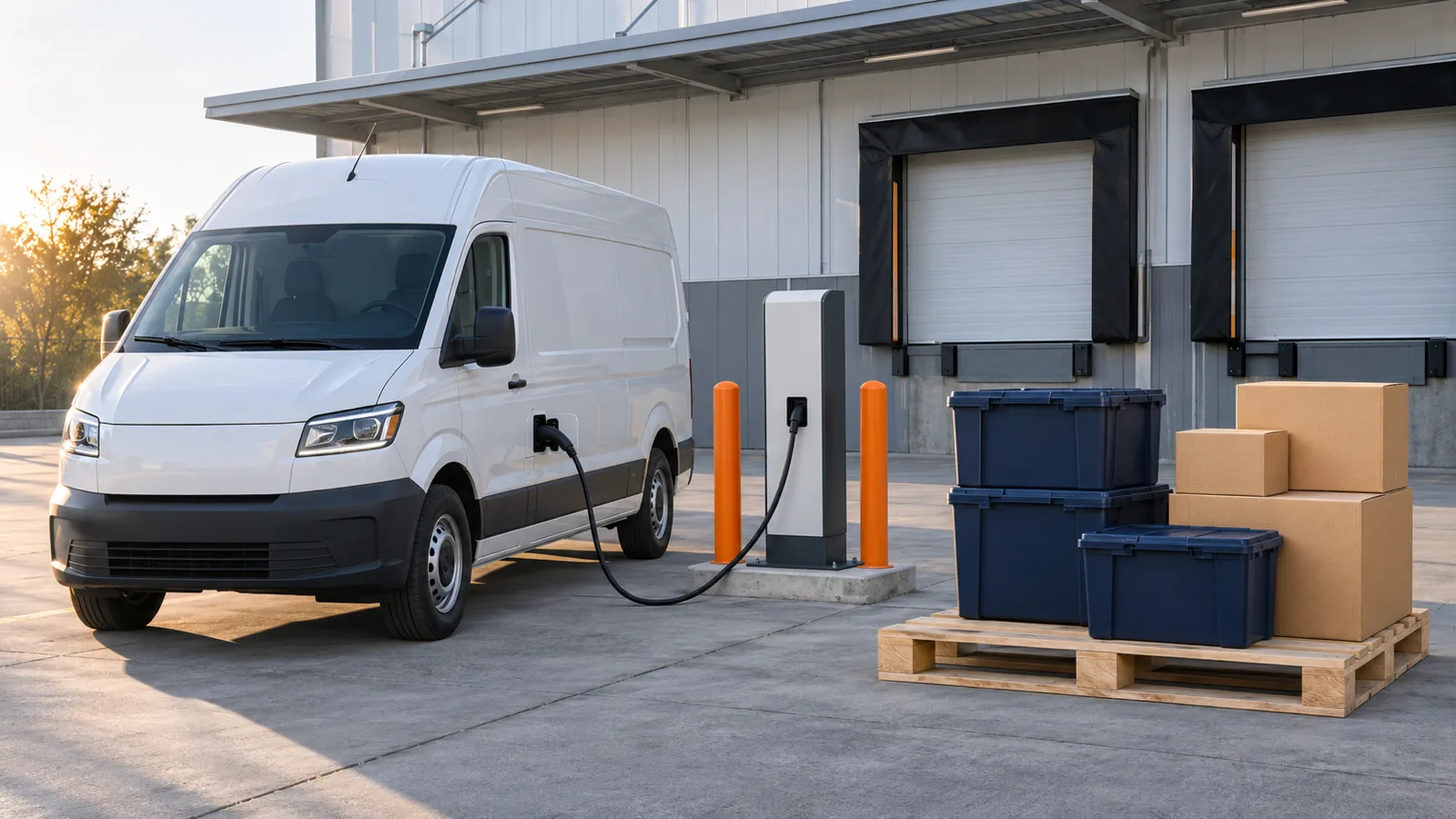
Many carriers operating in the GTA are adding electric delivery vans, testing alternative fuels and optimizing routes. Their progress varies, and claims should be checked rather than taken at face value, but carrier choice can make a difference over time. Ask carriers what they report on emissions, what programs they offer, and whether they can provide shipment-level emissions estimates.
Lever 8: Work Around Mississauga Congestion
Anyone who has driven the 401 near the 410 and 403 interchanges at rush hour knows how much time trucks can spend idling or crawling. Congestion burns fuel without moving goods anywhere. Shippers can't fix traffic, but they can schedule around it:
- Arrange receiving appointments and outbound pickups outside peak commuting hours where your customers and carriers allow it.
- Ask retail customers whether early-morning or evening delivery windows are possible at their distribution centres.
- Avoid booking urgent same-day runs across the city in the late afternoon when a next-morning delivery would serve the customer just as well.
- For regular routes, let carriers optimize stop sequences rather than insisting on fixed time windows that force inefficient routing.
Talking About Your Progress Honestly
Once you've made changes, it's natural to want to tell customers. Be careful with claims. Statements like "carbon neutral shipping" or "eco-friendly packaging" invite scrutiny, and Canada's Competition Act addresses misleading environmental claims. It's safer, and usually more persuasive, to describe specific actions: "We've switched to right-sized boxes made with recycled content" or "We now consolidate shipments to our retail partners into weekly deliveries." Specific, verifiable statements build trust with both consumers and the procurement teams asking the questions.
Measuring Your Starting Point
You can't credibly claim improvement without a baseline. A simple approach for a mid-sized shipper:
- Gather shipment data for a representative period: origin, destination, weight, mode and carrier.
- Apply recognized emission factors for each mode, or request estimates from carriers who provide them.
- Calculate totals by lane, mode and customer to see where emissions concentrate.
- Pick two or three changes from the levers above and track their effect over the following months.
Good shipping data makes this much easier. ShipCarte's reporting and analytics tools give clients visibility into shipment volumes, weights and carriers, which is the raw material for any emissions estimate.
A Few Myths Worth Clearing Up
"Sustainable shipping always costs more."
Not necessarily. Right-sized packaging, fuller trucks and fewer split shipments usually lower costs. Some options, like carbon offset programs or certain alternative-fuel services, can add cost, but the foundational improvements tend to pay for themselves.
"Offsets are enough."
Offsets can play a role, but buyers and regulators increasingly want to see actual reductions first. Reducing emissions at the source is more credible than compensating for them afterwards.
"Our shipments are too small to matter."
Individually, maybe. But your customers are adding up their suppliers' emissions, and the small decisions across thousands of shipments add up too.
Build a Leaner, Cleaner Shipping Operation
Reducing the carbon footprint of shipping from Mississauga mostly comes down to doing logistics well: fewer wasted kilometres, less empty space and fewer repeated journeys. ShipCarte can help you find those opportunities in your packaging, carrier mix and distribution model. Schedule a consultation to review your shipping data and talk about where improvements could come from.