
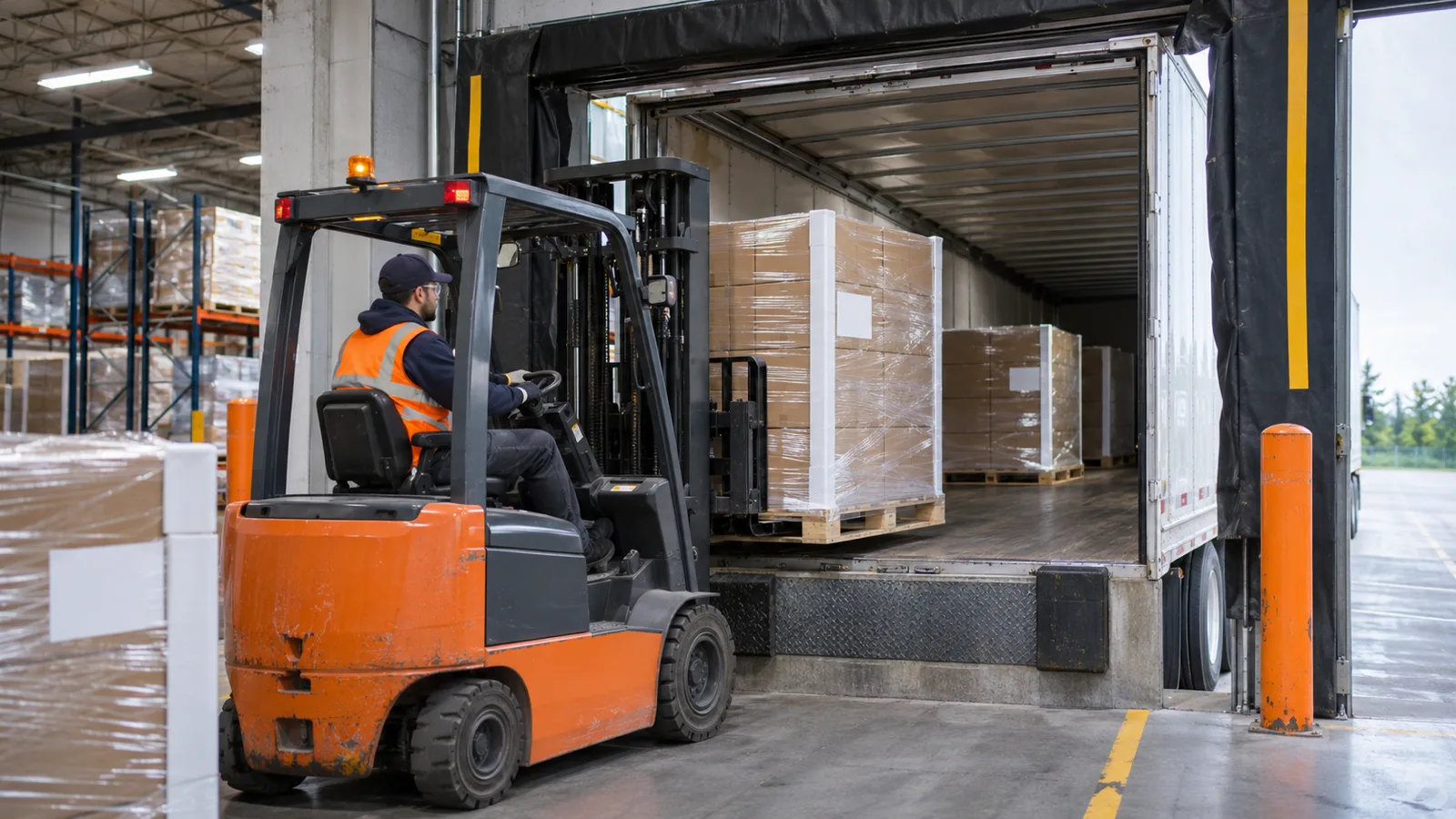
A snack brand based near Sheridan Park lands its first purchase order from a national grocery chain. The team celebrates, books a truck, and ships 12 pallets to the retailer's distribution centre. Three weeks later the payment arrives, but it is short. Deductions for missing advance ship notices, non-compliant carton labels, pallets taller than the allowed height and a missed delivery appointment have quietly eaten a meaningful slice of the invoice. Nobody had read all 60 pages of the vendor routing guide.
That experience is a rite of passage for many brands moving into retail. Big-box and grocery retailers run their distribution centres on tight schedules and automated systems. To keep them flowing, they publish detailed rules for how suppliers must label, pack, document and deliver. Breaking those rules triggers chargebacks, sometimes called compliance fines or deductions, and repeated problems can put the relationship at risk.
Mississauga is one of the busiest B2B distribution hubs in Canada, surrounded by retailer distribution centres across Peel, Halton and York regions. This guide explains what retailer compliance involves and how to set up B2B distribution from Mississauga so your orders arrive exactly as the buyer expects.
What a routing guide actually contains
A routing guide, also called a vendor compliance manual or supplier requirements guide, is the retailer's rulebook. The details differ between retailers, but most cover the same territory:
- Transportation: Whether the retailer arranges freight (collect) or you do (prepaid), approved carriers, how to request a pickup, and which shipments go LTL versus truckload.
- Delivery appointments: How to book, how far in advance, and penalties for being late, early or missing the slot.
- Electronic documents: EDI transactions such as purchase orders (850), advance ship notices (856) and invoices (810), with timing rules.
- Labelling: GS1-128 shipping labels with Serial Shipping Container Codes (SSCC), label placement on cartons and pallets, and product barcodes.
- Packaging: Carton strength, maximum weights, inner packs, case-pack quantities and product presentation.
- Pallet specifications: Pallet type and grade, maximum height and weight, stacking patterns, overhang rules and wrapping.
- Documentation: Bill of lading content, packing lists, and any regulatory documents.
- Chargeback schedule: The penalties for each type of non-compliance.
The first job with any new retail customer is to read the guide end to end and turn it into a checklist your warehouse can follow.
The five compliance areas that cause most chargebacks
1. Advance ship notices that are late or wrong
An ASN tells the retailer exactly what is coming: which purchase order, how many cartons, which SSCC is on which carton or pallet, and what is inside each one. The retailer's receiving systems scan your labels and match them to the ASN. If the ASN is missing, late or does not match the physical shipment, receiving slows down and the retailer typically charges for it.
Getting ASNs right means your warehouse system must record what goes into each carton as it is packed and then transmit that data through EDI. ShipCarte works with EDI providers to connect retailer orders directly to the warehouse; its post on the partnership with SPS and CommerceHub explains how that connection works.
2. Labels that will not scan or are in the wrong place
Retailers expect GS1-128 labels with an SSCC on each carton and/or pallet, printed clearly and placed in a specific position. Smudged thermal printing, labels on the wrong face, labels wrapped over a corner, or stretch wrap covering the barcode all cause scan failures. Product-level barcodes must match the UPCs registered with the retailer. If the difference between product identifiers is new to you, see ShipCarte's explainer on SKU versus UPC numbers.
3. Pallets that do not meet specs
Pallet rules commonly cover pallet type and condition, maximum height, maximum weight, no overhang, interlocking or column stacking, corner boards, and wrapping. In Canada, retailers commonly specify standard 48 by 40 inch pallets of a defined grade, and some participate in pallet exchange or pooling programs. A pallet that is too tall or unstable may be refused or reworked at your expense.
4. Missed or mismanaged delivery appointments
Retailer distribution centres schedule dock doors tightly. Arriving late, arriving early without approval, or not having an appointment at all can lead to refusal and fines. When the retailer controls freight, you may have to tender the shipment to their nominated carrier by a set date. When you control freight, you or your carrier must book the appointment, which requires accurate pallet counts and purchase order details. ShipCarte's article on delivery appointments in freight goes into the mechanics.
5. Order accuracy and fill rate
Short shipments, overages, wrong items and substitutions all count against you. Many retailers also track fill rate, the percentage of ordered units actually shipped, and on-time-in-full performance. Persistent shortfalls can lead to reduced orders or delisting.
Canadian-specific considerations
Brands selling to Canadian retailers face a few requirements that US-based guides do not always emphasize:
- Bilingual labelling. Consumer packaging generally needs English and French under federal rules, and some retailers apply bilingual requirements to case labels and inner packs too.
- Food and health products. Food shipments must meet Safe Food for Canadians requirements, including traceability, and health products have Health Canada licensing and labelling rules.
- Dangerous goods. Products such as aerosols, certain cleaning products and lithium batteries may fall under Transportation of Dangerous Goods (TDG) regulations, which affect documentation and handling.
- Imported goods. If you import product before distributing it, customs clearance through CBSA, accurate classification and CARM account management all affect when stock is available to ship.
Why Mississauga is a strong base for retail distribution
Location matters in B2B distribution because delivery appointments and lead times are tight. From Mississauga, shipments reach retailer distribution centres in Brampton, Vaughan, Milton, Bolton and Toronto in a short drive using Highways 401, 407, 410 and 427. Eastern Ontario and Quebec are a day's trucking away via the 401, and US retailers are reachable through the Niagara crossings and the Ambassador Bridge.
The density of LTL and truckload carriers in Mississauga also helps. When a retailer moves an appointment or a purchase order lands with a short ship window, having many carriers close by makes it easier to find capacity.
A pre-shipment compliance checklist
Before any retail order leaves the dock, a well-run warehouse checks:
- The purchase order has been acknowledged and any changes accepted.
- Items and quantities match the PO, including case packs.
- Each carton carries the correct GS1-128 label in the correct position, and labels scan.
- Pallets meet type, height, weight and build requirements, with labels visible outside the wrap.
- The ASN has been generated from scanned data and transmitted on time.
- The bill of lading includes PO numbers, pallet and carton counts, and any required references.
- The delivery appointment is booked or the freight has been tendered to the retailer's carrier.
- Photos of finished pallets are taken and stored, which is invaluable for disputing chargebacks.
Collect versus prepaid freight: who books the truck?
One of the first questions in any routing guide is who controls transportation, and the answer changes your workflow considerably.
Collect (retailer-controlled) freight
The retailer has negotiated rates with its own carriers. You request a pickup through the retailer's transportation portal or logistics provider, usually by a set number of days after the order is ready. The carrier arrives at your warehouse on its schedule, and the retailer books the delivery appointment. Your main risks are missing the tender deadline, providing inaccurate pallet counts or weights, and not being ready when the truck arrives.
Prepaid (vendor-controlled) freight
You choose and pay the carrier, often building the cost into your pricing. You or your carrier book the delivery appointment and are responsible for arriving on time. This gives you more control over transit and costs but also more responsibility. A logistics partner with strong LTL freight and truckload relationships in the GTA can help you meet appointment windows reliably.
Some retailers mix the two: collect freight for regular replenishment, prepaid for small or urgent orders. Make sure your team knows which applies to each purchase order before it ships.
Handling chargebacks when they happen
Even with good processes, some chargebacks will arrive. Treat them as data rather than background cost:
- Log every deduction by retailer, reason and order.
- Look for patterns. Repeated label issues may point to a printer problem; repeated appointment misses may point to a carrier.
- Dispute deductions you can disprove, using pallet photos, scan records, ASN timestamps and proof of delivery.
- Update your checklists when a retailer changes its guide, which happens regularly.
How a 3PL supports retail compliance
Many brands find it difficult to build retail compliance capability in-house while also running direct-to-consumer orders. A 3PL experienced in retail fulfillment brings EDI connections, label printing, pallet-building know-how and carrier relationships already in place. ShipCarte's distribution services and distribution warehousing are designed to handle both retail replenishment and e-commerce orders from the same inventory, which is especially useful for consumer packaged goods brands selling across channels.
When evaluating a partner, ask which retailers they already ship to, how they generate ASNs, how they handle routing guide updates, and how they help you dispute chargebacks.
Ship to retailers with confidence
Winning shelf space is hard. Losing margin to avoidable chargebacks after you have won it is frustrating. With the right processes, B2B distribution from Mississauga can be precise, predictable and scalable. If you are preparing for a first retail order or want to cut down on compliance deductions, schedule a consultation with ShipCarte and bring your retailer routing guides; we will help you turn them into a workflow that ships right the first time.