
A family in a Port Credit semi-detached house has been washing dishes by hand for two weeks, waiting for a new dishwasher. Delivery day arrives. The truck shows up outside the promised window, the crew discovers the old unit was never disconnected, the new one will not fit through the side door without removing the handle, and nobody brought the right water supply line. The appliance goes back on the truck. The retailer pays for a second trip, the customer takes another day off work, and the review that follows mentions the store by name.
Appliances are among the most demanding products to deliver. They are heavy, awkward, easily dented, often need connection to water, gas or a dedicated circuit, and they go into the most personal place a customer has: their home. For retailers, e-commerce brands and manufacturers selling appliances in Mississauga and across the GTA, the last few metres of the journey decide whether the sale feels like a success.
This article follows an appliance from the warehouse to the kitchen, stage by stage, and looks at what has to go right at each point for white-glove delivery to work.
What "white-glove" actually means for appliances
White-glove is used loosely in logistics, so it helps to define it. For appliances, a complete white-glove service typically includes:
- Scheduling a delivery window with the customer in advance and confirming it the day before.
- A two-person crew trained to handle heavy, bulky items inside a home.
- Carrying the appliance to the room of choice, including stairs where agreed.
- Unpacking, inspecting for damage with the customer, and removing packaging.
- Basic installation or connection where qualified and permitted.
- Haul-away of the old appliance for recycling or disposal.
- Proof of delivery with photos and the customer's sign-off.
Lighter "threshold" or "room of choice" services stop at earlier steps. Being clear with customers about which level they are buying prevents most disputes.
Stage 1: Inbound freight and warehouse storage
Appliances usually arrive at a distribution warehouse by full truckload or LTL freight from manufacturers, many of them in the US or overseas. Mississauga's location makes it a natural staging point: inbound trucks reach the city's industrial districts via Highways 401, 407, 410 and 427, and containers moving through rail terminals in the GTA arrive by drayage.
Receiving appliances requires more care than general freight. Each unit should be inspected for crushed corners, punctures and tilted orientation before the delivery receipt is signed, and concealed damage should be checked promptly after unloading. Most appliances must be stored upright, in their original packaging, away from forklift traffic lanes, and stacked only to the manufacturer's limits. Refrigerators in particular are sensitive to being laid on their side.
Good inventory management matters here because appliances are serialized. Tracking serial numbers from receiving to delivery makes warranty registration, recalls and damage claims far simpler. ShipCarte's distribution warehousing service supports this kind of staged, high-value storage.
Stage 2: Order capture and the pre-delivery conversation
Many failed appliance deliveries are decided at the point of sale. The customer has not measured the doorway, does not know whether the existing gas line is compatible, or assumes installation is included when it is not. Retailers can head these problems off by collecting information up front:
- Home type: detached, townhouse, condo or apartment. Condos in City Centre and along Hurontario often require booked elevators and loading dock time.
- Access path: number of stairs, tight turns, door widths and any doors that need removal.
- Utilities: water supply, drain, gas or electrical requirements for the new unit.
- Whether an old appliance needs disconnecting and removal.
- Parking restrictions and any HOA or property management rules.
A short pre-delivery checklist emailed after purchase, with measurement guidance and photos of what crews need, reduces surprises considerably.
Stage 3: Route planning and scheduling
Appliance deliveries are time-consuming at each stop, which limits how many a crew can complete in a day. Route planning has to balance:
- Delivery windows promised to customers.
- Installation time, which varies by appliance type.
- Traffic on the 401, QEW and 403 corridors and in busy areas such as Square One and Heartland.
- Condo elevator bookings with fixed times.
- Truck capacity and the order in which units are loaded, so the first delivery comes off first.
Customers increasingly expect narrow windows and live updates. A call or text when the crew is about 30 minutes away is a simple touch that prevents many "nobody was home" failures. A tracking link, like the one on ShipCarte's tracking page, keeps customers informed without calls to your service team.
Stage 4: Transport and handling
Appliance delivery trucks are typically straight trucks with tail-lifts, equipped with appliance dollies, straps, moving blankets, floor runners, door-frame protectors and basic tools. Units should be strapped upright and blanketed to prevent shifting. Loading should follow route order to avoid moving other units at each stop, which is where many dents and scratches happen.
For brands shipping appliances to customers outside the GTA, the long-haul portion may travel as LTL freight to a regional terminal before a local final-mile crew completes delivery. ShipCarte's article on delivery appointments in freight explains how appointment-based delivery fits into that model.
Stage 5: In-home delivery and installation
This is the moment the customer sees. A professional crew will:
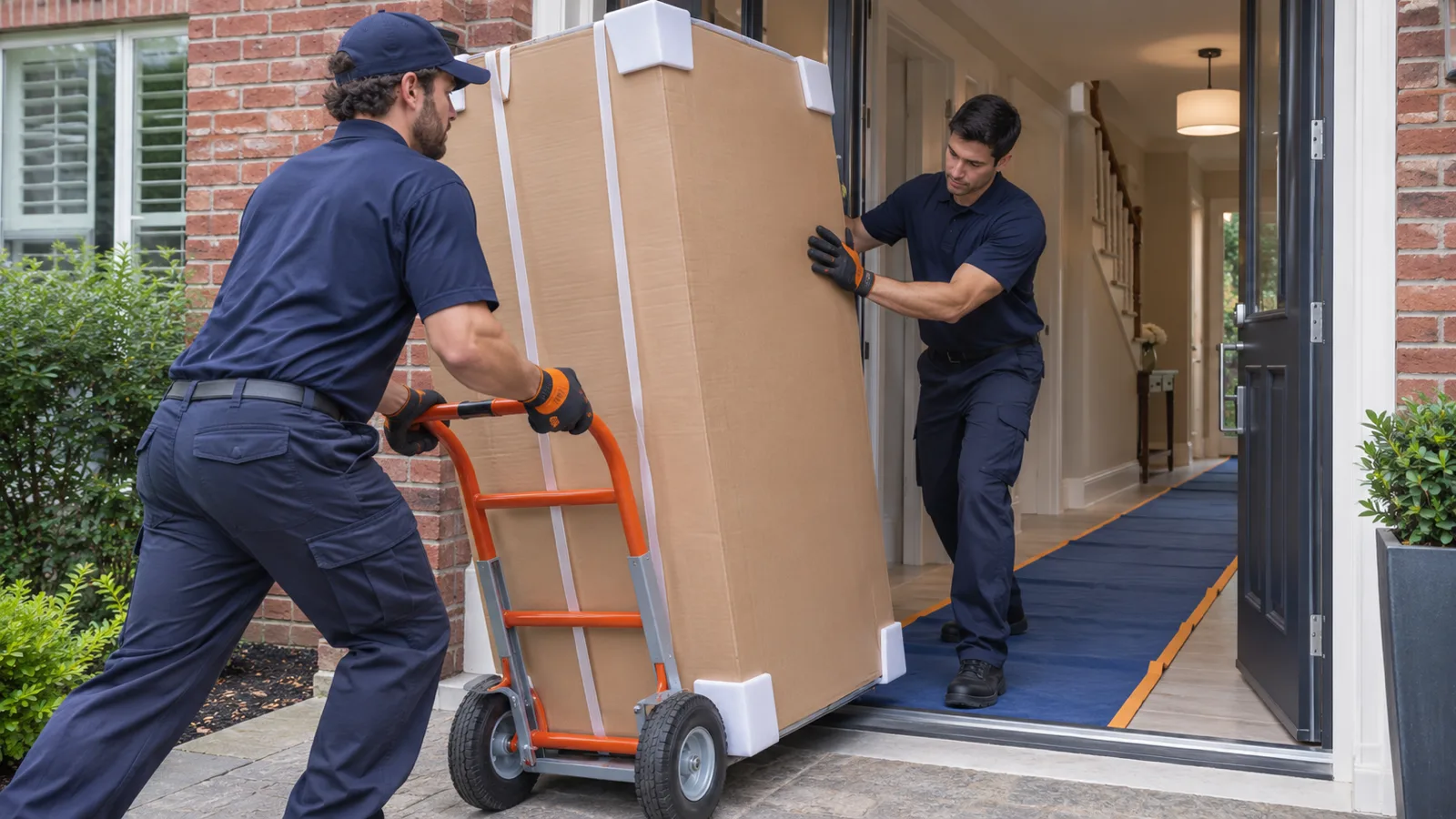
- Walk the path first and lay down floor runners and door protectors.
- Uncrate the unit outside or in a garage where practical, and inspect it with the customer before bringing it in.
- Move the appliance into position without dragging across floors.
- Connect it to existing services where qualified and permitted.
- Level the unit, test basic operation and explain any break-in requirements, such as letting a refrigerator stand before plugging it in if the manufacturer recommends it.
- Take photos of the installed unit and the surrounding area, and get the customer's sign-off.
Know the limits of installation
In Ontario, work on gas appliances must be done by appropriately certified gas technicians under rules administered by the Technical Standards and Safety Authority (TSSA), and new electrical circuits or wiring changes fall under the Electrical Safety Authority's framework. Delivery crews should know exactly what they can connect and when to refer the customer to a licensed contractor. Clear rules protect the customer, the crew and the retailer.
Appliance-by-appliance notes for crews
Each category brings its own habits that experienced crews follow:
- Refrigerators: Keep upright wherever possible, check that the water line for an ice maker is compatible before arrival, and confirm the door swing works in the space. French-door models often need doors removed to pass through standard interior doorways.
- Washers: Remove the manufacturer's shipping bolts before running the unit; leaving them in can damage the drum. Check hose condition on the existing supply and bring new hoses if the retailer offers them.
- Dryers: Confirm whether the home needs an electric or gas model and whether the venting route suits the new unit. Crushed or improvised venting is a fire risk, so many retailers include new vent kits.
- Ranges: Install anti-tip brackets as the manufacturer directs. Electric ranges need the correct cord for the home's outlet; gas ranges need a qualified gas technician for connection.
- Dishwashers: Usually the most installation-heavy delivery: water supply, drain, electrical and securing the unit to the countertop or cabinets. Allow enough time in the schedule.
Building these notes into crew checklists, and into the order data the crew sees before the stop, saves return trips.
Stage 6: Haul-away and reverse logistics
Removing the old appliance is part of the expected service for many customers. Old refrigerators, freezers and air conditioners contain refrigerants that must be recovered properly before scrapping, and responsible recycling keeps metal and components out of landfill. Delivery partners should have a documented process for where removed units go.
Appliance returns are a separate challenge. A customer may refuse delivery due to damage, wrong size or a change of mind. The unit has to come back to the warehouse, be inspected, graded and either restocked, sold as open-box or returned to the manufacturer. A structured returns management process keeps those units visible instead of piling up in a corner of the warehouse.
Where appliance deliveries go wrong, and how to prevent it
- Wrong size for the space. Prevent with measurement guidance at purchase and a pre-delivery confirmation.
- Missing parts or fittings. Prevent by stocking common supply lines, cords and venting kits on trucks, and confirming requirements in advance.
- Concealed damage. Prevent with careful storage, upright handling and inspection before entering the home.
- Customer not home. Prevent with confirmed windows, reminder messages and an "on our way" call.
- Building access problems. Prevent by booking condo elevators and loading docks in advance.
- Property damage. Prevent with floor and door protection and trained crews, and document with photos.
Choosing a logistics partner for appliances
If you are a retailer, e-commerce brand or manufacturer selling appliances in the GTA, look for a partner that can handle the full chain or coordinate it seamlessly: inbound freight, serialized warehousing, order integration, scheduling and final-mile white-glove crews. Ask how they handle damage claims, what installation services are offered, how they communicate with customers, and how removed appliances are recycled.
ShipCarte supports retail brands with warehousing, freight and distribution services, and can help design an appliance delivery flow around your products and customers.
Deliver an experience customers recommend
Appliance delivery is a high-stakes moment: the product is expensive, the customer is waiting, and the crew is in their home. Getting it right in Mississauga means planning for condos and detached homes, highway traffic and narrow hallways, utility connections and haul-away. If you want to build a dependable white-glove delivery program, schedule a consultation with ShipCarte to review your product range, delivery areas and service levels.