
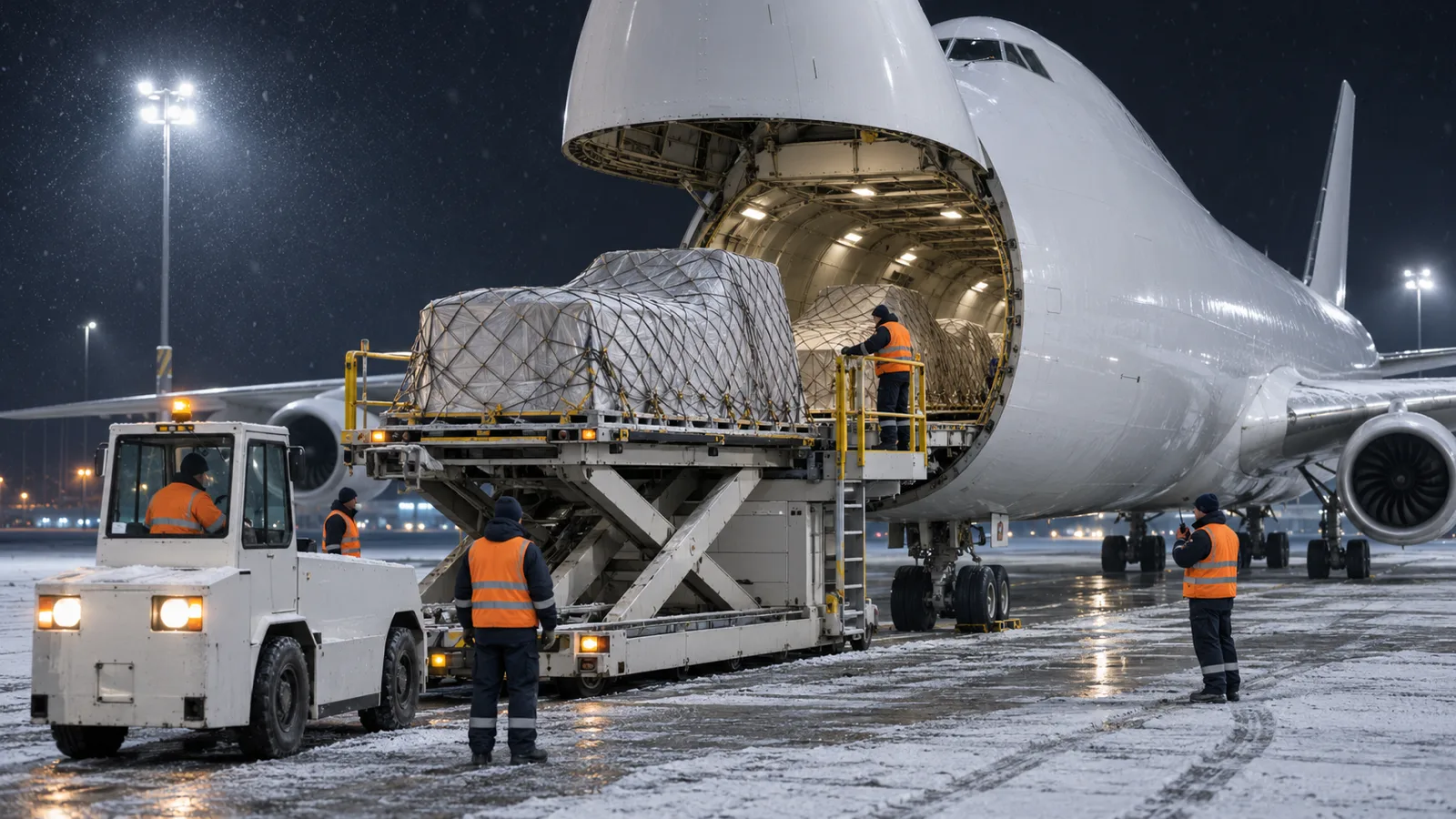
Every December, somewhere in Canada, an operations manager looks at a spreadsheet and realises the January stock isn't going to arrive in time. The ocean container is still a week from Vancouver, rail to Toronto will take several more days, and the retailer's promotion starts in two weeks. The only way to make the date is to put part of the order on a plane. The quote comes back at many times the ocean rate per kilogram, and the question becomes: is it worth it?
Air freight has a reputation as the expensive, panic-button option, and sometimes that is exactly what it is. But for the right products, used deliberately, air can be the lower-cost choice once you look beyond the freight invoice. The past year has made the economics more volatile than usual. With so many passenger flights cancelled since early 2020, much of the belly capacity that normally carries cargo across the Pacific and Atlantic disappeared, and air cargo rates on many lanes into and out of Canada rose sharply.
This article sets out how air freight is priced, what really drives its cost, and a practical way for Canadian businesses to decide when speed pays for itself.
How Air Freight Is Priced
Chargeable weight
Airlines sell space and lift. A shipment is charged on whichever is greater: its actual gross weight or its volumetric (dimensional) weight. The standard international convention calculates volumetric weight by multiplying length by width by height in centimetres and dividing by 6,000. In other words, one cubic metre is treated as roughly 167 kilograms.
That has a big consequence. A pallet of dense metal parts is charged on its actual weight, while a pallet of lightweight but bulky goods, like pillows, lampshades or empty packaging, is charged on its volume and can cost far more than its scale weight suggests. Before you compare air with ocean, calculate chargeable weight. Our article on how package dimensions affect shipping costs explains the dimensional principle in parcel terms; it works the same way in air cargo, only with larger consequences.
Rate components
An air freight quote usually includes several lines:
- Base air rate per kilogram, typically with breaks that lower the rate per kilogram as chargeable weight increases.
- Fuel surcharge, which moves with jet fuel prices.
- Security surcharge, reflecting screening requirements.
- Origin charges: pickup, export documentation, terminal handling and screening at the departure airport.
- Destination charges: terminal handling, customs brokerage, delivery order fees and final delivery.
- Special handling fees for dangerous goods, temperature control, oversized pieces or high-value cargo.
Compare quotes on an all-in, door-to-door basis. A low per-kilogram rate with high terminal fees can easily cost more than a higher rate that includes them.
Canada's Air Cargo Geography
Most international air cargo into and out of Canada moves through a small number of airports. Toronto Pearson is the largest gateway, serving Ontario's manufacturing and distribution base. Vancouver handles a significant share of trans-Pacific traffic. Montreal serves Quebec, with Mirabel playing a role in dedicated cargo operations. Calgary, Edmonton and Winnipeg have growing cargo facilities, and Hamilton's airport is an important hub for express and overnight courier networks. Halifax handles seafood exports and serves Atlantic Canada.
Where your goods fly into matters for total cost. A shipment that arrives in Vancouver but needs to reach a warehouse in Ontario will either connect onward by air or be trucked across the country, adding several days by road. Sometimes routing direct to Toronto at a higher rate is cheaper than flying to Vancouver and then trucking.
The Real Question: What Does Waiting Cost?
The freight bill is only one side of the equation. The other side is the cost of not having the goods. To decide whether air is justified, add up what slower transport would cost you.
Lost margin from stockouts
If a best-selling SKU runs out, you lose the margin on every sale you miss, not the revenue. A product earning a healthy margin per unit that would sell a predictable number of units per day during a stockout gives you a straightforward daily cost of waiting. Lost customers who switch to a competitor and don't come back make the real cost higher still.
Retail penalties and lost placements
If you supply big-box or department store retailers, missing a delivery window can bring chargebacks, a cancelled purchase order or a lost shelf placement that took a year to win. A late delivery for a seasonal promotion may simply mean the order is refused.
Inventory carrying cost
Goods on the water are inventory you have usually already paid for. Faster transit shortens the cash cycle and reduces the amount of safety stock you need to hold. For high-value products, the carrying cost of several extra weeks in transit can be material.
Product life
Perishables, fashion items, electronics with short life cycles and products tied to launch dates lose value every day they are not on sale. For fresh seafood leaving Halifax or cherries leaving the Okanagan, air is not optional at all.
A Worked Example
Consider a hypothetical Canadian online retailer selling small electronics accessories, holding stock in a fulfillment centre in the Greater Toronto Area. A replenishment order of 2,000 units is ready at the factory in southern China. The cartons are dense: the whole order fits on two pallets, about 1.5 cubic metres and 400 kilograms in total. Volumetric weight is around 250 kilograms, so chargeable weight is the actual 400 kilograms.
By ocean LCL via Vancouver and rail to Toronto, the goods might take several weeks door to door. By air into Toronto Pearson, perhaps under a week including clearance. The air freight bill will be considerably higher than the ocean bill. But each unit carries a meaningful margin and the SKU sells steadily. If the existing stock will run out within days, every extra week on the water costs a week's worth of margin, plus any customers who do not return. Spread across 2,000 units, the air premium per unit may be small compared with the margin protected.
Now change one variable: the product is a bulky, light item like a foam cushion. The same 2,000 units fill 15 cubic metres but weigh only 300 kilograms. Volumetric weight is now around 2,500 kilograms, more than eight times the actual weight. The air premium per unit rises steeply, and the margin per unit is lower. The same decision process says: ship by ocean and adjust the promotion date.
The lesson is that air works best for goods with a high value-to-weight ratio, high margin per unit, or high cost of delay. It is hard to justify for low-value, bulky goods.
Smart Ways to Use Air Without Overspending
- Split shipments. Fly enough units to cover the gap until the ocean shipment arrives, and send the rest by sea.
- Consider sea-air. On some lanes, goods move by ocean to a hub and then onward by air, offering a middle ground on cost and time.
- Use deferred air services. Many forwarders offer slower, consolidated air products at lower rates than priority services.
- Pack for air. Reduce void space and use cartons that fit pallets efficiently to keep volumetric weight down.
- Book early in peak periods. Space can be scarce before the holidays, Lunar New Year and major retail events, particularly when belly capacity is reduced.
- Know your security status. Cargo going on aircraft must be screened or come from a secure supply chain under Transport Canada's air cargo security program. Unscreened cargo can be delayed at the airport.
- Declare dangerous goods properly. Lithium batteries, aerosols, perfumes and many chemicals are regulated under the IATA Dangerous Goods Regulations for air, and under Transport Canada's Transportation of Dangerous Goods rules for the road leg. Undeclared dangerous goods can lead to fines and refused shipments.
Domestic Air Freight Within Canada
Air is not only an international option. Canada's size means that a truck from Toronto to Vancouver takes several days, and delivering to northern communities in Nunavut, the Northwest Territories, Yukon or remote parts of the provinces may rely on air for much of the year. Next-flight-out and overnight air services between major Canadian cities are useful for critical spare parts, medical supplies and urgent replacement stock. For healthcare shippers, temperature-sensitive product handling often combines air legs with controlled ground transport at each end.
For most routine replenishment within Canada, though, LTL and full truckload services offer far better value. A well-positioned inventory network often removes the need for domestic air entirely.
Reducing the Need for Air in the First Place
Businesses that rely on air every month usually have a planning problem rather than a freight problem. Better forecasting, earlier purchase orders, safety stock for fast movers, and real-time visibility into inventory levels all reduce emergency shipments. Tools that show stock on hand, inbound purchase orders and sales velocity in one place, such as an inventory management system combined with reporting and analytics, let you spot a coming stockout early enough to act with slower, cheaper freight.
Air freight will always have a role, but it should be a decision rather than a reflex.
Work Out Your Air Freight Options With ShipCarte
ShipCarte helps businesses across Canada plan freight across modes, store inventory where it is needed and fulfill orders quickly once goods arrive. If you are weighing air against ocean for an upcoming shipment, or want to build a supply chain that relies less on emergency freight, schedule a consultation or request a quote.