
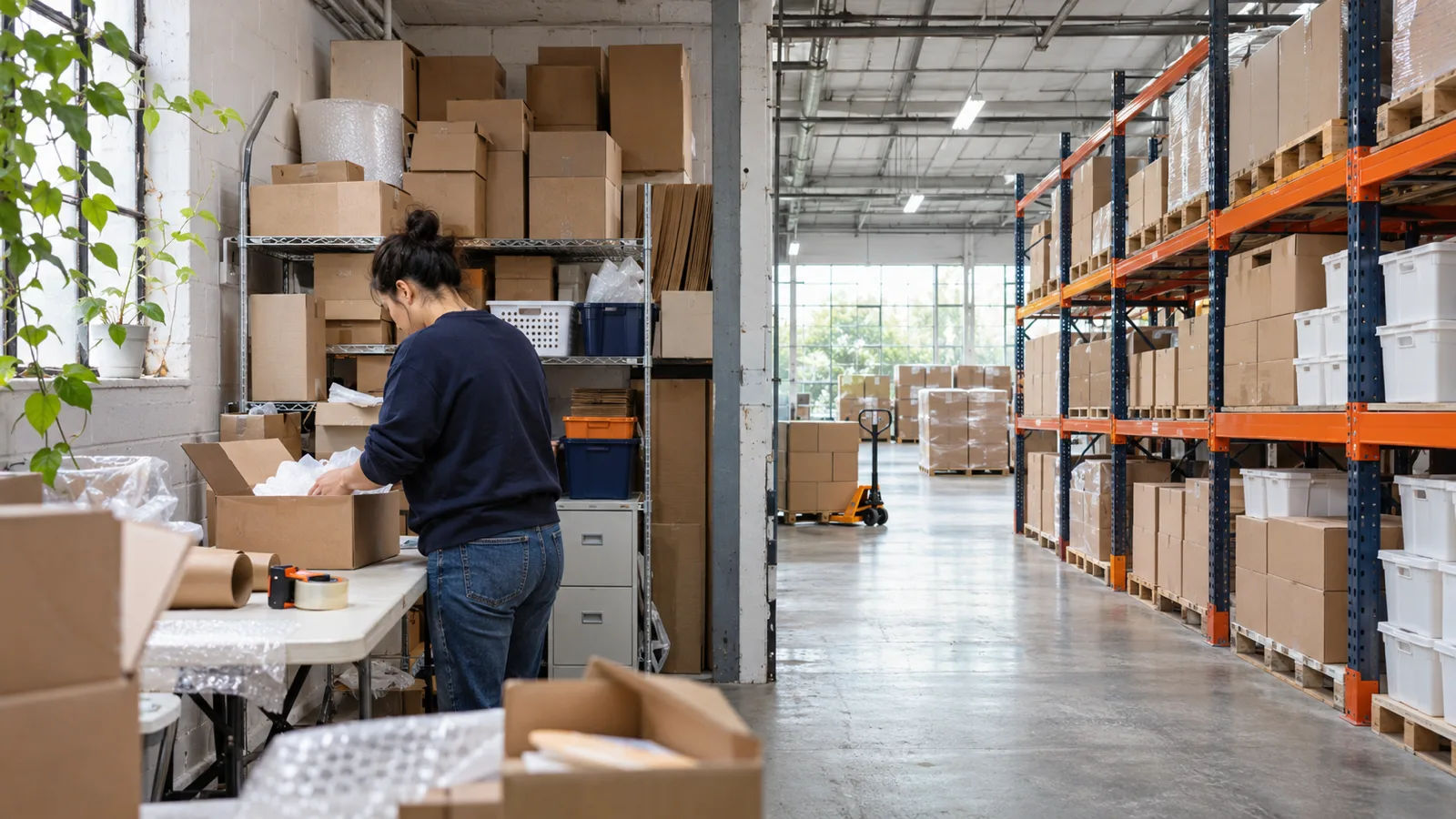
Cyber Monday has just passed, and for a lot of online sellers in Canada the weekend looked the same: a spare room or rented unit stacked with boxes, a couple of family members or part-time helpers taping cartons, and a courier pickup that arrived before the last orders were labelled. It is the moment when many owners start asking whether they should keep packing orders themselves or hand the job to a third-party logistics provider.
The answer usually gets framed as a feeling. In-house feels cheaper and more controlled. A 3PL feels professional but expensive. Neither feeling is reliable. The only way to decide is to put real numbers on both options, including the costs that do not show up as a line on any invoice. That is what this article helps you do.
We will work through every cost category on both sides, look at the factors that do not fit neatly in a spreadsheet, and finish with a worksheet you can fill in with your own figures. We will not supply prices, because they vary by province, city, product and volume. Your own numbers are the ones that count.
Side One: The True Cost of In-House Fulfillment
In-house fulfillment almost always costs more than owners think, because several of its costs are hidden in other budgets or paid in time rather than money.
Space
Start with the space where inventory is stored and orders are packed. If you rent a unit, include rent, common area charges, property tax passed through, utilities and insurance. Industrial space in major Canadian markets such as the Greater Toronto Area and Metro Vancouver has become notably tight in recent years, and lease terms often run several years, which turns space into a long-term commitment. If you work from home, the space still has a cost, even if it is your living room.
Remember that you pay for space all year, sized for your peak. A unit big enough for December inventory sits partly empty in February.
Labour
Labour is the biggest in-house cost for most brands. Include wages for everyone who receives stock, picks, packs and handles returns, and add employer costs: CPP and EI contributions, vacation pay, statutory holiday pay, workplace safety insurance premiums through WSIB or the relevant provincial board, and any benefits. Then consider the less visible costs: hiring and training seasonal staff, overtime during peaks and paying people when volume is low.
Your own time
This is the cost owners most often leave out. If you, the founder, spend fifteen hours a week packing boxes and chasing couriers, that is fifteen hours not spent on product, marketing, wholesale accounts or financing. Put a value on it. Even a modest hourly figure adds up quickly over a year.
Equipment and supplies
- Shelving, racking, packing tables, label printers, scales and scanners.
- Pallet jacks and, for larger operations, a forklift with trained operators.
- Packaging materials, which smaller buyers usually pay more for per unit.
- Software: shipping, inventory and possibly a warehouse management tool.
Shipping rates
Small shippers typically pay higher parcel rates than high-volume shippers. A 3PL that ships for many clients may have access to better rates, more carrier choices and rate shopping by order. This is often where the biggest difference between the two options lies, so make sure you compare real rates rather than assumptions. Our guide on reducing shipping costs for an ecommerce business explains what drives parcel pricing.
Errors and inefficiency
Mis-picks, wrong addresses, damaged parcels and late shipments all cost money in reshipments, refunds and lost repeat business. In-house operations without barcode scanning tend to make more errors as volume grows.
Side Two: The True Cost of a 3PL
A 3PL turns most of these costs into variable fees that rise and fall with your volume. The main categories are:
- Receiving fees for inbound inventory.
- Storage per pallet, bin or cubic foot.
- Pick and pack per order and per additional item.
- Packaging, if not included.
- Shipping at the 3PL's rates or on your account.
- Special services such as kitting, inserts and returns.
- Account fees and monthly minimums.
Our article on 3PL pricing models in Canada explains each in detail. There are also costs on your side even after outsourcing: freight to send inventory to the 3PL, a person to manage the relationship and transition costs during onboarding.
The Factors That Don't Fit in a Spreadsheet
Flexibility
With a 3PL, you are not locked into a lease or a headcount. If sales double, the warehouse absorbs it. If sales slow, your costs fall. In-house, scaling up means finding more space and hiring, and scaling down means carrying fixed costs.
Control
In-house gives you direct control over every package, which matters for brands whose unboxing experience is highly customised or whose products need judgment to pack. A good 3PL can follow detailed instructions, but you are relying on documented rules rather than your own eyes.
Geography
Canada is a wide country. A single in-house location means every order to the far side of the country travels the full distance. Some 3PLs can split inventory between regions, putting stock closer to customers in Western Canada or Atlantic Canada, which can shorten delivery times and reduce shipping costs. That is very hard to replicate in-house without opening a second location.
Compliance and capability
Some requirements are easier with an experienced partner: retail routing guides and labelling, Amazon prep requirements, lot and expiry tracking for food or health products, cross-border paperwork for shipping to the United States under NAFTA, or temperature-controlled storage.
Risk
In-house, a sick day, a burst pipe or a broken label printer can stop shipping. A 3PL spreads that risk across a larger team and facility, though it introduces a dependency on a partner.
When In-House Usually Wins
- Very low order volume, where 3PL minimums would exceed your costs.
- Highly customised, made-to-order or personalised products.
- Products that need specialist handling the market does not readily offer.
- Businesses that already own suitable space and have spare staff capacity.
When a 3PL Usually Wins
- Volume is growing faster than your space or team can keep up with.
- Strong seasonality makes fixed space and staff inefficient.
- Your shipping rates are a competitive disadvantage.
- Customers are spread across Canada and the United States.
- You sell through several channels, such as your own site, Amazon and wholesale.
- The founder's time is better spent on growth.
The Worksheet: Running Your Own Numbers
Use the following steps with your own data. Work in annual totals, and then divide by annual orders to get a cost per order for each option.
In-house annual cost
- Rent, utilities, insurance and related occupancy costs for the space used for inventory and packing.
- Wages plus employer costs for all fulfillment work, including seasonal staff.
- Value of your own time spent on fulfillment.
- Equipment, amortised over its useful life.
- Packaging materials.
- Software subscriptions.
- Shipping costs at your current rates.
- Estimated cost of errors: reshipments, refunds and replacements.
3PL annual cost
- Receiving fees for your inbound volume.
- Storage at your average inventory level, plus peak months.
- Pick and pack at your orders and units per order.
- Packaging, if billed separately.
- Shipping at the 3PL's rates for a sample of real orders.
- Special services and returns.
- Monthly fees and any minimums in slow months.
- Inbound freight to the 3PL and staff time to manage the relationship.
- One-time onboarding and transition costs.
Compare the two totals, then look at how each changes if your volume grows by half or falls by a quarter. In-house costs tend to step up in big jumps, a new unit or a new hire, while 3PL costs tend to move more smoothly with volume. That difference often matters as much as the totals themselves.
Reading the Results Honestly
Once the worksheet is filled in, resist the temptation to tweak inputs until the answer matches what you hoped. A few checks keep the comparison honest:
- Use real shipping quotes. Ask each provider to rate a few hundred actual past orders with real postal codes from across Canada. Estimates based on a single "average parcel" are rarely accurate.
- Include your peak. If December needs three extra people and a second rented unit, those costs belong in the in-house column even though they only last a few weeks.
- Value your time realistically. If you would otherwise hire someone to do the growth work you are not getting to, use what that hire would cost.
- Look at the next two years, not just this one. If your lease renews next year at a higher rate, or your volume plan requires a bigger space, model that.
- Count the cost of switching. Moving to a 3PL has one-time costs: inbound freight, onboarding fees and a few weeks of management attention. Spread them over a reasonable period rather than ignoring them or loading them all into year one.
Many owners find the totals are closer than they expected, and that the deciding factor turns out to be flexibility, delivery speed to distant provinces or the founder's time rather than the raw cost per order. That is a perfectly good reason to decide either way, as long as it is a conscious one.
A Middle Path
The choice is not always all or nothing. Some brands keep a small in-house operation for custom or high-touch orders and send standard orders to a 3PL. Others outsource storage and freight but keep packing for a flagship product. Others start with a 3PL for overflow during peak season. These hybrid models can be a good way to test outsourcing before committing fully. If you decide to make the move, our guide to a realistic 3PL onboarding timeline explains what happens next.
Let ShipCarte Run the Comparison With You
ShipCarte provides ecommerce fulfillment, inventory management and shipping for businesses across Canada. If you share your order history and current costs, we can help you see where outsourcing would save money and where it would not. Request a quote and we will build it around your real numbers.